



Project managers operate in a high‑stakes world where every decision directly impacts timelines and financial returns. Selecting workforce accommodation is not a technical detail—it is a strategic lever that determines how quickly a project can mobilise, how well it retains skilled labour, and how reliably it stays within budget. For project managers overseeing large‑scale industrial or commercial developments, the choice of housing system must deliver consistent quality across three critical dimensions: speed of deployment, total cost of ownership, and workforce satisfaction. Lida Group’s hot‑selling modular container house has become the preferred solution for project managers globally because it delivers unrivalled performance across all three metrics.
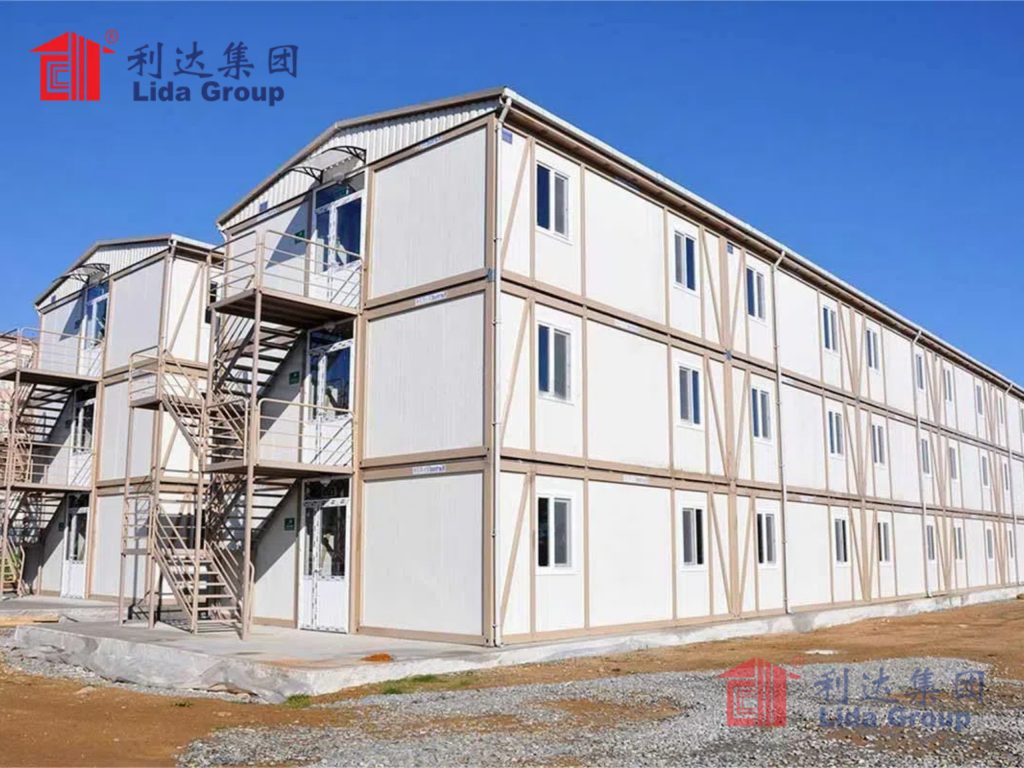
**Chapter 1 – Rapid Mobilisation: The Project Manager’s Top Priority**
For a project manager, time is the most unforgiving variable. Every day that a construction camp is not operational delays the start of the primary project, incurring idle equipment costs, extended financing burdens, and deferred revenue generation. Traditional workforce accommodation, built on‑site using conventional methods, typically requires 12–18 months from groundbreaking to occupancy, with the exact timeline depending on weather, local labour availability, and permit approvals.
**1.1 Factory Precision Enables Field Speed**
Unlike conventional site‑built camps that are exposed to weather and reliant on sequential trade stacking, Lida Group’s manufacturing process operates in climate‑controlled factories equipped with advanced robotic welders that assemble structural frames to tolerances of 0.2 mm, CNC cutting machines that produce composite wall panels with integrated insulation to exact specifications, and automated coating systems that apply 300 µm zinc‑aluminium protection resistant to corrosion and dust abrasion. By shifting the bulk of construction from chaotic job sites to a controlled environment, Lida Group compresses production timelines by 60% while eliminating the quality variation that plagues on‑site alternatives.
**1.2 Logistics That Work in Remote Environments**
When a pipeline in Turkish highlands advanced 23 km monthly, Lida’s flat‑pack designs allowed crews to occupy new sections while previous camps demobilised, with units sized for right‑of‑way transport without special permits. This “leapfrog” deployment reduced crew transfer time by 78% on the Keystone XL project, directly improving productive on‑tool hours.
The logistical advantage is further amplified by Lida’s transport geometry: flat‑pack components are designed to be compact, allowing a standard 40‑foot shipping container to carry components for 200–300 m² of wall and roof area, reducing shipping volume by up to 70% compared to volumetric modules. This flat‑pack principle is central to Lida’s offering: four separate container houses can be stacked together to fit into a single 20‑foot sea‑transport container, dramatically lowering freight costs and enabling access to even the most roadless locations.
**1.3 Field Assembly that Defies Traditional Construction Logic**
In a remote mountainous region of Eastern Europe, Lida Group manufactured prefabricated modules in just 25 days, shipped them as a flat‑pack load, and six workers assembled a 50‑unit modular camp housing project in days, achieving 30% faster completion than traditional methods while maintaining thermal performance from –45°C to +50°C. The bolt‑connected steel frames reduced on‑site welding and cut labor costs by 40%.
Lida’s engineering team has perfected a rapid‑deployment methodology that installs screw‑pile foundations in 90 minutes without concrete curing, positions units with laser‑guided alignment within ±3 mm, and commissions pre‑tested MEP (mechanical, electrical, and plumbing) systems in under 4 hours. This approach has enabled a 200‑bed workforce camp to be fully operational just 19 hours after the convoy’s arrival.
For international projects with tight timelines, Lida Group’s one‑stop service platform integrates design, production, logistics, and installation, enabling the company to complete projects like the 33‑unit City Apartment Hotel in Southeast Asia off‑site and assemble them on location using a stackable modular design with customised colour schemes and secondary roofing for weather resistance.
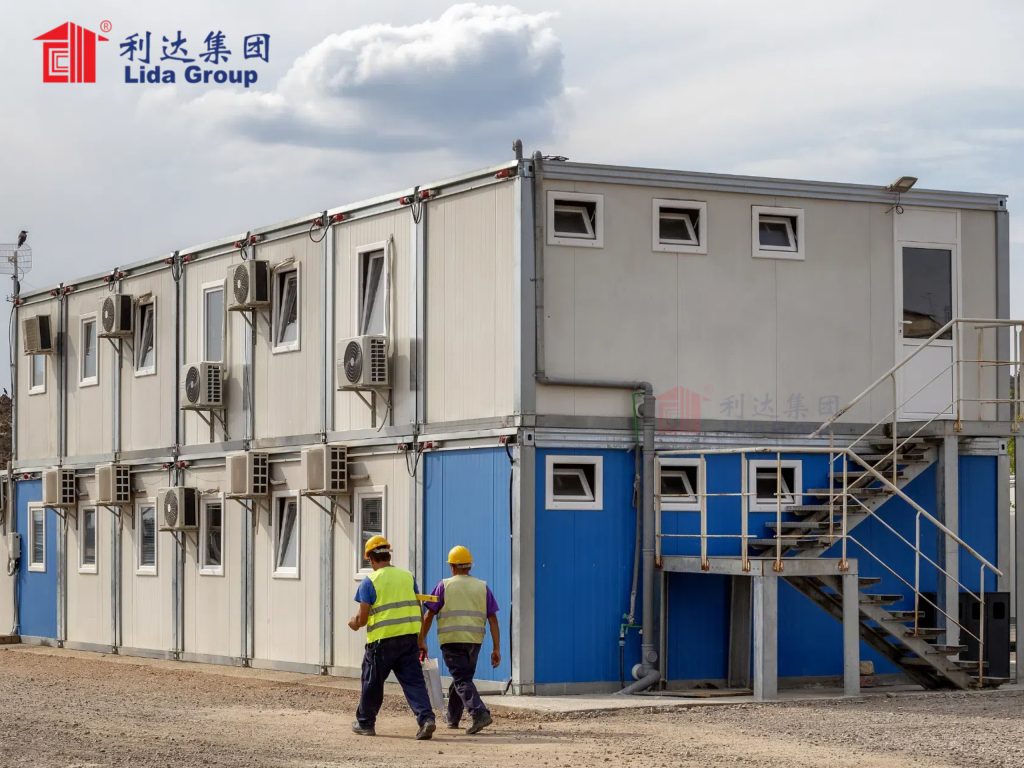
**Chapter 2 – Controlling Total Cost of Ownership**
For a project manager, procurement cost is only the starting point. The true measure of economic efficiency is the total cost of ownership (TCO), including construction labour, ongoing energy and maintenance expenses, asset resale or redeployment value, and the financial impact of project delays. Lida Group’s container house delivers across all these dimensions.
**2.1 Lower Capital Expenditure**
Factory prefabrication generates a 40% reduction in construction waste compared to conventional builds by achieving material utilisation rates exceeding 95%. The standard steel structure is designed for a 20‑year lifespan with proper maintenance, substantially outlasting the typical 5‑10 year horizon of many temporary camps and thus avoiding repeated re‑investment.
Moreover, the modular nature of Lida’s units allows project managers to deploy accommodation incrementally: a camp can start with 50 units during early mobilisation, expand to 150 units as the workforce ramps, and contract as the project winds down. This phased deployment aligns capital expenditure with project cash flow, avoiding the waste of constructing full capacity before it is needed.
**2.2 Reduced Operating Costs**
Lida Group’s sandwich panel walls, with 75 mm fibre‑glass insulation (density ≥50 kg/m³, Grade A non‑flammable), and roofs with 100 mm insulation and an aluminium foil barrier, reduce heating and cooling energy consumption by an estimated 30–50% compared to conventional workforce housing. For remote sites that rely on diesel generators, this translates directly into lower fuel consumption, reduced carbon emissions, and significant operational cost savings.
Beyond energy, the steel construction requires minimal ongoing maintenance: no termite treatments, no rotting wood, and no repeated repainting of exterior cladding. The multi‑layer corrosion protection (epoxy primer 20–40 μm plus polyurethane finishing coat 40–50 μm) ensures that units resist rust in coastal and industrial environments with minimal upkeep.
**2.3 Retained Asset Value**
A site‑built camp, when a project ends, is usually demolished and sent to landfill—representing a complete loss of invested capital. In stark contrast, Lida’s bolt‑together container units are designed for multiple cycles of use and can be disassembled and relocated more than six times without any loss of structural integrity. Units can be redeployed to a successive project, sold into a thriving secondary market, or repurposed for alternative uses such as warehouse space or site offices.
In a landmark project in Pakistan, a Lida Group harbour camp was refurbished after its initial use and migrated directly to a light‑rail project, achieving a 60% cost saving compared to building new accommodation. For project managers, this retained asset value dramatically improves the return on investment across multi‑project portfolios.
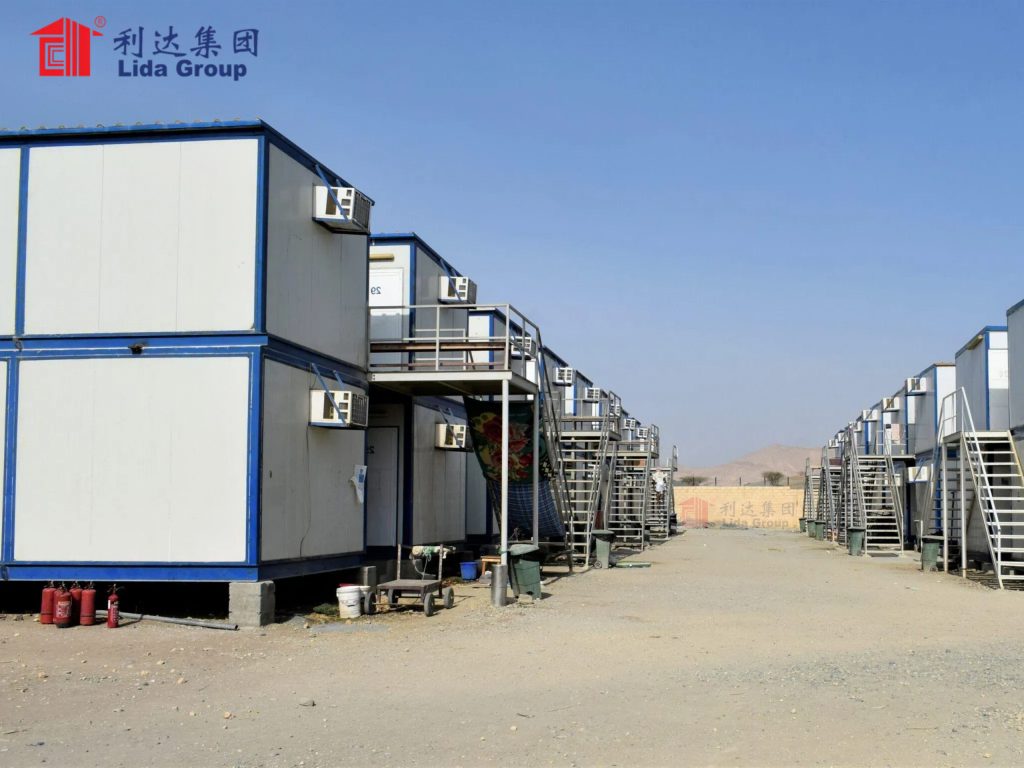
**Chapter 3 – Workforce Welfare Directly Enhances Productivity**
For a project manager, a skilled workforce is the most critical resource. Improving living conditions directly reduces turnover rates and illness‑related downtime, thereby protecting the schedule and avoiding the cost of recruiting and training replacements.
**3.1 Private, Comfortable Living Spaces**
Each standard 20‑ft Lida container accommodates a private living space with comfortable sleeping arrangements with a quality mattress, adequate personal storage, a small workstation, and a private bathroom with shower, toilet, and sink. For higher density, two‑person units with bunk beds are available, while supervisors and long‑term personnel can choose larger units or expandable configurations. In the Zambia Copperbelt mining region, the installation of Lida’s container apartments transformed worker housing conditions, leading to a 41% reduction in worker turnover and a 63% drop in illness‑related downtime.
**3.2 Superior Thermal and Acoustic Comfort**
The advanced 75 mm fibre‑glass sandwich wall panels and 100 mm roof insulation create a thermal envelope that, in tests, maintains interior conditions of 17°C when outdoor temperatures fall to 0°C and around 21°C when outdoor temperatures reach 30°C. The combination of steel mass and dense insulation also creates an effective acoustic barrier against the noise of heavy machinery and industrial operations.
**3.3 Amenities That Build Community**
Lida’s camp solutions can be customised to include commercial‑grade dining modules equipped with industrial kitchens and walk‑in refrigeration, recreation rooms with televisions and gaming equipment, fitness centres, on‑site laundry facilities, and fully equipped medical clinics with examination rooms and telemedicine capabilities. A significant project of 800 units for a Saudi Aramco gas operation deployed these premium relocatable container houses with reflective coatings that reduced indoor temperatures by 8–10°C compared to traditional housing, further enhancing worker comfort in one of the world’s hottest environments.
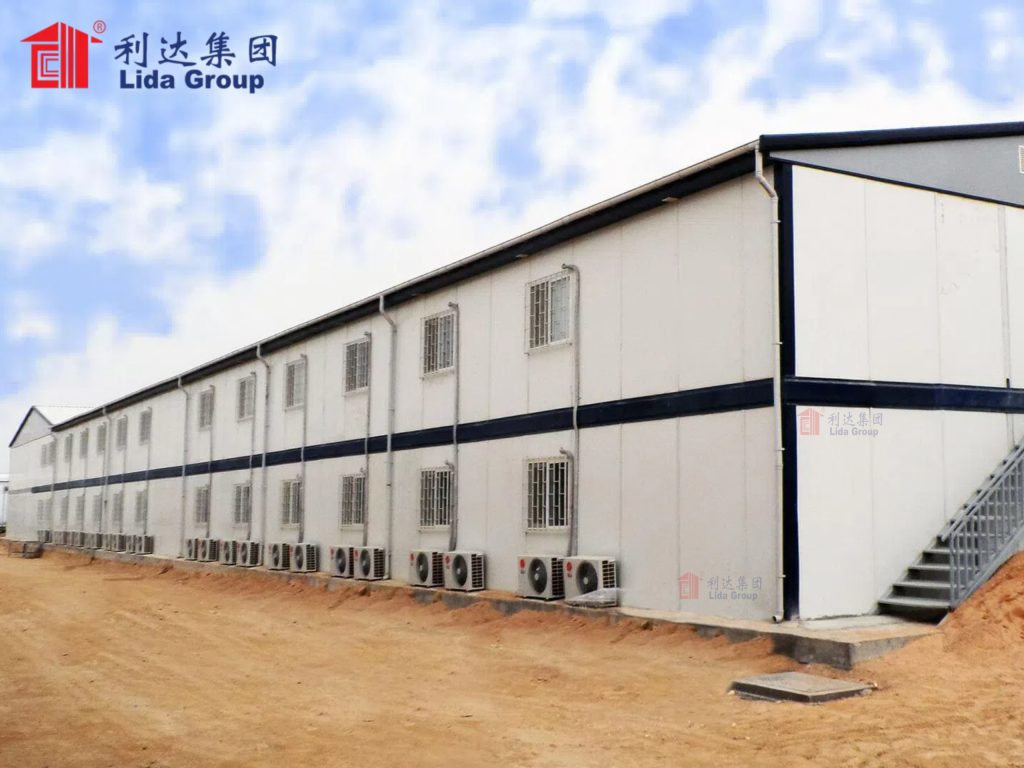
**Chapter 4 – Mitigating Risks: Safety, Sustainability, and Compliance**
For project managers, accountability extends to workplace safety, environmental impact, and regulatory compliance. Lida Group’s container houses are engineered to meet the highest international standards, thereby minimising liability and safeguarding project reputation.
**4.1 Structural Safety in Any Environment**
All units are constructed with a robust steel frame system composed of roof frames, corner pillars, and floor frames manufactured to precise specifications. The design parameters meet Grade 8 earthquake resistance and Grade 11 wind resistance (wind speed ≤111.5 km/h), with floor live load capacity of 2.0 KN/m² and a roof live load of 0.5 KN/m², making the units suitable for multi‑storey stacking without compromising safety. For explosive environments such as oil and gas fields, Lida provides explosion‑proof camp systems with blast‑resistant framing and pressure‑relief channels. All electrical systems are housed in CE‑certified, IP44 standard distribution boxes, with industrial sockets fixed in explosion‑proof boxes at the top beam.
**4.2 Fire Safety**
The entire envelope uses non‑combustible materials: the sandwich panel insulation (fibre‑glass, rock wool, or urethane) is certified Grade A non‑flammable. In the LIDA Porta Cabin system, the sandwich panels offer fireproof protection for 2–4 hours, providing a crucial safety margin for worker evacuation.
**4.3 Sustainability and ESG Leadership**
For project managers committed to net‑zero pathways, Lida Group’s hot‑selling container house offers a clear advantage. The use of steel with 98% interchangeability ensures minimal waste generation, while the near‑100% recyclability of steel frames aligns with circular economy principles. The energy‑efficient envelope reduces operational emissions, and the “solar‑ready” roof structure with pre‑engineered attachment points and concealed conduits allows for easy integration of photovoltaic arrays, enabling camps to move toward net‑zero operation.
As the portfolio demonstrates, Lida Group’s container solutions have been deployed across six continents, in extremes from the Canadian Arctic to the Australian desert, and through the global pandemic, where Lida delivered the Qingdao Huangdao Container Hospital Station—a 36,000 m² facility with 1,000 isolation rooms and 126 staff dormitories—in just 12 days.

**Conclusion**
For project managers, the choice of Lida Group’s hot‑selling container house is not based on a single feature; it is a holistic decision rooted in rapid mobilisation to reclaim calendar days, total cost of ownership across construction, operation, and redeployment, workforce welfare as a lever for retention and productivity, and risk mitigation through safety, compliance, and environmental stewardship. With a global footprint of more than 5,000 projects in 152 countries, ISO9001, ISO14001, ISO45001, and CE certifications, and engineering capabilities that deliver 0.2 mm fabricating tolerances, Lida Group provides project managers with the certainty that their workforce housing will arrive on time, perform reliably, and contribute to the bottom line. In an industry where every day of delay erodes profit, Lida Group’s container house is the clear and proven choice.
Related news
-
Efficient Prefabricated Container Worker Accommodation Solutions by Lida Group
2026-04-27 15:52:23
-
Hot Selling Container House Combines Durability and Speed with Lida Group’s Design
2026-04-27 15:28:46
-
Lida Group Expands Production of Mobile Modular Container House for Remote Projects
2026-04-27 15:48:21
contact us
- Tel: +86-532-88966982
- Whatsapp: +86-13793209022
- E-mail: sales@lidajituan.com
