



Scalable Site Living: Modular Prefab Housing Units for Dynamic Construction Workforce
2026-Nov-13 11:41:51
By Admin
01 Introduction: Housing a Population in Motion
Every large construction project is a series of overlapping phases, and each phase brings a different number of people to site. Earthworks may require a few dozen operators, the structural stage may bring several hundred trades, fit-out may draw on specialist crews who arrive for weeks and then leave, and commissioning may shrink the population again almost overnight. Housing that is sized for one moment in this sequence will be wrong at every other moment, and being wrong in either direction costs money.
This article looks at how modular prefab housing units from Lida Group respond to that reality. Instead of treating accommodation as a single fixed camp built to a forecast, the system treats each unit as an independent module that can be added, removed, and reassembled as the workforce changes. The result is a camp whose capacity follows the work rather than an estimate made months before the first worker arrives. What follows explains why that matters, how the system performs in practice, and what it changes for contractors who must house a moving population without overspending.
02 The Cost of Sizing for a Single Moment
The conventional approach to site accommodation is to build for the peak. A camp is designed around the largest workforce the project is expected to need, on the reasoning that capacity must exist before the busiest phase begins. That reasoning is sound in principle and frequently wrong in practice, because peaks move, forecasts change, and the largest phase often arrives later or smaller than the plan assumed. The result is either capacity standing empty for months or an expensive scramble for rooms when the numbers arrive early.
Both outcomes carry a cost that never appears in the original accommodation budget. Idle buildings still need heating, security, maintenance, and management, and they occupy ground that could be used for something else. Emergency capacity, by contrast, is bought at short notice and at a premium, often in the form of rented housing far from site, which adds travel time and transport cost to every shift. Sizing for a single moment turns a predictable operational requirement into a source of risk, and it does so for no better reason than the assumption that a camp must be built as one object. Once the camp is treated as a set of units instead, that assumption disappears and the risk it created goes with it.
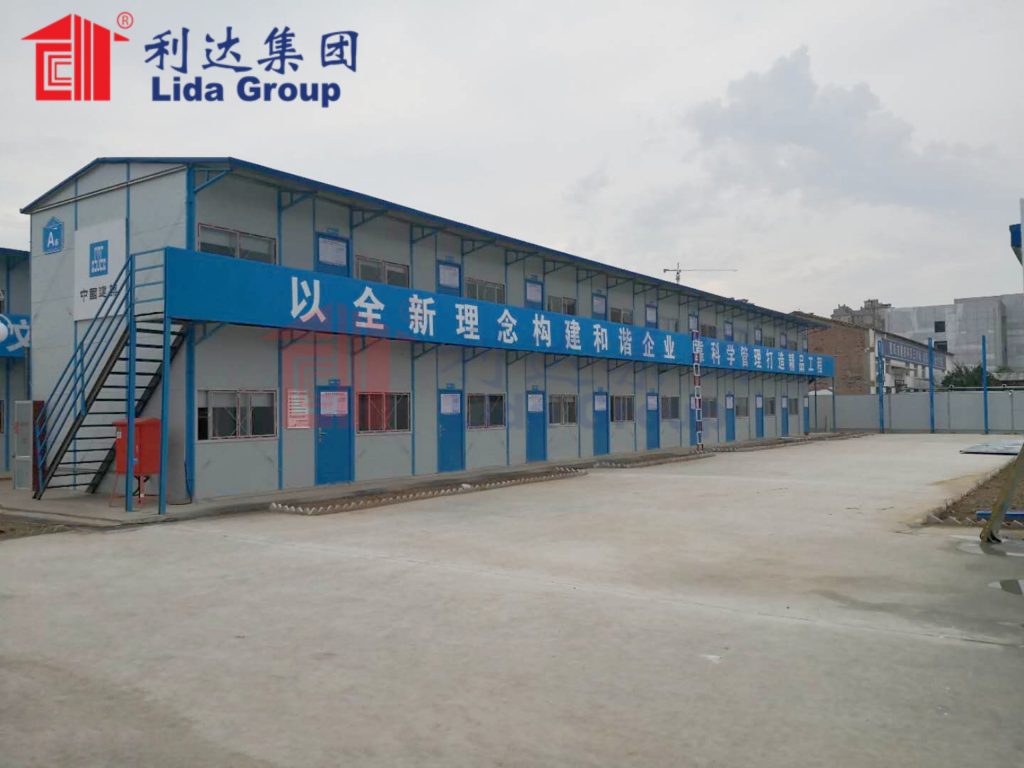
Integrated prefab dormitory and office modular building for construction site camp
03 The Unit as the Building Block
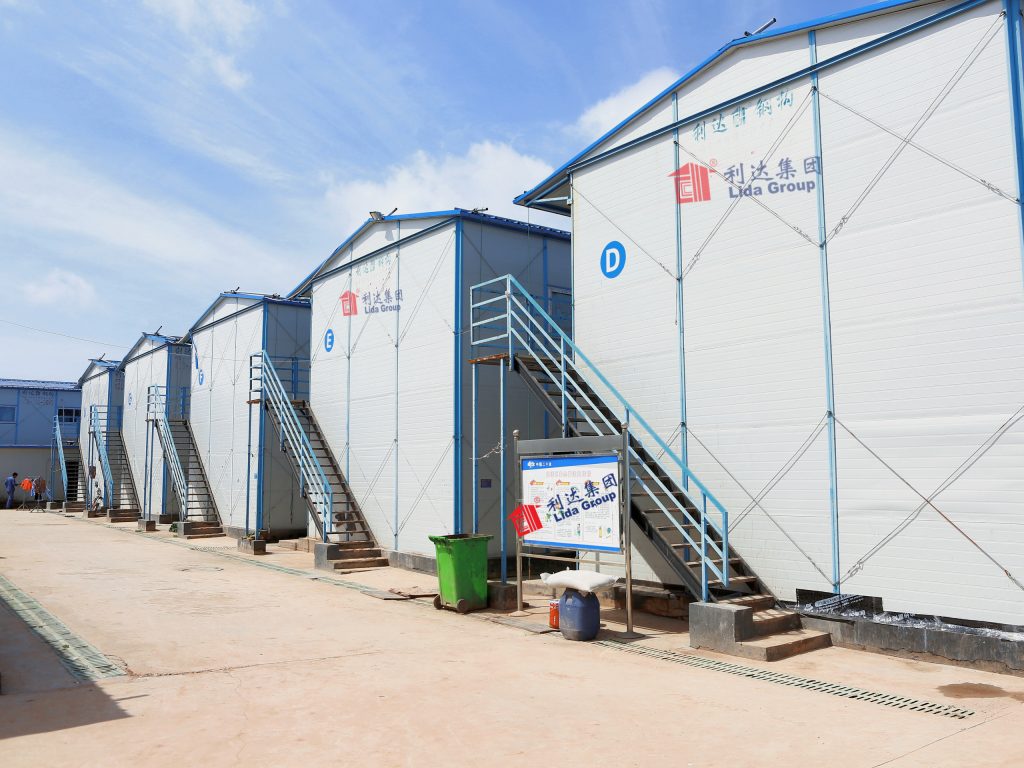
Modular housing resolves this by changing the basic element of the system. Rather than designing a camp as a whole and then constructing it, Lida designs a unit and then composes camps from units. Each module is a complete structure with its own walls, insulation, floor, and finishes, capable of standing on its own or joining with others to form a larger block. Because the modules share standard dimensions and connection details, they can be arranged and rearranged without redesigning anything.
This shift has consequences beyond convenience. When the unit is the building block, capacity becomes a number that can be chosen rather than a structure that must be commissioned. A camp can begin small and grow in defined increments, or begin at full size and contract as phases complete. The same inventory can serve different arrangements, so a configuration that suits an early phase can be reorganised into one that suits a later phase without any new construction. Flexibility stops being an aspiration and becomes a property of the system itself, and the operator can decide what to build based on what is actually happening on site rather than on what was expected a year earlier.
04 Expanding Quickly When Demand Spikes
The moment modular capacity proves its worth is when the workforce grows faster than expected. A subcontractor mobilises early, a phase overlaps with another, or a schedule is compressed to recover lost time, and suddenly several hundred additional people need beds within weeks. Conventional construction cannot respond to that, because building a dormitory takes seasons rather than weeks. Modular units can, because the fabrication has already happened and the work on site is limited to delivery, placement, and connection.
Lida’s units leave the factory complete and tested, so a new block arrives ready to occupy once it is positioned, secured, and joined to the camp’s power, water, and waste systems. That work is measured in days for a block of reasonable size, which means mobilisation need not be delayed by accommodation nor accommodation need not be improvised in a hurry. The units also arrive to a known standard, so a block added under pressure is not a rushed, lower-quality structure but an identical one to those already in use, with the same insulation, the same fittings, and the same performance. For a contractor whose programme depends on bringing people in on schedule, this responsiveness is the difference between a plan that holds and one that slips at the very point where the project can least afford it.
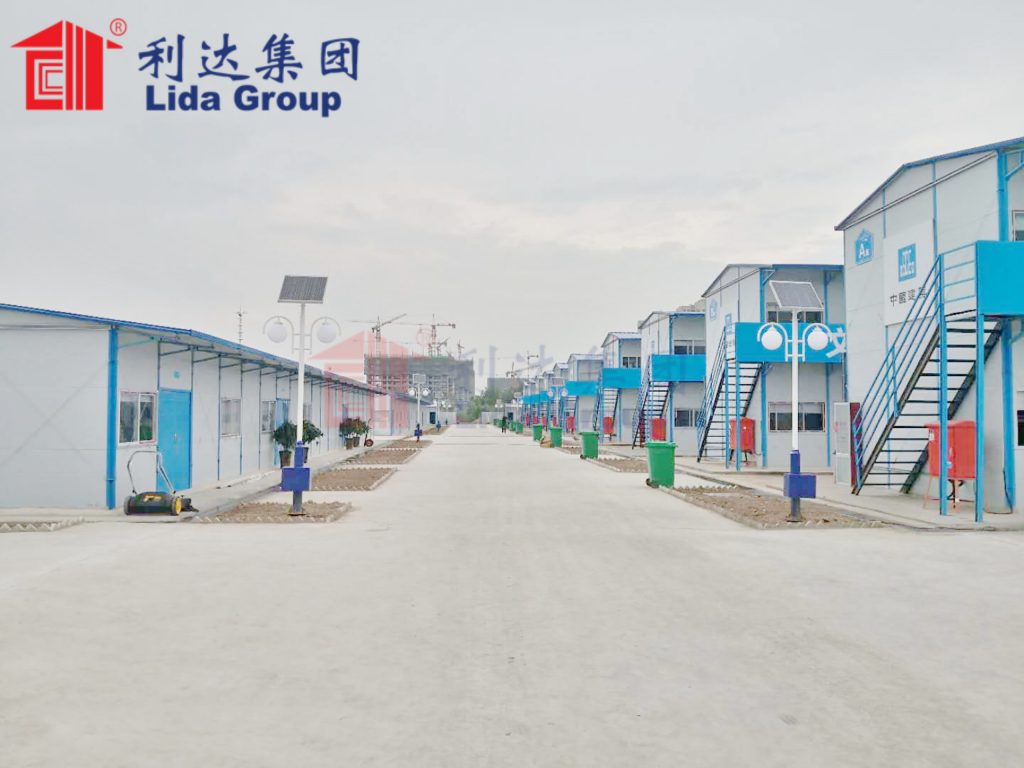
Fast installation light steel structure prefab office and staff dormitory building
05 Contracting Without Leaving Waste
The other test comes when numbers fall. A phase completes, a specialist crew demobilises, and a camp built for six hundred people suddenly houses three hundred. Fixed accommodation leaves the operator with buildings that must still be powered, maintained, and guarded, even though half of them are empty. Modular accommodation allows the camp to shed the surplus, with units removed and either stored for the next phase or transferred to another project that needs them.
For contractors working across multiple sites, this turns accommodation into a managed asset rather than a sunk cost. A pool of units can be allocated to whichever project is entering its busy period and recovered when that period ends, rather than each site owning a camp that sits idle between contracts. Over several years, the same investment serves a whole pipeline of work, and the capital tied up in housing delivers returns repeatedly instead of once. That is the practical meaning of scalability: not merely the ability to grow, but the ability to shrink without loss.
06 Comfort That Keeps People on Site
Flexibility in the system does not by itself make the units good places to live, and a construction workforce that is uncomfortable will not stay. Workers on remote projects spend months away from their families, and the standard of their accommodation is one of the main reasons people remain on a job or leave it for the next offer. Lida’s modules are designed with that in mind, offering proper sleeping space with storage for personal belongings, shared areas for meals and conversation, and sanitary facilities finished to the same standard as the rest of the camp.
The physical performance of the unit supports this comfort. Insulation keeps interiors stable through hot and cold seasons, ventilation maintains fresh air and controls humidity, and the envelope keeps the inside dry when weather outside is severe. Power and lighting are provided to a consistent standard, and layout is arranged to limit disturbance between neighbouring berths. Doors, windows, and fittings are chosen for the wear that daily use imposes in a shared building, so that the accommodation still looks and functions properly after months of occupancy rather than showing its age within the first season. The cumulative effect is accommodation that people treat as a home rather than a temporary shelter, which is exactly what a camp must provide if it is to hold a workforce through a long project.

07 Durability Through Repeated Relocation
Because modular units are moved, they must be built to survive movement. Lida constructs each module around a structural steel frame chosen for strength and dimensional stability, engineered to carry wind and snow loads and to withstand the concentrated forces of lifting and transport. Reinforced corners and lifting points allow the unit to be handled by standard site equipment, and the envelope is detailed to stay sealed through the journey so that insulation and interior finishes arrive intact.
Consistency in fabrication reinforces this. Units are built indoors under controlled conditions, with procedures and inspections applied at each stage, so that seals are properly formed, insulation is installed as designed, and services are tested before dispatch. The consequence is that a unit added in the third year of a project performs the same as one installed in the first, and a unit moved to a second site retains the quality it had when new. Nothing in the camp becomes an older, less reliable generation of building simply because it arrived later in the programme. For an operator planning to reuse accommodation many times, that repeatability is what makes the strategy dependable rather than speculative.
08 A Camp That Follows the Programme
Taken across the life of a project, modular housing produces a distinctive pattern. It begins with a small number of units housing the initial team, keeping early expenditure modest while the project is still finding its shape. As mobilisation proceeds, units arrive in step with the workforce, so capacity tracks demand rather than anticipating it far in advance. At peak, the camp reaches the size the work requires, assembled incrementally rather than through one large construction programm.
As phases close, the pattern reverses. Units are removed, stored, or dispatched to the next project, and the camp contracts to match the remaining workforce, leaving no idle capacity to maintain. The operator’s housing cost therefore follows the actual labour profile of the job rather than a forecast made before it started. Planning becomes simpler as well, because the camp can be specified in stages aligned to the construction programme, and each stage can be reviewed against what the previous stage actually needed.
09 Conclusion: Capacity That Tracks the Work
Scalable site living is not a matter of buying more accommodation than a project needs, nor of accepting whatever temporary housing can be found at short notice. It is a matter of building accommodation from units that can be added and removed as the workforce changes, so that capacity always reflects the work in front of it. Lida Group’s modular prefab housing units make that possible by combining a complete, habitable module with a structure engineered for transport and a fabrication process that guarantees consistency across years of reuse.
The benefits compound over a project and across a portfolio. Capacity rises when numbers rise, contracts when they fall, and surplus units move onward instead of standing empty. Comfort holds the workforce in place, durability allows the same units to serve site after site, and the housing budget stays aligned with the labour profile at every stage. In an industry where programmes shift and headcounts change constantly, that combination gives contractors something rare: accommodation that behaves like a resource under their control rather than a commitment they must live with.
Related news
-
Next-Gen Mining Facilities: High-Durability Steel Factories and Worker Rest Lounges
2026-11-10 15:14:49
-
Maximum Mobility: The Advantages of Relocatable Container Offices in Dynamic Construction
2026-11-09 17:59:19
-
All-in-One Site Infrastructure: Steel Warehouses, Field Dormitories & Rest Lounges
2026-10-29 16:33:47
contact us
- Tel: +86-532-88966982
- Whatsapp: +86-13793209022
- E-mail: sales@lidajituan.com
