



Public health organization partners with Lida Group to pilot mobile modular camps featuring prefabricated sanitation facilities constructed from stacked container components
2026-Sep-07 17:51:22
By Admin
Global public health emergency response and rural and remote community medical support have long been constrained by rigid infrastructure layouts and slow facility deployment. Traditional public health service stations rely heavily on fixed buildings with lengthy construction cycles, making it difficult to rapidly cover underdeveloped areas or respond to sudden epidemic situations, disaster relief scenarios, and temporary population gatherings. In many field operation sites and remote regions, the lack of standardized, clean, and movable sanitation facilities has become a key hidden danger affecting public health management, easily leading to environmental pollution, bacterial spread, and reduced on-site medical service efficiency. To address these systematic industry challenges, a professional public health organization has established an in-depth strategic partnership with Lida Groupto launch a new pilot project for mobile modular public health camps. Centered on stacked container component technology and integrated prefabricated sanitation facilities, the project builds highly adaptable, rapidly deployable, and reusable mobile camp systems, filling the gap of flexible public health infrastructure in temporary scenarios.
For a long time, temporary public health and field sanitation support have faced prominent structural drawbacks. Most conventional temporary camps adopt simple makeshift buildings or single-layer container units with fragmented functional layouts. These makeshift facilities lack standardized sanitation systems, independent drainage and purification structures, and professional cleaning and disinfection spaces. In field rescue, mobile medical screening, and remote community health services, outdated temporary facilities often fail to meet public health management requirements, resulting in disorderly functional zoning, poor on-site environmental hygiene, and insufficient separation of clean and polluted areas. Moreover, traditional temporary buildings are poor in structural scalability and mobility. They cannot be flexibly expanded or disassembled according to population changes and service cycle adjustments, leading to low repeated utilization rates and high comprehensive construction costs. In response to these practical pain points, the cooperative pilot project abandons scattered and backward temporary construction modes, and adopts integrated stacked container modular design to realize standardized, systematic, and intelligent upgrading of mobile public health camps.
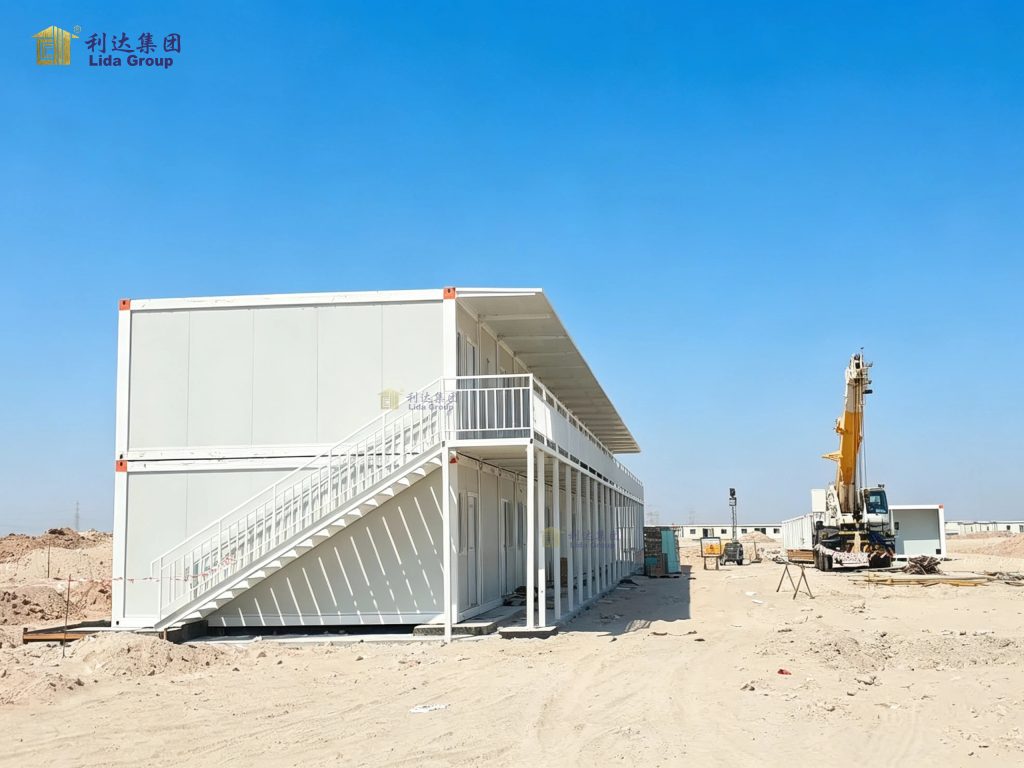
The core innovation of the pilot camp lies in the stacked container component construction system developed by Lida Group. Different from single and non-expandable ordinary container houses, this project uses standardized modular container units as basic building components. Through scientific stacking, horizontal splicing and vertical combination, it realizes multi-layer and multi-functional integrated camp construction. Each container unit is prefabricated with unified size specifications, structural interfaces and reserved pipeline positions in the factory, ensuring precise docking and stable assembly between units. The stacked structure effectively optimizes land utilization, which is particularly suitable for limited field construction sites and densely arranged temporary service areas. While improving space utilization, the overall structural stability of the camp is fully guaranteed. All container frames adopt high-strength galvanized steel structures with professional anti-corrosion and weather-resistant treatments, which can adapt to complex outdoor environments such as high temperature, heavy rain, strong wind and humid climate, ensuring long-term stable operation of public health facilities in different regions.
Based on the stacked container bearing structure, the project is equipped with fully prefabricated professional sanitation facilities, solving the most critical functional defects of traditional temporary camps. Lida Group completes the integrated prefabrication of sanitation systems in the factory, including standardized cleaning areas, disinfection operation areas, sewage temporary storage and preliminary treatment areas, and independent personnel washing and sanitizing spaces. All sanitation facilities are installed and debugged in advance before leaving the factory, realizing plug-and-play use after on-site assembly. Compared with on-site temporary construction, prefabricated sanitation units have more standardized pipeline layout, more reasonable space partitioning, and more rigorous pollution isolation design. The independent drainage system effectively avoids the cross-flow of clean water and sewage, while the closed sanitation space reduces the risk of bacterial proliferation and cross-infection. The whole set of sanitation facilities complies with international public health operation specifications, enabling temporary mobile camps to achieve professional hygiene management standards close to fixed medical stations.
The mobile modular camp built through this cooperation has achieved comprehensive optimization in public health service capability and scenario adaptability. In terms of functional design, the camp realizes the organic integration of public health inspection, daily disinfection, personnel sanitation, temporary medical observation and on-site environmental management. The stacked modular design supports flexible adjustment of camp scale. According to the actual service population and project cycle, the construction team can increase or decrease container units and expand or shrink sanitation functional areas at any time, realizing dynamic matching of service capacity and actual demand. This flexible adjustment capability is impossible for traditional fixed public health buildings and simple temporary facilities.
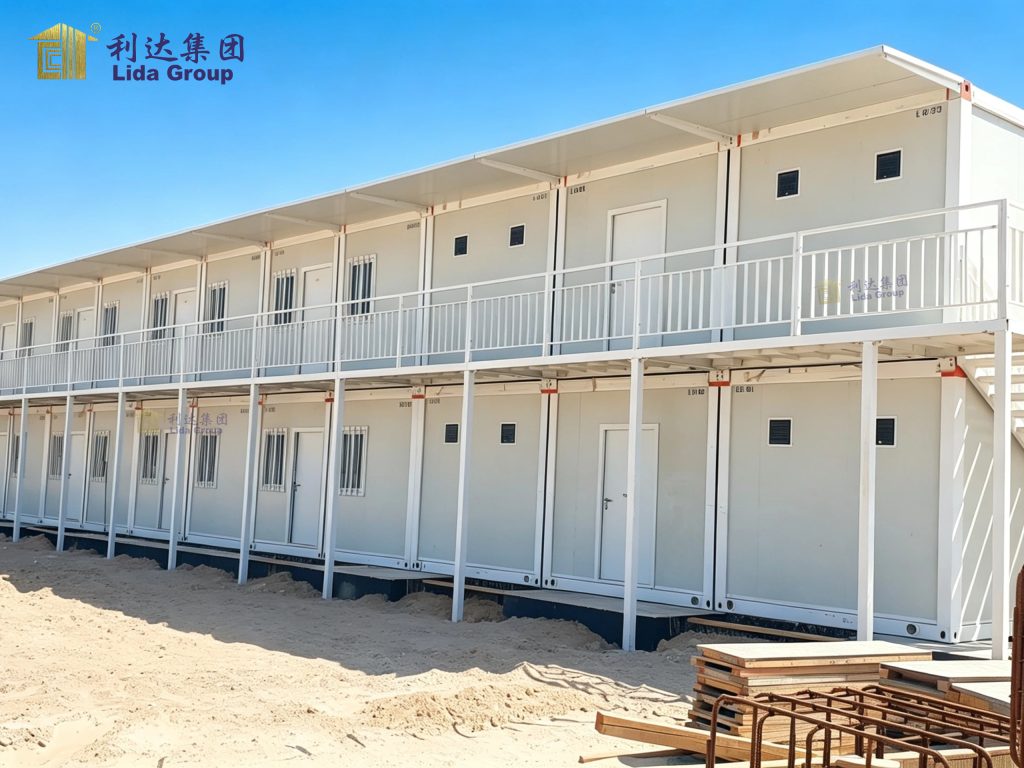
In terms of mobility and emergency response efficiency, the modular container units feature convenient disassembly and transportation. After the completion of a single service task, the camp can be quickly disassembled, packaged and transported to the next service site without generating construction waste. The repeated utilization of equipment and structures greatly reduces the resource consumption and construction cost of public health emergency support. At the same time, the factory integrated prefabrication mode greatly shortens the on-site deployment cycle. The whole camp can complete assembly and sanitation system commissioning in a very short time, forming an effective public health service capacity rapidly, which provides strong support for sudden public health incident disposal and post-disaster medical and health assistance.
In terms of on-site health and safety management, the optimized camp structure realizes clear separation of people flow and logistics, clean areas and polluted areas, effectively standardizing on-site operation procedures. The supporting ventilation system, waterproof and dustproof enclosure structure and integrated disinfection equipment ensure the cleanness and safety of the working environment. The exterior wall and interior decoration materials of the container units are environmentally friendly, antibacterial and easy to clean, which can adapt to frequent disinfection operations in public health scenarios and avoid material aging and bacterial residue caused by long-term use. These detailed designs fully consider the professional needs of public health work and ensure the sustainability and standardization of on-site health services.
As an innovative exploration in the field of mobile public health infrastructure, this pilot cooperation project also provides a replicable and promotable new model for the industry. In the past, mobile public health facilities were mostly limited to simple temporary offices and isolation rooms, ignoring the importance of supporting sanitation systems. The cooperation between the public health organization and Lida Group breaks this inherent limitation, taking professional prefabricated sanitation facilities as the core of the camp construction, and building a complete set of mobile public health service carriers integrating accommodation, office, observation, disinfection and sanitation. This model effectively makes up for the shortcomings of insufficient supporting facilities and non-standard sanitation management in traditional mobile camps.
Through the pilot operation of the new modular camp, the project has verified the feasibility and superiority of stacked container components applied in public health scenarios. The standardized modular production ensures stable product quality, the flexible stacking structure improves space utilization, and the integrated prefabricated sanitation system realizes professional and efficient on-site health management. Whether it is used for regular health support in remote areas, mobile medical screening in suburban areas, or emergency public health response in sudden disasters, the camp can maintain efficient and stable operation effects, showing extremely high scenario adaptability and practical value.
-1024x768.jpg)
Conclusion
To sum up, the partnership between the public health organization and Lida Group creates a new generation of mobile modular camp solution driven by stacked container technology and prefabricated professional sanitation facilities. The project effectively solves the long-standing problems of slow deployment, single function, non-standard sanitation and poor mobility of traditional temporary public health infrastructure. The innovative stacked container structure realizes flexible expansion and stable construction of the camp, while the integrated prefabricated sanitation system greatly improves the professional level of on-site public health management and eliminates potential health and safety hazards. With the advantages of rapid deployment, reusable utilization, low carbon and environmental protection, and flexible scenario adaptation, this modular camp model provides an efficient and reliable carrier for emergency public health response, remote medical support and field health service guarantee. As a successful industry pilot, it will further promote the standardized, modular and mobile upgrading of global public health infrastructure, and provide a sustainable technical and model reference for improving the coverage and response capacity of public health services in complex and temporary scenarios.
Related news
-
Lida Group breaks ground on new steel structure production facility to mass produce modular building components for high-rise apartment construction.
2026-09-04 17:12:58
-
Lida Group develops standardized modular container house system for rapid deployment of transitional housing communities in disaster impacted regions.
2026-08-28 13:50:53
-
Researchers design prefab mobile house made with lightweight metal frame and assembled off-site at Lida Group using insulated composite sandwich wall panels
2026-09-02 17:49:37
contact us
- Tel: +86-532-88966982
- Whatsapp: +86-13793209022
- E-mail: sales@lidajituan.com
