



Introduction
In an era defined by accelerating climate change and increasingly frequent natural disasters, the global community faces a profound and growing challenge: providing safe, dignified, and rapidly deployable shelter for millions of displaced people. Earthquakes, hurricanes, floods, and wildfires continue to devastate communities with relentless regularity, leaving behind an urgent need for transitional housing that can be delivered not in months, but in days and weeks. Traditional construction methods, with their reliance on on-site labor, weather-dependent schedules, and fragmented supply chains, consistently fail to meet these time-sensitive demands. The gap between disaster and shelter—measured in weeks and months—represents a period of profound human suffering that innovative building solutions must urgently address.
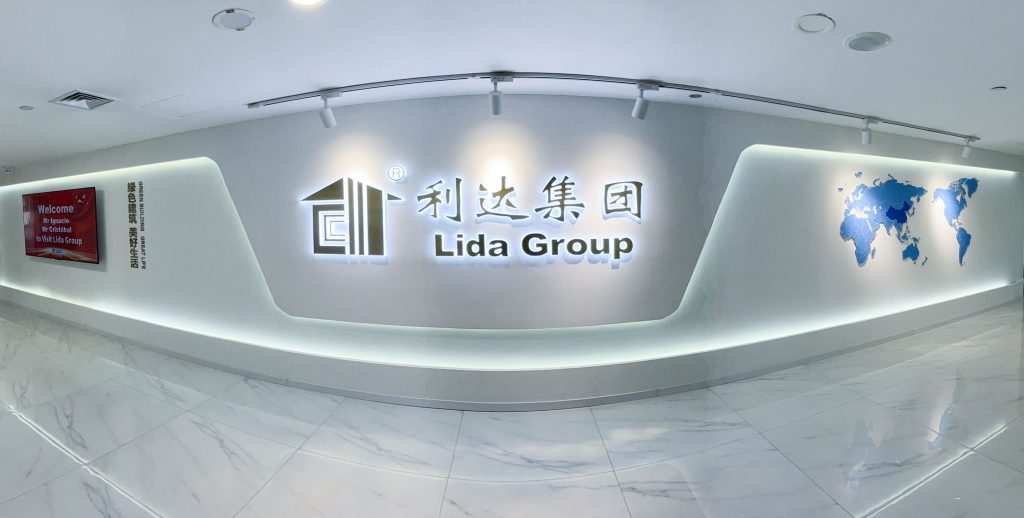
Recognizing this critical humanitarian imperative, Lida Group—a global leader in integrated building engineering solutions established in 1993—has developed a comprehensive standardized modular container house system specifically engineered for the rapid deployment of transitional housing communities in disaster-impacted regions. With over three decades of experience, more than 5,000 completed projects across 152 countries, and a portfolio of over 60 independent patents, Lida Group has positioned itself at the forefront of humanitarian construction. The company’s standardized modular container house system represents a sophisticated synthesis of industrial efficiency, engineering precision, and humanitarian purpose—a solution that not only addresses the immediate need for shelter but also provides the foundation for community stabilization and long-term recovery.
The Core Design Philosophy: Standardization and Modularity
At the heart of Lida Group’s disaster response capability lies a rigorously standardized modular container house system built upon the foundational principles of “standardization, lightweight design, high efficiency, and versatility.” The system adopts unified international modular size standards, with all structural components designed in a standardized and serialized manner. This approach ensures that every module—whether destined for an earthquake zone in Turkey, a floodplain in Southeast Asia, or a cyclone-ravaged coastal community—adheres to the same rigorous specifications, enabling seamless interoperability and predictable performance across diverse environments.
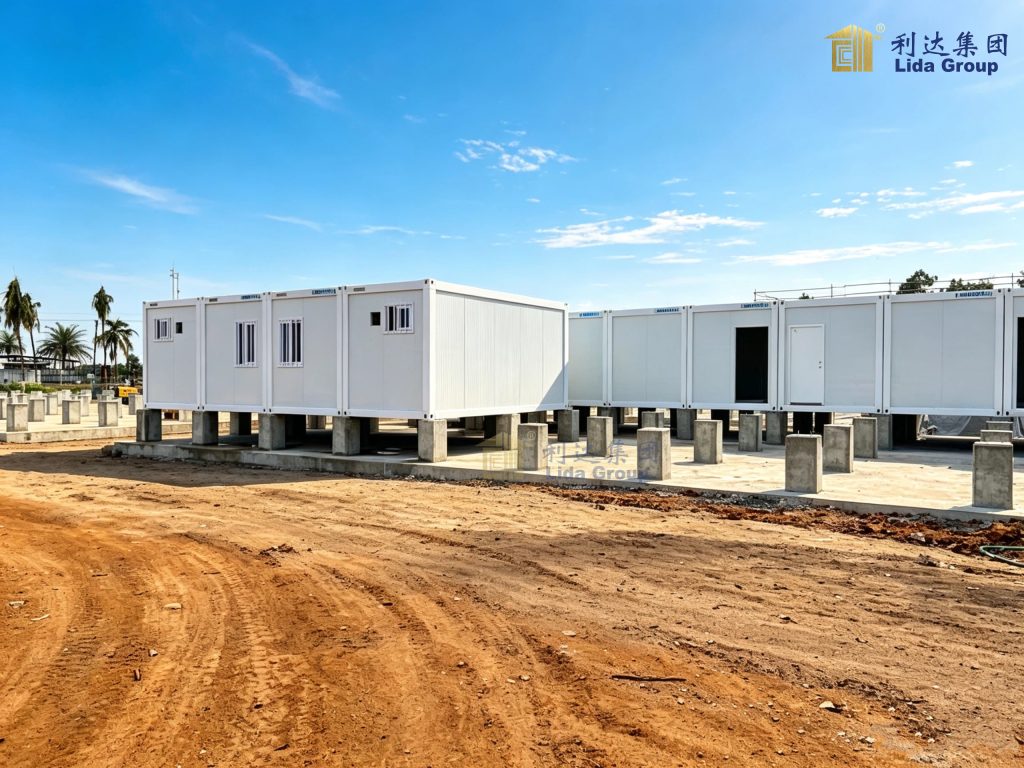
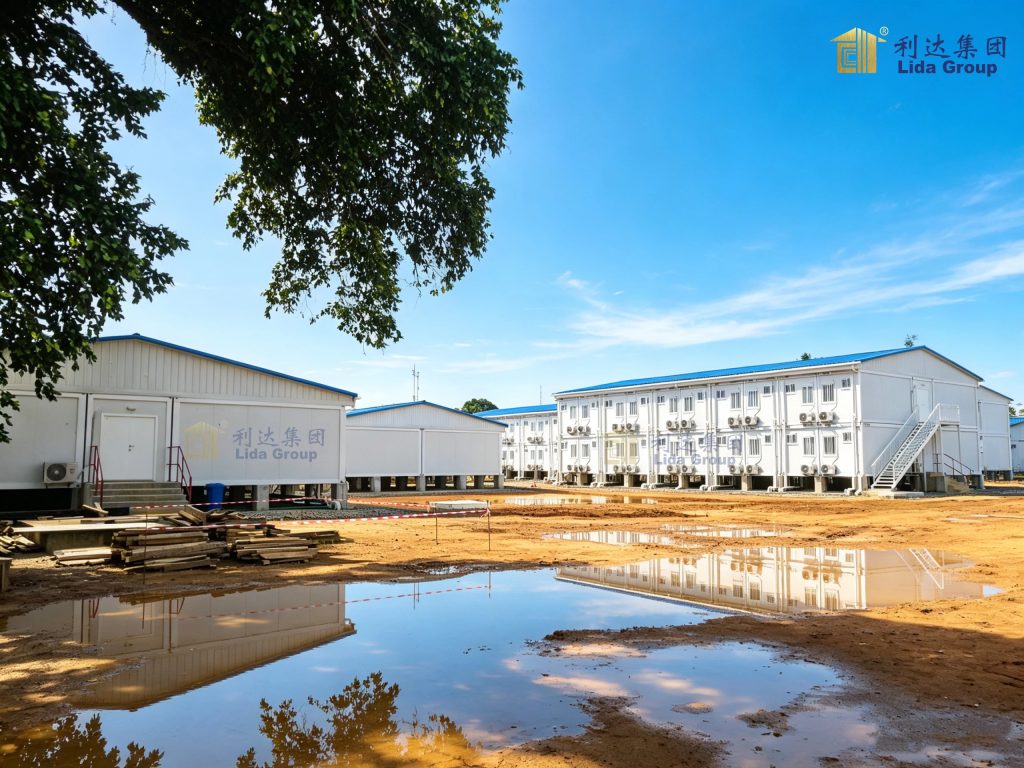
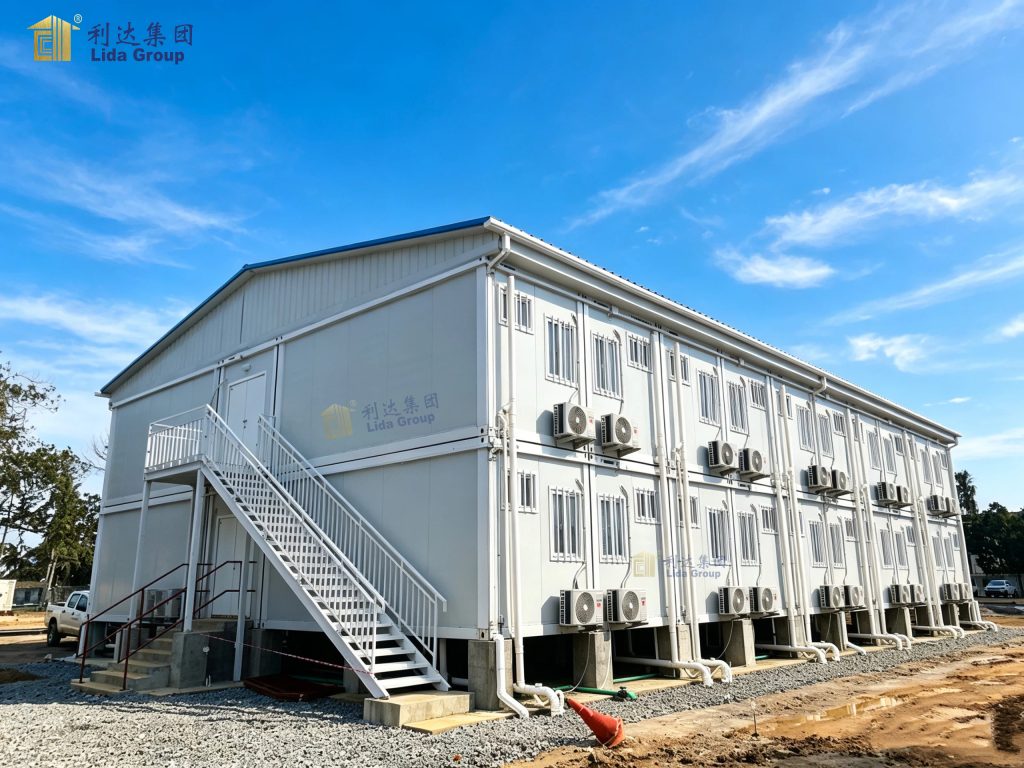
The modular nature of these container homes allows for various configurations, from single-container units for individuals or families to multi-container arrangements for larger groups or community facilities. This adaptability ensures that living spaces can grow or change based on the occupants’ needs, providing flexibility that traditional emergency shelters cannot match. Multiple single modules can be freely combined horizontally and vertically to form large-scale building complexes—multi-story dormitories, integrated office buildings, centralized medical facilities, and comprehensive service stations. This modular flexibility transforms what might otherwise be a collection of isolated shelter units into a coherent, functioning community capable of supporting displaced populations through the transitional period between emergency response and permanent reconstruction.
Engineering Excellence: Technical Specifications and Durability
The structural foundation of each container module consists of high-strength galvanized steel frames engineered to withstand extreme conditions. The standard dimensions follow shipping container specifications—20 feet (6.058 meters by 2.438 meters by 2.591 meters) and 40 feet (12.19 meters by 2.438 meters by 2.591 meters)—ensuring compatibility with global shipping and logistics networks. These modules are designed with wind resistance up to Grade 12, wall permitted loading of 0.6 KN/m², and ceiling permitted live loading of 0.5 KN/m².
The modules feature advanced insulation systems with thermal conductivity coefficients that maintain comfortable indoor temperatures even in extreme environments ranging from -45°C to 50°C. Insulation options include EPS (expanded polystyrene), rock wool, fiberglass wool, and polyurethane, with thicknesses ranging from 50mm to 200mm, allowing customization based on specific climate requirements. This thermal resilience is critical for disaster-affected populations who often find themselves sheltering in regions with compromised infrastructure and extreme weather conditions.
Lida Group’s commitment to quality is validated through comprehensive certifications. The company holds ISO9001 (quality management), ISO14001 (environmental management), and ISO45001 (occupational health and safety) certifications, along with EU CE certification (EN1090). Its facilities and products have successfully passed inspections by SGS, TUV, and BV—three of the world’s most respected independent testing and certification organizations. The company also holds a Second Class Qualification of Steel Structure Professional Construction Contracting and General Contracting Qualification of Construction Engineering in China.
The resilience of container-based architecture derives fundamentally from its material foundation. Shipping containers are engineered from weathering steel to withstand the corrosive marine environment and the immense stresses of international shipping. This inherent robustness translates directly into exceptional durability for building applications. When strategically modified and engineered, these structures offer superior resistance to extreme weather phenomena—a critical advantage in an era of intensifying hurricanes, floods, and wildfires. Lida Group’s patented steel structure joint technology ensures buildings can withstand seismic activity, with particular attention to regions like Japan and Turkey where earthquake resistance is paramount.
Rapid Deployment: Engineering for Urgency
The defining characteristic of Lida Group’s container house system is its capacity for extraordinary speed of deployment—a feature that directly translates into lives saved and suffering reduced. In disaster response scenarios, every day of delay means more families displaced, critical services disrupted, and recovery timelines extended. Lida Group has engineered its entire production and logistics chain to minimize these delays.
The company operates six dedicated container modular house production lines and eight independent steel structure production lines, all following unified internal quality standards. This industrial-scale manufacturing capability enables the company to mobilize resources rapidly when disaster strikes. All container building units are completely manufactured in standardized factories, with precise material cutting and unified component processing greatly reducing production time compared with traditional on-site cutting and assembly. Every production link follows unified environmental protection standards, ensuring consistent quality across all units.
Perhaps the most significant innovation in Lida Group’s rapid deployment capability is the flat-pack container house design, which addresses one of the most formidable logistical bottlenecks in disaster response: transportation. Traditional integral container houses can only transport two to three units per standard shipping container, resulting in prohibitively high unit transportation costs. Lida Group’s flat-pack design disassembles the building into flat plate components and stacked accessories, enabling a single standard shipping container to hold multiple complete units. This dramatically increases shipping efficiency, reducing both cost and delivery time. The flat packed modular container house adopts a disassembled flat packaging structure that enables rapid assembly and multi-scenario adaptability.
The company has also developed advanced on-site assembly protocols that further accelerate deployment. Using drone-assisted positioning technology, Lida Group can achieve the assembly of 50 modules—approximately 1,500 square meters of living space—in a single day. In emergency scenarios, the company has demonstrated the capability to deploy complete transitional housing communities within 48 hours of receiving a request.
Sustainability and Circular Economy Principles
Beyond their immediate humanitarian function, Lida Group’s modular container houses embody a profound commitment to environmental sustainability—a consideration that grows increasingly urgent as climate change accelerates both the frequency of disasters and the imperative to reduce carbon emissions across all sectors of the economy.
The most immediate environmental benefit of container-based construction is upcycling. With millions of shipping containers sitting idle in ports worldwide, their repurposing into habitable structures dramatically reduces the demand for virgin construction materials like brick, concrete, and timber. This approach conserves natural resources and minimizes the embodied energy typically associated with mining, processing, and transporting new materials. Lida Group’s use of repurposed shipping containers significantly reduces material costs while promoting eco-friendly living.
The precision of factory-based modular construction significantly reduces on-site waste. Components are manufactured to exact specifications in controlled factory environments, leading to material savings of up to 90 percent compared to traditional construction waste levels. Factory production also reduces material waste through precise material cutting and unified component processing.
Perhaps most significantly, Lida Group’s modular buildings support complete disassembly, migration, and repeated reuse, forming a closed-loop sustainable construction model. The company’s patented structural design enables camp house clusters and functional container building spaces to be disassembled, transported, and reinstalled multiple times without performance degradation. This reusable feature aligns perfectly with circular economy principles, allowing humanitarian organizations and governments to reuse modular facilities in subsequent disaster responses, avoiding repeated resource investment. Lida Group’s over 60 technical patents optimize connection structures and anti-aging performance, ensuring that reused buildings still meet local safety and environmental protection standards after multiple deployments in different countries.
Energy efficiency further enhances the sustainability of these structures. Lida Group emphasizes energy-efficient designs, with options for solar panels, energy-efficient insulation, and high-quality windows that reduce energy consumption and lower utility bills. These features are particularly valuable in disaster contexts where grid connections may be compromised or non-existent.
Proven Track Record: Case Studies in Humanitarian Response
The theoretical capabilities of Lida Group’s modular container house system have been repeatedly validated through real-world humanitarian deployments across diverse disaster scenarios. These case studies demonstrate not only the technical effectiveness of the system but also its capacity to restore dignity, stability, and hope to communities in crisis.
Qingdao Huangdao Container Hospital Station
One of the most compelling demonstrations of Lida Group’s capabilities occurred during the height of the global pandemic. The Qingdao Huangdao Container Hospital Station project covered 74,000 square meters with a construction area of 36,000 square meters, including 1,000 isolation container rooms and 126 staff dormitories, along with function halls, catering buildings, reception centers, and supporting infrastructure. In collaboration with the China Construction Eighth Engineering Bureau, Lida Group delivered the hospital station in just 12 days from start to delivery. The project encompassed 726 prefab houses, including 574 isolation container rooms, more than 620 sets of integrated sanitary facilities, over 3,000 square meters of concrete work, and the installation of 636 air conditioners and 632 televisions. Upon completion, the facility provided a strong guarantee for epidemic prevention and effectively eased the strain on isolation wards. This achievement underscored Lida Group’s ability to mobilize resources at scale, integrate engineering efficiency with humanitarian urgency, and deliver projects that directly improve public health and community resilience.
Earthquake Response in Europe
Following the devastating earthquake in Europe in 2023, Lida Group demonstrated its rapid response capabilities by shipping 1,000 flat-pack units via truck from its factory to the disaster zone—covering 800 kilometers in just 12 hours. Each unit was equipped with beds, kitchens, and insulation to protect families from the cold. The rapid deployment of these fully functional living units provided immediate relief to thousands of displaced families during a critical period when traditional housing solutions would have required months to implement.
Post-Typhoon Response in the Southeast Asia
After Typhoon Rai hit the Philippines in 2024, Lida Group delivered 200 camp house modules in 30 days—half the time of traditional construction—by leveraging its modular light steel production lines. Each module was pre-fitted with insulation, plumbing, and electrical systems, allowing on-site teams to simply connect the units “like building blocks.” This speed demonstrated how modular construction can fundamentally rethink how housing is delivered in crisis situations.
Humanitarian Mission in Africa
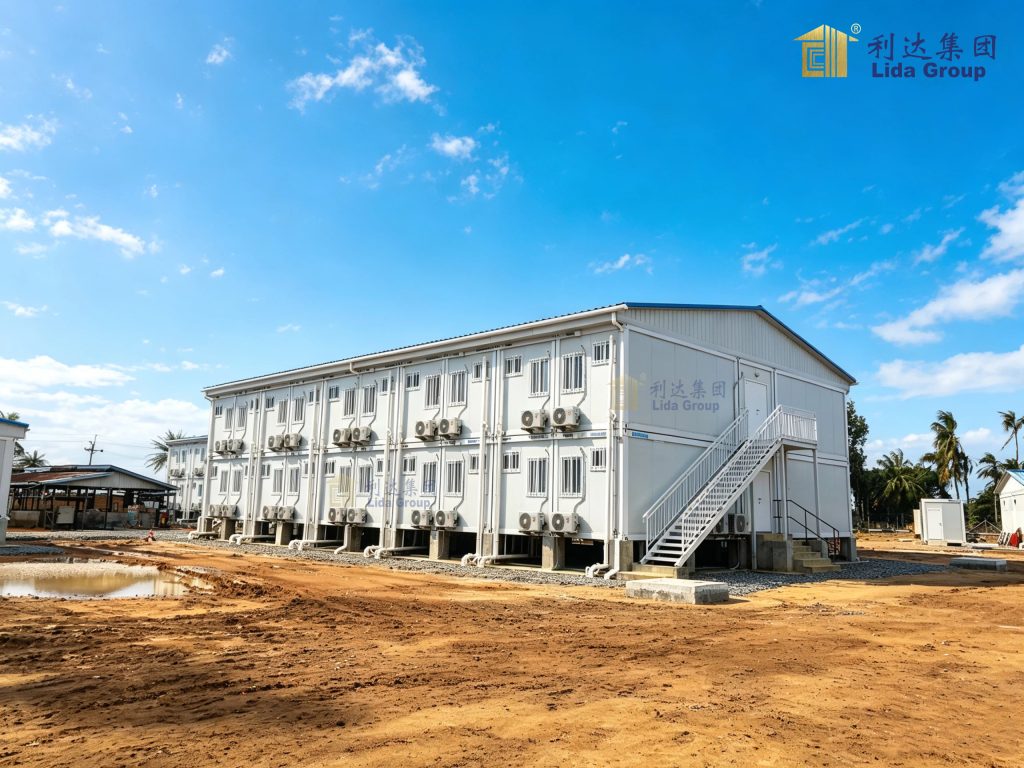
In one of the company’s most demanding humanitarian assignments, Lida Group constructed 182 living container houses from shipping containers in war-torn Africa. The United Nations Mission sought temporary housing urgently for peacekeeping troops deployed in the ongoing conflict. Skilled technicians reconfigured durable containers at Lida’s manufacturing plant, with walls reinforced to withstand winds and monsoonal rains, and insulated interiors guaranteeing comfort through endemic heat. Modules were trucked to remote field locations for swift on-site assembly, establishing rows of watertight container homes within rapid deadlines. For peacekeepers protecting Africa’s most vulnerable, the sanitary and sturdy camp provided sanctuary during hazardous deployments.
Post-Hurricane Reconstruction in the South America
After a hurricane devastated South America, Lida Group delivered 1,200 modular steel camp house modules in 28 days—each pre-fitted with insulation, plumbing, and solar panels—providing shelter for thousands before the start of the rainy season. The modular design also allowed for quick reconfiguration, demonstrating the system’s adaptability beyond mere shelter provision to support broader community recovery.
Humanitarian Philosophy and Global Reach
Lida Group’s work in disaster response transcends commercial considerations; it is rooted in a profound vision of humanitarian engineering. The company has been recognized as a 5.12 earthquake relief advanced enterprise for its contributions to disaster response in China. From epidemic prevention facilities to emergency resettlement housing, the company is committed to creating structures that not only withstand challenges but also uplift communities during their most difficult moments.
This humanitarian commitment is reflected in the company’s pricing approach for disaster response projects. To support disaster-affected areas, Lida Group has offered modular buildings at accessible rates, with 100 modular buildings priced at $3,000 each for rapid deployment. Each container house includes essential features such as a door and a window, providing basic shelter for those in immediate need.
Lida Group’s products have been exported to more than 150 countries and regions worldwide, serving as critical infrastructure solutions for governments, NGOs, and private sector partners. As a member of the China Steel Structure Association, China Council for the Promotion of International Trade, and the China Building Metal Structure Association, Lida Group continues to strengthen its industry leadership and expand its international footprint.
Conclusion
Lida Group’s standardized modular container house system offers a comprehensive, scalable, and sustainable solution to one of the most pressing humanitarian challenges of our time: providing rapid, dignified transitional housing for communities devastated by natural disasters. By leveraging decades of engineering expertise, industrial-scale manufacturing capacity, and a deep commitment to humanitarian values, the company has created a system that saves lives, restores communities, and builds resilience against an uncertain future.
The system’s core strengths—standardization enabling rapid production and predictable quality, modularity allowing flexible configuration for diverse needs, durability ensuring safety in extreme conditions, and sustainability supporting circular economy principles—position it as an essential tool in the global humanitarian toolkit. The company’s demonstrated ability to deliver thousands of housing units within days or weeks of a disaster, to withstand extreme weather and seismic events, and to provide comfortable, dignified living environments for displaced populations, has established Lida Group as a trusted partner for governments and humanitarian organizations worldwide.
As climate change continues to intensify the frequency and severity of natural disasters, the demand for rapid, reliable, and sustainable transitional housing solutions will only grow more urgent. Lida Group’s standardized modular container house system represents a mature, proven response to this challenge—one that combines industrial-scale manufacturing efficiency with humanitarian sensitivity and environmental responsibility. In doing so, the company is helping to build not just shelter, but hope—providing the foundation for communities to rebuild, families to recover, and lives to continue with dignity in the aftermath of disaster.
Related news
-
Engineers Specify Inclusive Prefabricated Wellness Units from Lida Group Equipped with Composite Panel Laundry, Medical and Kitchen Amenities within Mobile Labor Camps
2026-08-26 17:17:12
-
Lida Group develops standardized prefabricated steel structure building system for fireproof chicken houses to support expanding commercial poultry operations.
2026-08-28 13:23:07
-
Long-span warehouse for major logistics company features open-web steel joists that provide unobstructed floorplans perfectly suited for modern distribution operations.
2026-08-25 17:49:52
contact us
- Tel: +86-532-88966982
- Whatsapp: +86-13793209022
- E-mail: sales@lidajituan.com
