



New Oil Gas Field Worker Dormitory Features Temporary Building and Easy Assembly Panels
2026-Jun-24 13:28:29
By Admin
1. Introduction
Global oil and gas exploration, drilling, and pipeline construction projects are predominantly deployed in remote, barren, and climatically harsh regions, including desert basins, coastal salt spray zones, high-altitude cold plateaus, and mountainous wilderness areas. These operational sites lack mature urban infrastructure, making on-site worker dormitories the core logistical guarantee for personnel settlement, daily rest, and stable project advancement. Unlike ordinary construction site accommodation, oil and gas field dormitories face dual stringent requirements: rapid deployment to match tight engineering schedules and reliable environmental adaptability to cope with extreme field conditions. Meanwhile, as temporary supporting facilities for phased energy projects, field dormitories must also feature flexible mobility, controllable costs, and standardized safety performance to support long-term and large-scale field operations.
Traditional oilfield worker dormitories have long adopted two outdated construction modes: fixed on-site masonry buildings and simple makeshift tents. Fixed masonry structures require lengthy foundation treatment, wet concrete construction, and on-site decoration, featuring slow deployment, high comprehensive costs, and poor reusability, which often delay project startup progress and reduce overall engineering efficiency. In contrast, simple tents and low-grade color steel sheds can be erected quickly but suffer from weak structural stability, insufficient fire resistance, poor thermal insulation performance, and extremely low livability. These crude temporary shelters bring frequent safety hazards in high-risk oilfield environments and generate continuous hidden costs from repeated maintenance and component replacement throughout the project cycle.
To resolve the inherent contradictions of traditional accommodation solutions, Lida Group has launched a new generation of upgraded oil and gas field worker dormitories that perfectly integrate standardized temporary building systems and high-performance easy assembly sandwich panels. This innovative field dormitory abandons the drawbacks of traditional fixed buildings and simple temporary facilities, innovatively balancing rapid assembly, structural safety, extreme weather adaptability, humanized comfort, and flexible turnover capability. It has become a brand-new benchmark for temporary accommodation in global energy engineering projects. This article systematically elaborates on the design features, core structural advantages, functional performance highlights, on-site application strengths, and industrial promotion value of the new sandwich panel temporary dormitories for oil and gas fields, delivering a complete, well-structured, and professionally in-depth analysis.
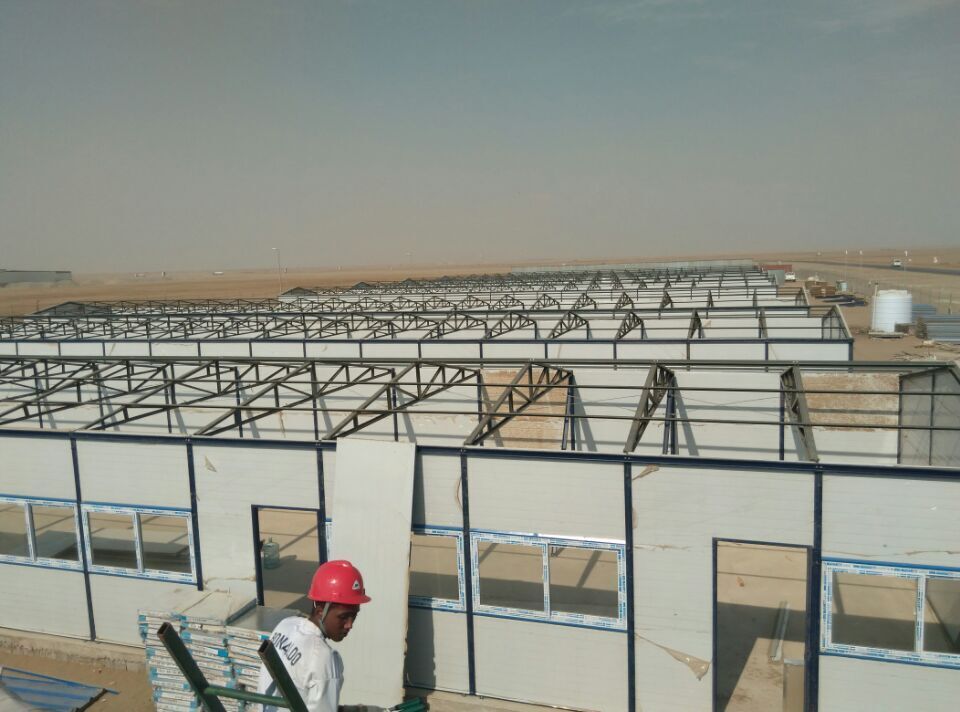
2. Defects of Traditional Oilfield Dormitory Construction Modes
Traditional temporary accommodation solutions for oil and gas fields have obvious technical and functional defects, which cannot adapt to the high-standard operational needs of modern energy projects and severely restrict the efficient, safe, and sustainable development of field construction work. These long-standing industry pain points have created an urgent demand for upgraded temporary dormitory solutions tailored for harsh oilfield scenarios.
First, fixed masonry dormitories have low flexibility and poor economic efficiency. Traditional fixed buildings adopt integrated pouring and masonry structures, requiring 30 to 45 days of complicated on-site construction processes and consuming massive manpower, materials, and financial resources. Once phased oilfield exploration and drilling tasks are completed, these fixed buildings cannot be disassembled, relocated, or reused, resulting in complete abandonment and large-scale construction waste. Energy enterprises have to repeatedly invest in new dormitory construction for subsequent regional projects, forming a vicious cycle of one-time construction and repeated capital waste that seriously weakens project profit margins.
Second, simple temporary shelters have insufficient safety and long-term durability. Low-grade tents and ordinary color steel houses lack professional fire-proof, anti-corrosion, and wind-resistant design optimized for oilfield environments. In flammable and explosive oil and gas working areas, flammable thermal insulation core materials and irregular on-site wiring easily trigger fire and electrical accidents, posing serious threats to personnel and property safety. In extreme climates including desert sandstorms, coastal high humidity and salt spray, and plateau low-temperature freezing, simple structures are prone to permanent deformation, rainwater leakage, surface rust, material aging, and thermal insulation failure. Frequent maintenance, partial renovation, and overall replacement lead to continuous operational investment and unstable long-term performance.
Third, traditional dormitories fail to balance construction speed and living quality. Fixed masonry buildings deliver relatively reliable structural quality but suffer from extremely slow deployment that delays project mobilization. Simple makeshift shelters support fast setup but provide harsh living conditions with poor sound insulation, unbalanced indoor temperature, insufficient ventilation, and cramped space. The substandard living environment greatly reduces worker satisfaction and sense of belonging, resulting in high personnel turnover rates. Frequent staff changes increase enterprise recruitment, induction, and training costs and seriously affect the stability and execution efficiency of on-site construction teams.
Fourth, traditional construction modes have strong site dependence and low environmental adaptability. Traditional masonry and pouring construction require flat terrain, complete water and electricity supply, sufficient local building materials, and skilled professional construction teams. Most remote oil and gas fields are located in undeveloped wilderness areas that lack these basic construction conditions, leading to difficult site preparation, prolonged construction cycles, and uncontrollable project quality. Such rigid site dependence cannot meet the flexible and rapid deployment needs of modern mobile oil and gas exploration projects.
3. Core Design Features of the New Oilfield Temporary Dormitory
The newly upgraded oil and gas field worker dormitory developed by Lida Group takes “professional temporary building system + easy assembly sandwich panel structure” as the core design orientation. It retains the flexible deployment and cost-effective advantages of traditional temporary buildings while completely making up for the defects of conventional temporary facilities in safety, durability, and living comfort, realizing targeted customization for the unique high-risk, harsh, and mobile operational characteristics of oil and gas fields.
In terms of structural positioning, the new dormitory is defined as a standardized modular temporary building, abandoning both the rigid fixed design of masonry buildings and the crude simple structure of traditional temporary sheds. It strictly adheres to the design principles of rapid assembly, flexible disassembly, stable load-bearing structure, and recyclable turnover utilization, fully adapting to the phased construction and cross-regional mobility of oilfield projects. All building modules comply with international oilfield temporary facility construction specifications and industrial safety standards, ensuring standardized, normative, and professional application in high-risk energy working scenarios.
In terms of enclosure materials, the dormitory fully adopts upgraded easy assembly composite sandwich panels as the main materials for walls, roofs, and ceilings. Different from ordinary single-layer color steel plates with single functions and poor durability, the optimized sandwich panel adopts a three-layer composite structure composed of double-sided weather-resistant color steel plates and high-density functional core materials. All panels are integrally prefabricated and molded in standardized intelligent factories, with precisely reserved splicing interfaces and fixed bolt holes, supporting tool-free rapid on-site docking and assembly without secondary cutting or polishing. The integrated panel design organically integrates fire resistance, thermal insulation, sound insulation, waterproofing, and anti-corrosion functions, achieving multi-performance integration of building enclosure components.
In terms of overall structural matching, the new temporary dormitory adopts a lightweight high-strength hot-dip galvanized steel frame as the main load-bearing structure, perfectly matched with easy assembly sandwich panels to form an integrated modular building system. The high-rigidity steel frame provides stable structural support and strong deformation resistance, while the composite sandwich panels undertake environmental isolation and functional protection tasks. The flexible modular combination mode allows free adjustment of dormitory layout, unit quantity, and overall scale according to the actual number of on-site workers and complex site terrain, realizing personalized scenario customization on the basis of standardized mass production.
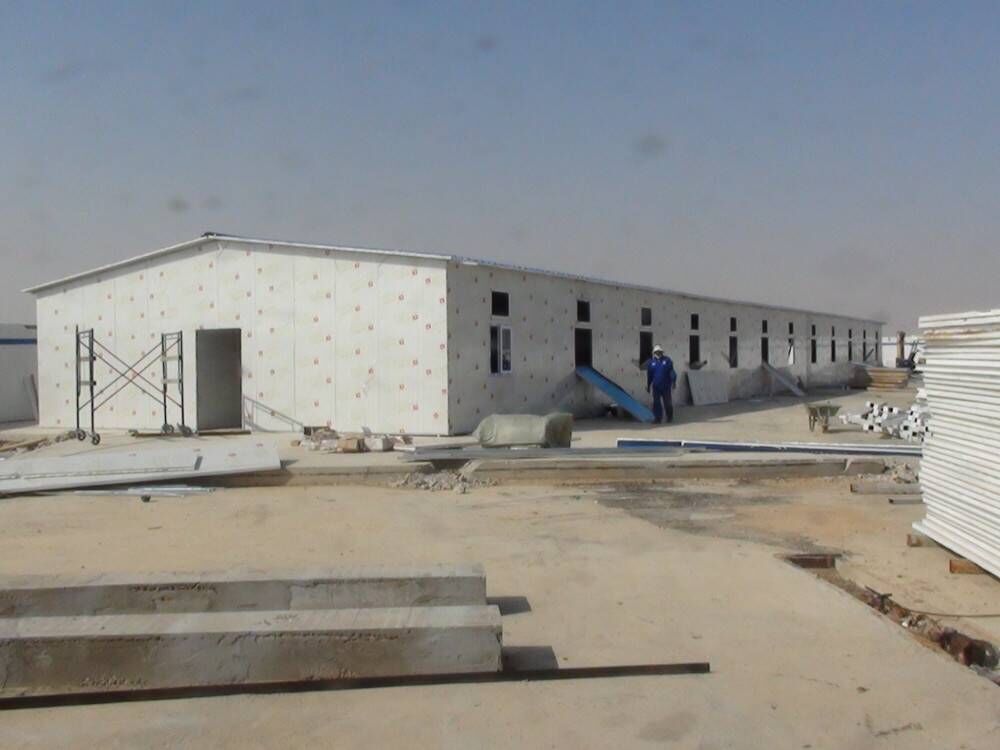
4. Technical Advantages of Easy Assembly Sandwich Panel Configuration
The excellent comprehensive performance of the new oilfield dormitory is mainly derived from the innovative technical advantages of customized easy assembly sandwich panels. Compared with traditional building materials and ordinary temporary enclosure panels, Lida Group’s upgraded panels achieve qualitative breakthroughs in assembly efficiency, environmental adaptability, safety performance, and functional diversity, forming the core competitiveness of the new-generation oilfield temporary dormitory.
4.1 Ultra-Simple On-Site Assembly Greatly Improves Deployment Efficiency
The core feature of the supporting sandwich panels is highly standardized factory prefabrication and ultra-low-threshold on-site assembly performance. All panels are produced in strict accordance with unified modular specifications in automated intelligent factories, with accurate reserved splicing gaps and bolt fixing positions, requiring no secondary processing on site. The on-site assembly process completely abandons traditional wet operations including welding, concrete pouring, and paint finishing, and only requires ordinary workers to complete component docking and fixing with conventional hand tools. A single standard dormitory unit can be fully assembled, wired, and commissioned for occupancy within 3 hours, and a medium-to-large-scale oilfield camp with complete dormitory groups and supporting functional rooms can be fully completed and delivered within one week. The overall construction efficiency is improved by more than 80% compared with traditional temporary buildings, completely solving the problem of slow camp deployment in remote oilfields.
4.2 Multi-Functional Composite Structure Ensures Oilfield-Grade Safety
Targeting the flammable and explosive high-risk attributes of oil and gas fields, the sandwich panel core material adopts A1-level non-combustible rock wool fireproof material, which will not burn or produce toxic smoke when exposed to open fire or high temperature, effectively restraining fire spread and reducing explosion risks. The outer color steel plate is treated with multi-layer anti-corrosion, ultraviolet-resistant, and weather-resistant coating, which can long-term resist coastal salt spray erosion, desert high-temperature aging, and plateau frost damage. The fully sealed panel splicing structure eliminates air and water penetration gaps, delivering excellent waterproof, dustproof, and windproof performance. Matched with the overall reinforced steel frame structure, the assembled dormitory can withstand level 12 strong winds and magnitude 8 earthquakes, ensuring stable and safe long-term operation in various extreme oilfield environments.
4.3 Efficient Thermal and Sound Insulation Optimizes On-Site Living Environment
The high-density composite core material of the sandwich panel forms an efficient closed thermal insulation barrier that effectively isolates external extreme temperature changes. In hot desert oilfields, it blocks intense solar heat radiation and reduces indoor sultriness; in cold high-altitude oilfields, it locks indoor heat and prevents low-temperature freezing, realizing automatic all-season constant temperature adjustment. Meanwhile, the multi-layer composite laminated structure has outstanding sound absorption and noise reduction capabilities, which can effectively isolate outdoor oilfield equipment operation noise, wind and sand noise, and construction noise. It greatly reduces indoor background noise and creates a quiet, comfortable rest space for workers after high-intensity field operations, helping relieve physical fatigue and improve sleep quality.
4.4 Lightweight and Detachable Design Enhances Flexible Mobility
The easy assembly sandwich panel features an overall lightweight design, which greatly reduces the self-weight of the dormitory building and supports foundation-free installation on complex terrains including sandy land, gravel ground, and uneven slopes in remote oilfields. More importantly, the full bolted splicing structure enables zero-damage disassembly of all panels and steel frame components. After the completion of a single oilfield project, all building modules can be flat-packed, transported, and reassembled in new working sites without structural deformation or functional performance attenuation. The reusable and turnoverable design perfectly matches the mobile and phased operational characteristics of oil and gas exploration projects, realizing cyclic utilization of temporary dormitory facilities and avoiding repeated construction waste.

5. Unique Operational Advantages of the New Temporary Dormitory for Oilfield Scenarios
Integrating the flexible mobility of professional temporary buildings and the high comprehensive performance of easy assembly sandwich panels, the new oilfield worker dormitory presents unique multi-dimensional advantages in emergency deployment, safety management, full-cycle cost control, workforce stabilization, and green construction, effectively solving multiple bottleneck pain points of traditional field accommodation facilities.
First, ultra-fast emergency deployment meets urgent project schedule needs. Modern oil and gas engineering projects feature tight schedules and almost no redundant construction buffer time. The new dormitory’s dual model of factory prefabrication and on-site rapid assembly realizes same-day installation and same-day occupancy, quickly completing large-scale worker settlement and supporting early project mobilization. It effectively avoids project delays, equipment idleness, and economic losses caused by slow camp construction under traditional modes.
Second, standardized temporary construction realizes unified and refined safety management. As a professional standardized temporary building tailored for energy scenarios, the new dormitory fully complies with international oilfield safety specifications and industrial temporary facility construction standards. The unified structural specification, standardized fire-proof configuration, and normalized electrical layout eliminate irregular safety hazards existing in traditional makeshift camps. It facilitates energy enterprises to implement unified safety inspection, standardized personnel management, and daily operational supervision, comprehensively improving the overall safety management level of remote oilfield sites.
Third, full-cycle cost optimization significantly improves project economic benefits. The new dormitory achieves balanced optimization of low upfront investment and low long-term operational costs. The simplified assembly process greatly reduces on-site labor input and mechanical equipment rental costs, lowering initial construction investment. The excellent weather resistance and structural durability of upgraded sandwich panels reduce daily maintenance and partial renovation expenses throughout the service cycle. Most importantly, the reusable modular design completely eliminates repeated construction investment for multi-project layout, saving more than 60% of long-term camp construction costs for energy enterprises.
Fourth, humanized temporary living space effectively stabilizes on-site workforce. Different from the purely functional and crude traditional temporary facilities, the new dormitory integrates systematic humanized design on the premise of meeting temporary industrial use needs. The stable constant temperature environment, efficient sound insulation, scientific ventilation and lighting, and complete supporting living facilities create a safe, dry, bright, and comfortable living space. The improved accommodation environment effectively enhances workers’ job satisfaction and sense of belonging, reduces unnecessary personnel turnover, and stabilizes the on-site construction team for long-term and continuous oilfield operation.
Fifth, green low-carbon temporary construction conforms to industrial sustainable development trends. The factory centralized prefabrication mode produces zero on-site construction waste, dust pollution, and construction noise pollution. All steel frames and sandwich panel materials can be 100% recycled and reused, avoiding massive solid waste generated by the demolition of traditional disposable temporary buildings. This environmentally friendly construction mode fully meets the ESG green assessment standards of modern international energy enterprises, realizing coordinated development of project construction, economic benefit improvement, and ecological environmental protection.
6. Practical Application and Industrial Promotion Value
Since its official launch, the new oil and gas field worker temporary dormitory equipped with easy assembly sandwich panels has been widely promoted and applied in global desert oilfield development, coastal offshore gas field construction, and high-altitude cold-region energy exploration projects, achieving excellent on-site practical effects and forming high industrial promotion and reference value.
In practical engineering applications, the new dormitory has perfectly adapted to various harsh and complex oilfield working environments. Its ultra-fast modular assembly capability ensures rapid emergency camp deployment in resource-scarce remote wilderness areas; its oilfield-grade fire-proof, anti-corrosion, and wind-resistant performance eliminates potential safety hazards of traditional temporary facilities; its flexible disassembly and reusable turnover characteristics fully match the phased construction and cross-region migration needs of mobile energy projects. Verified by numerous field applications, this new-type temporary dormitory can effectively shorten project preparation cycles, reduce comprehensive operational costs, standardize on-site site management, and stabilize field workforce, becoming the most preferred temporary accommodation solution for modern large-scale oil and gas field projects.
In terms of industrial upgrading and promotion, the new dormitory breaks the long-standing industry stereotype that temporary buildings are low-quality, short-lived, and functionally single. It establishes a new industrial construction standard of “efficient assembly, safe and durable, comfortable and environmentally friendly, reusable and economical” for oilfield temporary supporting facilities. It provides a replicable, popularized, and high-performance temporary construction mode for the global energy industry and other remote engineering projects, driving the overall upgrading and standardized development of temporary accommodation facilities for harsh-field engineering.

7. Conclusion
The new oil and gas field worker dormitory integrating standardized temporary building systems and easy assembly sandwich panels is a targeted and high-performance upgraded solution for the inherent defects of traditional oilfield accommodation facilities. It organically combines the flexible deployment, convenient disassembly, and cost-saving advantages of traditional temporary buildings with the high safety, strong environmental durability, and superior living comfort of upgraded composite sandwich panels, completely resolving the core industry contradictions of slow construction speed, insufficient safety performance, low livability, and serious resource waste in conventional dormitory construction modes.
Relying on mature factory modular prefabrication and tool-free rapid assembly technology, the new dormitory realizes ultra-fast on-site deployment to meet the tight schedule and urgent mobilization needs of modern oil and gas projects. The optimized multi-functional sandwich panel structure provides comprehensive fire resistance, anti-corrosion, wind resistance, thermal insulation, and sound insulation performance, fully adapting to extreme climates and high-risk industrial environments of remote oil and gas fields. Meanwhile, the detachable and recyclable modular design optimizes full-cycle project economic benefits, and the systematic humanized functional design effectively stabilizes the on-site workforce and improves operational efficiency.
With the continuous expansion of global oil and gas resource development toward more remote and harsher regions and the continuous improvement of energy engineering refined management standards, high-efficiency, safe, economical, and green temporary accommodation facilities will become the mainstream configuration of modern oilfield camps. As a new-generation standardized temporary building product, Lida Group’s easy assembly sandwich panel dormitory provides a reliable, scalable, and cost-effective solution for global oil and gas field supporting construction. It will continue to lead the upgrading of temporary building standards in the energy industry and empower the safe, efficient, green, and sustainable high-quality development of global oil and gas engineering projects.
Related news
-
Lida Group Combines Affordability and Speed in Oil Gas Field Worker Dormitory Construction
2026-06-18 13:37:51
-
Fast Deployment of Oil Gas Field Worker Dormitory with Easy Assembly Sandwich Panels
2026-06-12 16:55:02
-
Temporary Building from Lida Group Transforms Oil Gas Field Worker Dormitory Projects
2026-06-11 16:48:27
contact us
- Tel: +86-532-88966982
- Whatsapp: +86-13793209022
- E-mail: sales@lidajituan.com
