



Lida Group Delivers Oil Field Worker Dormitory Using Temporary Low Cost Building Solutions
2026-May-25 11:16:26
By Admin
Introduction
The global oil and gas industry operates predominantly in remote, harsh, and undeveloped regions, including desert basins, coastal offshore zones, high-altitude plateaus, and barren wilderness areas. These isolated operational environments lack mature residential infrastructure, urban supporting facilities, and stable accommodation conditions for on-site construction and drilling teams. For oilfield enterprises, providing safe, habitable, and cost-effective worker dormitories is not only a basic guarantee for employee welfare but also a key factor affecting project progress, team stability, operational safety, and overall investment returns. Unlike ordinary urban construction projects, oilfield exploration and development projects feature flexible construction cycles, phased operation modes, and uncertain project durations, making permanent building solutions extremely uneconomical and impractical.
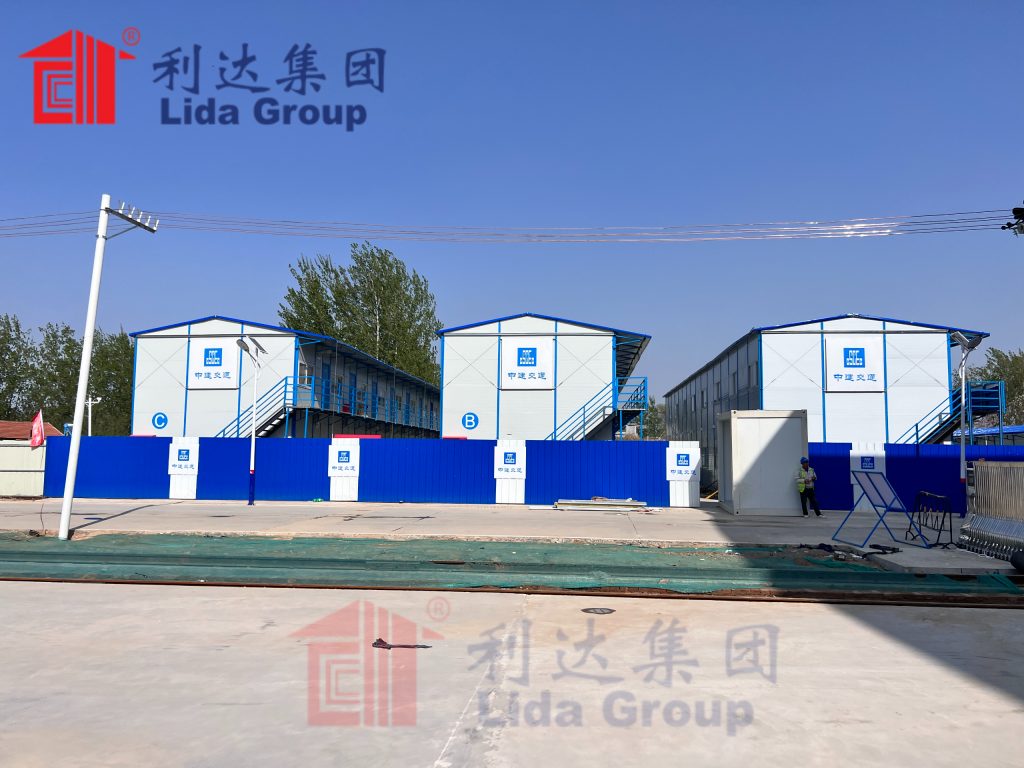
Traditional on-site temporary housing for oilfield workers, including simple canvas tents, crude wooden shanties, and manually assembled low-standard color steel houses, can barely adapt to the extreme environmental conditions and long-term operational needs of oilfield sites. These conventional solutions are plagued by high construction costs, long deployment cycles, poor safety performance, short service life, and inconvenient relocation, resulting in huge resource waste and hidden operational risks for energy enterprises. As a leading global provider of modular prefabricated building solutions, Lida Group has long focused on customized temporary building services for the energy industry. The company’s low-cost temporary building series, specially optimized for oilfield working scenarios, has become the preferred housing solution for numerous oil and gas exploration projects worldwide. This article elaborates on the unique housing challenges of oilfield projects, the core advantages of Lida Group’s low-cost temporary building solutions, key technical and design features of oilfield worker dormitories, practical project delivery value, and long-term economic and safety benefits for energy enterprises.
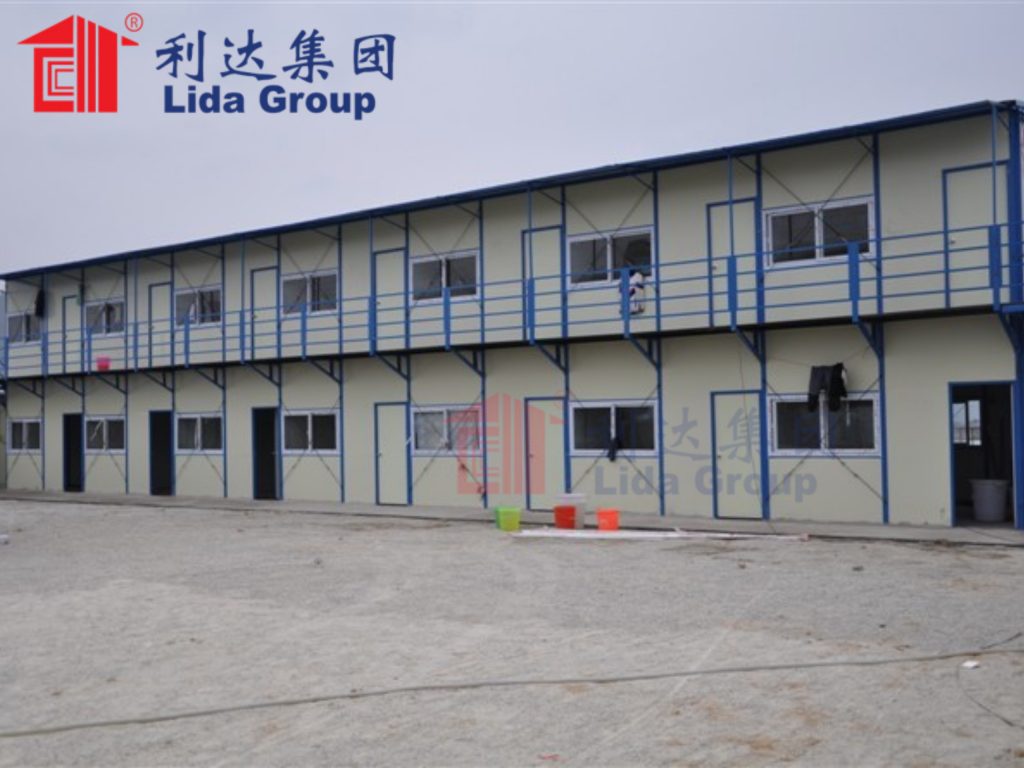
1. Unique Housing Challenges Faced by Oil Field Projects
Oilfield worker accommodation scenarios are vastly different from ordinary construction camps. The special geographical environment, extreme climatic conditions, industrial safety standards, and phased project characteristics put forward higher comprehensive requirements for temporary dormitory buildings. Traditional temporary housing solutions cannot fully adapt to these specialized demands, bringing multiple operational and management challenges to oilfield enterprises.
1.1 Harsh Working Environments and High Safety Risks
Most oilfield sites are located in extreme environments with strong winds, high temperatures, severe cold, sandstorms, and high humidity. Ordinary temporary buildings lack effective wind resistance, heat insulation, dust prevention, and anti-corrosion performance. In desert oilfields, persistent sandstorms easily erode building structures and block indoor ventilation systems; in high-altitude cold regions, ultra-low temperatures cause freezing damage to building components and indoor facilities; in coastal oil exploration zones, high-salinity humid air accelerates structural rust and aging. More importantly, oilfield operation areas belong to flammable and explosive industrial environments with strict fire prevention and explosion-proof standards. Traditional simple temporary houses use low-grade flammable thermal insulation materials, which pose serious fire hazards and fail to meet the industrial safety specifications of oil and gas projects.
1.2 Phased Project Cycles and Low Asset Utilization
Oilfield exploration, drilling, and development projects have obvious phased characteristics, including preliminary site exploration, mid-term large-scale construction, and later maintenance and closure. The number of on-site workers fluctuates dynamically with project progress, and the service cycle of on-site dormitories is temporary and uncertain. Permanent brick-concrete buildings require huge upfront investment and cannot be disassembled and relocated after project completion, resulting in extremely low asset utilization. Disposable simple temporary houses have low construction costs but short service life and poor reusability, requiring repeated investment and reconstruction for subsequent new oilfield projects, which virtually increases the long-term operating costs of enterprises.
1.3 Remote Locations and High On-Site Construction Costs
Oilfield sites are far away from urban areas, with inconvenient transportation, scarce local construction resources, and insufficient professional construction personnel. Traditional on-site built temporary dormitories require a large amount of raw material transportation, mechanical equipment investment, and skilled labor deployment. Long-distance material transportation leads to soaring logistics costs, and the shortage of local workers increases labor expenses and construction cycles. In addition, the lack of mature supporting facilities in remote areas increases the difficulty of on-site construction, making traditional temporary housing construction inefficient and costly.
1.4 Poor Living Conditions and Unstable Workforce
Long-term isolation, harsh working environments, and high-intensity work already bring great physical and psychological pressure to oilfield workers. Traditional crude temporary dormitories have cramped indoor space, poor heat and sound insulation, incomplete supporting facilities, and unsanitary living conditions. The poor accommodation experience easily leads to low worker satisfaction, high turnover rate, and low work efficiency. Frequent personnel replacement not only increases enterprise recruitment and training costs but also affects the continuity and stability of oilfield exploration and construction progress.
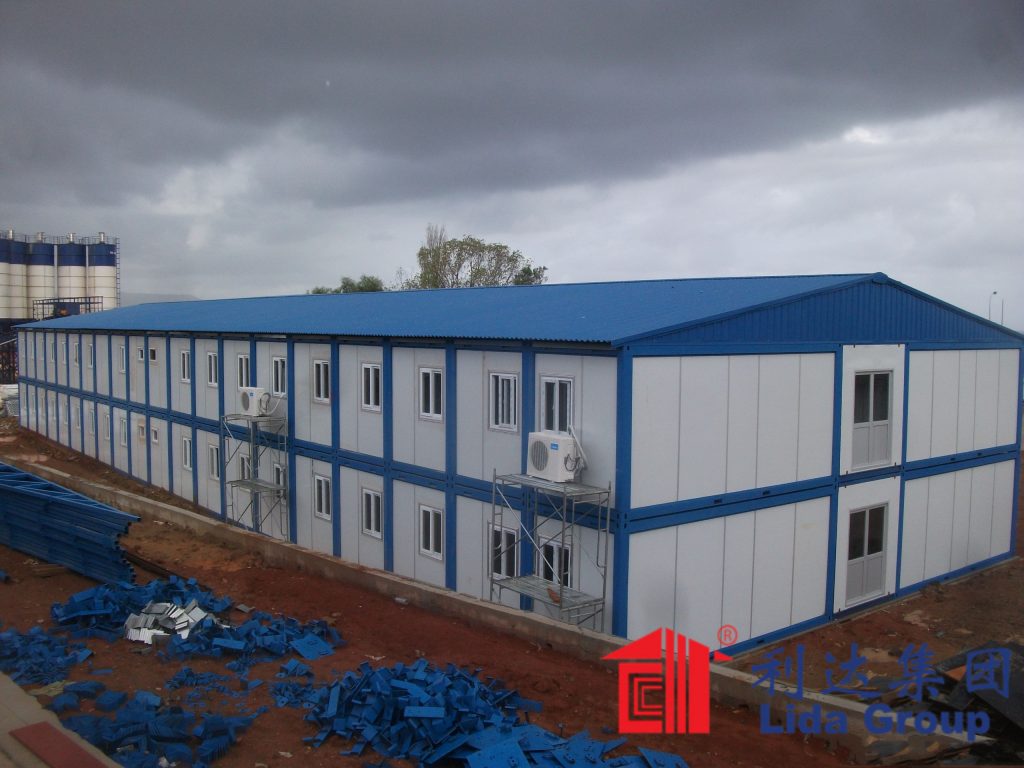
2. Core Advantages of Lida Group’s Low-Cost Temporary Building Solutions for Oilfields
Targeting the multiple pain points of oilfield worker accommodation, Lida Group has upgraded and optimized temporary building solutions exclusively for energy industry scenarios. Breaking the industry dilemma of “low cost with poor quality and high quality with high price”, the company’s low-cost temporary dormitory buildings balance economical investment, safe performance, environmental adaptability, and reusable value, perfectly matching the temporary, phased, and high-safety operational needs of oilfield projects.
2.1 Lean Factory Prefabrication Reduces Overall Project Costs
Different from the high-cost on-site pouring and assembly mode of traditional temporary buildings, Lida Group’s oilfield dormitories adopt full standardized factory prefabrication. All structural frames, wall panels, roof systems, thermal insulation layers, and basic electrical facilities are completed in large-scale intelligent production bases. Batch industrial production greatly reduces unit material costs and avoids raw material waste caused by on-site manual operation. The modular finished product delivery mode eliminates the demand for on-site secondary processing, decoration, and facility installation, saving a large amount of mechanical equipment rental fees, on-site labor costs, and long-distance material transportation expenses. Compared with traditional temporary housing, Lida’s oilfield temporary dormitories reduce the comprehensive upfront investment by more than 35%, achieving true low-cost deployment without sacrificing core safety and performance.
2.2 Rapid On-Site Assembly Adapts to Flexible Project Schedules
Oilfield projects have sudden startup demands and flexible progress adjustments, requiring rapid deployment of supporting accommodation facilities. Lida Group’s temporary oilfield dormitories adopt optimized bolt connection modular structure, realizing tool-free rapid assembly. All components are pre-processed with unified positioning interfaces, and ordinary workers can complete unit assembly, sealing, and debugging without professional welding and cutting equipment. A standard oilfield dormitory unit can be put into use within several hours, and a large-scale worker camp accommodating hundreds of employees can be fully completed in three to five days. The ultra-fast deployment efficiency solves the problem of slow construction of traditional dormitories, ensures timely worker settlement, and guarantees the rapid startup and continuous advancement of oilfield projects.
2.3 High Industrial Safety Performance Meets Oilfield Standards
Safety is the primary indicator of oilfield temporary buildings. Lida Group strictly abides by international oil and gas industry safety specifications and upgrades the fireproof, explosion-proof, wind-resistant, and dust-proof performance of dormitory products. The wall and roof panels adopt high-density non-combustible rock wool thermal insulation materials, which have excellent fire resistance and high-temperature resistance, effectively avoiding fire hazards caused by electrical faults and open flames. The integral high-strength steel frame structure meets international wind resistance and seismic standards, capable of resisting desert sandstorms and coastal strong winds. All electrical systems adopt explosion-proof and leakage-proof configurations suitable for flammable and explosive oilfield environments, eliminating potential safety hazards and fully meeting the special safety access standards of oil and gas exploration projects.
2.4 Reusable Modular Design Improves Long-Term Asset Value
Lida Group’s low-cost oilfield temporary dormitories have a detachable modular structure and ultra-long service life. The main steel structure has a stable service life of more than 15 years and can be disassembled, transported, and reassembled multiple times across different oilfield project sites. After the completion of a single exploration project, the dormitory modules can be flat-packed, stored, and quickly deployed for new oilfield construction tasks, completely avoiding the disposable waste of traditional temporary buildings. The cyclic reusable design greatly improves the turnover efficiency of enterprise fixed assets, eliminates repeated housing investment for each new project, and significantly reduces the long-term comprehensive operational costs of oilfield enterprises.
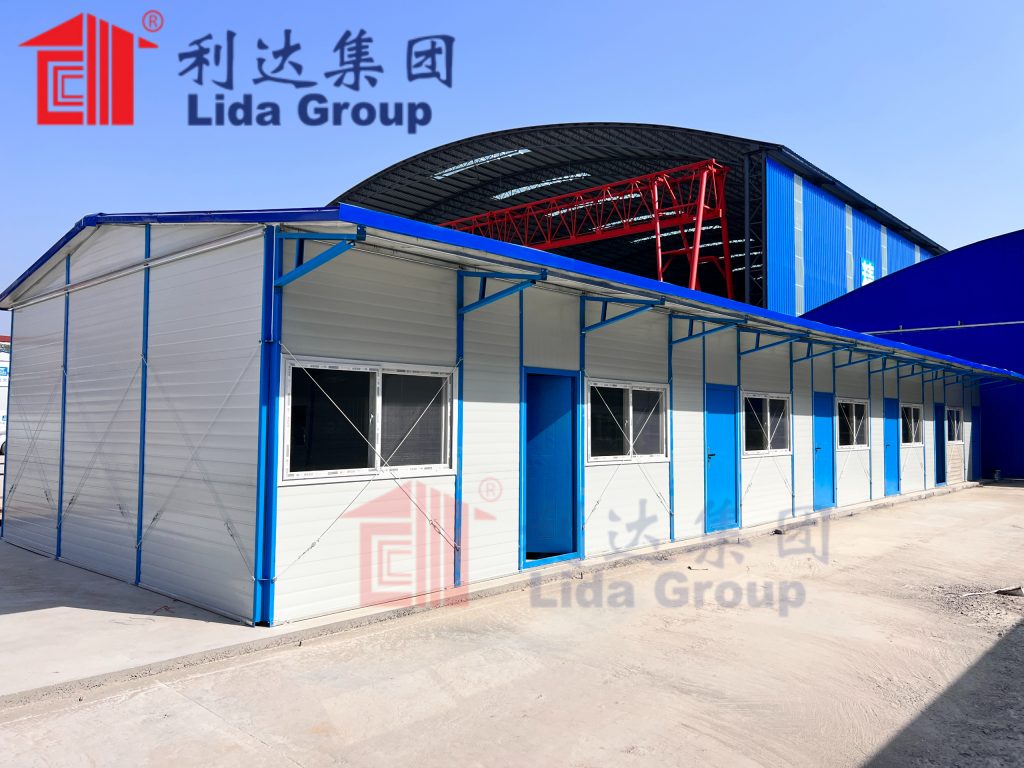
3. Humanized and Scenario-Based Design of Lida’s Oil Field Worker Dormitories
On the premise of ensuring low cost and high safety, Lida Group optimizes the functional design and living configuration of oilfield dormitories according to the long-term remote working characteristics of oilfield workers, creating a safe, comfortable, and standardized temporary living environment that balances cost performance and humanization.
3.1 Extreme Climate Adaptive Design for Oilfield Environments
Aiming at diverse extreme oilfield climates, Lida Group adopts targeted personalized configuration. For high-temperature desert oilfields, the dormitories are equipped with thickened thermal insulation layers, high-efficiency heat dissipation and dust sealing systems to isolate external high temperature and sand and dust, keeping indoor temperature constant and clean. For severe cold high-altitude oilfields, low-temperature resistant materials and enhanced thermal insulation structures are adopted to prevent freezing and heat loss, ensuring warm indoor living environment in winter. For humid coastal oilfields, full waterproof sealing and anti-corrosion treatment are carried out to avoid wall mildew, structural rust, and indoor water accumulation. The all-scenario adaptive design ensures stable and reliable operation of dormitories in various harsh oilfield environments.
3.2 Standardized Functional Configuration for Long-Term Remote Living
Each oilfield dormitory unit is pre-equipped with complete ventilation, lighting, power supply, and noise reduction systems. The indoor space is scientifically planned with reasonable height and activity area, which can flexibly accommodate 2 to 4 workers, matching the staffing standard of oilfield teams. The indoor floor adopts wear-resistant, waterproof, and easy-to-clean materials, adapting to the dusty and dirty working environment of oilfields and facilitating daily sanitation cleaning and management. Meanwhile, the dormitory reserves interfaces for air conditioning, network communication, and water supply and drainage, meeting the daily rest, bathing, entertainment, and communication needs of long-term remote workers, effectively relieving work fatigue and psychological loneliness.
3.3 Integrated Supporting Camp Layout for Standardized Management
Lida Group supports one-stop customized layout of integrated oilfield camps. On the basis of standard dormitory units, it can flexibly match modular offices, meeting rooms, canteens, toilet and shower rooms, storage rooms, and medical observation rooms. All supporting facilities adopt the same low-cost modular temporary building system, with unified specifications and neat layout, forming a fully functional and standardized closed-loop living camp. The integrated camp design facilitates unified personnel management, safety inspection, sanitation supervision, and daily scheduling for oilfield project teams, greatly improving the standardized management level of remote oilfield sites.
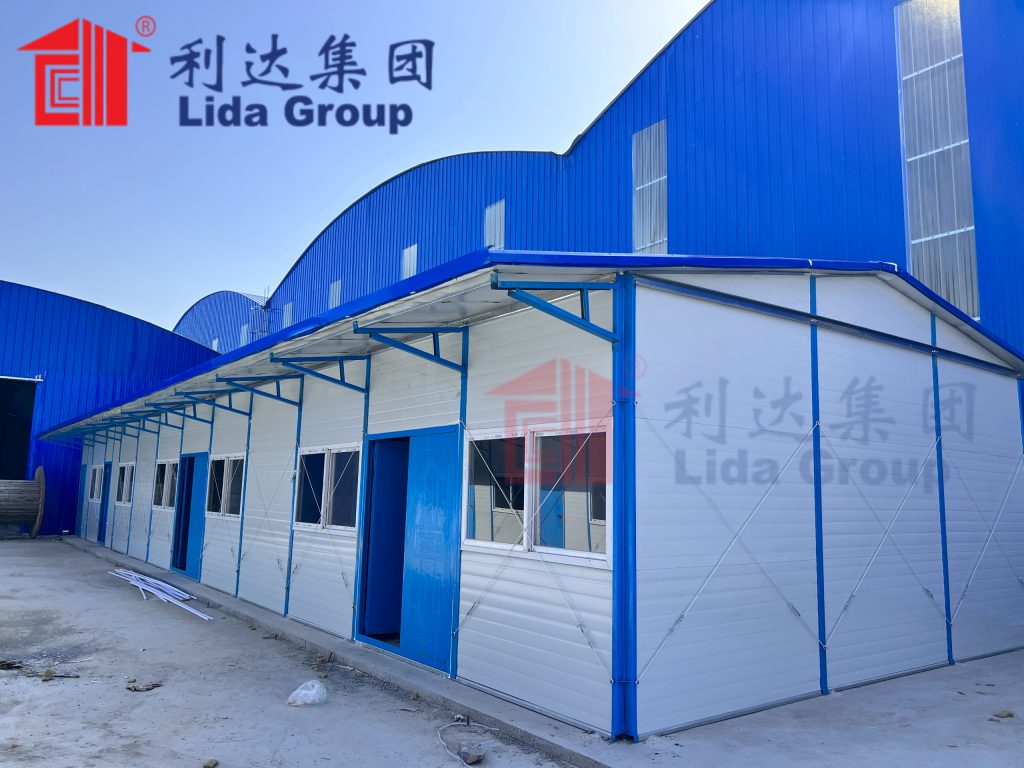
4. Full-Lifecycle Cost Control of Lida’s Temporary Building Solutions
The low-cost advantage of Lida Group’s oilfield dormitories is reflected in the full lifecycle, including upfront deployment cost, mid-term operation and maintenance cost, and later asset turnover cost, realizing comprehensive cost reduction and efficiency improvement for oilfield enterprises.
4.1 Low Upfront Deployment and Logistics Costs
The flat-pack modular structure of Lida’s temporary dormitories greatly reduces transportation volume and logistics costs. Compared with integral container buildings and traditional on-site built houses, flat-packed components save more than 70% of shipping and vehicle transportation space, adapting to narrow remote oilfield roads and limited transportation conditions. Batch factory production reduces unit material costs, and rapid assembly saves labor and mechanical costs. The overall upfront investment is far lower than traditional temporary building solutions, greatly reducing the capital pressure of oilfield project initial construction.
4.2 Ultra-Low Mid-Term Maintenance and Operating Costs
Lida Group’s oilfield-specific temporary buildings adopt high-quality anti-corrosion, anti-aging, and wear-resistant materials, with stable structural performance and low failure rate. In harsh oilfield environments, the dormitories do not require frequent maintenance, component replacement, and structural renovation. The high-efficiency thermal insulation and sealing system reduces the energy consumption of air conditioning and heating, saving daily power and energy costs for enterprises. Compared with traditional temporary houses that require regular maintenance and have high energy consumption, Lida’s products greatly reduce the mid-term operational comprehensive costs.
4.3 Zero Waste Later Asset Turnover
After the project is completed, Lida’s temporary dormitories can be completely disassembled, packaged, and stored without construction waste or asset loss. The reusable modules can be directly put into new oilfield projects or other engineering scenarios, realizing zero repeated investment. The long service life and high reuse rate maximize the residual value of temporary housing assets, completely changing the wasteful model of one-time construction and one-time use of traditional oilfield temporary buildings, and creating long-term economic benefits for enterprises.
5. Practical Application Value for Oilfield Enterprises
Lida Group’s low-cost temporary oilfield dormitory solutions bring multi-dimensional practical value to oil and gas enterprises, covering safety production, team stability, project efficiency, and green construction management.
In terms of safety production, high-standard fireproof, explosion-proof, and wind-resistant performance eliminates potential safety hazards in oilfield living areas, ensuring the personal safety of workers and the stable operation of on-site facilities, and helping enterprises meet industry safety assessment standards. In terms of team management, the humanized comfortable living environment improves worker satisfaction and sense of belonging, effectively reducing personnel turnover rate, stabilizing the construction team, and ensuring the continuous and efficient progress of oilfield exploration and development.
In terms of project efficiency, rapid deployment shortens the camp construction cycle, accelerates project startup progress, and creates more effective working time for oilfield operations. In terms of green and sustainable development, factory prefabrication produces no on-site construction waste, and reusable modular materials reduce resource consumption and environmental damage, meeting the green construction requirements of modern energy projects and helping enterprises establish environmentally friendly corporate images.
6. Conclusion
Oilfield project worker accommodation has long been restricted by harsh environmental conditions, phased project characteristics, and high industry safety standards. Traditional temporary housing solutions are difficult to balance cost control, safety performance, living comfort, and reusable value, resulting in high comprehensive operating costs, potential safety hazards, and unstable team management for oilfield enterprises. As a professional temporary building solution provider for the energy industry, Lida Group accurately grasps the core demands of oilfield camp construction, and delivers high-quality low-cost temporary worker dormitories through standardized factory prefabrication, rapid modular assembly, industry-specific safety optimization, and humanized living design.
Lida Group’s temporary oilfield dormitories effectively solve the pain points of high construction cost, long deployment cycle, poor safety, difficult relocation, and low asset utilization of traditional housing. While achieving significant full-lifecycle cost reduction for enterprises, they provide safe, comfortable, and standardized long-term living conditions for remote oilfield workers, stabilize on-site workforce, and guarantee the efficient and safe operation of oil and gas projects. With outstanding cost performance, extreme environmental adaptability, and reusable sustainable value, Lida Group’s low-cost temporary building solutions have become the most ideal worker accommodation choice for global oilfield and gas exploration projects. In the future, Lida Group will continue to optimize industry customized modular building technologies, create more economical, safer, and more practical temporary housing solutions for the energy industry, and empower the high-quality and sustainable development of global oil and gas engineering construction.
Related news
-
Prefabricated Container Worker Dormitory Offers Fast Assembly and Long Service Life
2026-05-22 17:36:13
-
Lida Group’s Living Container House Ideal for Construction Camps and Emergency Shelter
2026-05-22 17:47:19
-
Flat Packed Modular Container House from Lida Group Saves Shipping and Storage Space
2026-05-22 17:50:17
contact us
- Tel: +86-532-88966982
- Whatsapp: +86-13793209022
- E-mail: sales@lidajituan.com
