



Easy Assembly Sandwich Panel House Speeds Up Oil Gas Field Temporary Worker Housing
2026-Jun-29 17:33:56
By Admin
1. Introduction: The Urgent Demand for Rapid Temporary Housing in Oil and Gas Field Operations
The global oil and gas industry is a core pillar of modern energy supply, undertaking large-scale exploration, drilling, development, and maintenance projects across remote and harsh geographical regions. Most oil and gas field sites are far away from urban residential clusters, complete public infrastructure, and commercial supporting facilities, covering extreme environments such as arid deserts, frigid high-altitude plateaus, windy wilderness, and humid coastal offshore areas. Different from conventional construction projects, oil and gas engineering operations have prominent characteristics of sudden project initiation, phased construction cycles, and floating workforce scales, which put forward extremely urgent and specialized requirements for on-site worker temporary housing.
In oil and gas field projects, the construction team usually enters the site rapidly after project approval, and the number of on-site workers surges in a short period. Whether the temporary worker camp can be completed and put into use quickly directly determines the smooth entry of construction personnel, the stability of the construction team, and the overall progress of the project. Delayed housing deployment will lead to worker accommodation shortages, personnel turnover, and delayed construction schedules, bringing indirect economic losses and operational risks to energy enterprises. Meanwhile, oil and gas fields belong to high-risk flammable and explosive industrial scenarios, requiring temporary housing to have excellent fire resistance, structural stability, and environmental adaptability to cope with extreme weather and complex industrial environments.
For a long time, the oil and gas industry has relied on traditional tents and on-site welded color steel houses to solve temporary accommodation problems. However, these traditional housing modes have obvious drawbacks such as complicated construction procedures, long construction cycles, poor safety performance, and non-reusable structures. They cannot meet the rapid housing deployment needs of modern fast-paced oil and gas projects, and it is difficult to balance construction efficiency, living safety, environmental adaptability, and economic benefits. In the context of the rapid development of the global energy industry and the continuous improvement of project refined management standards, efficient, safe, and fast-deployed temporary housing solutions have become rigid demands for oil and gas field camp construction.
Easy assembly sandwich panel houses have completely changed the construction mode of traditional oilfield temporary housing with their modular prefabrication, tool-free quick assembly, excellent comprehensive performance, and flexible deployment advantages. This type of temporary building realizes rapid camp construction while ensuring industrial-grade safety and comfortable living conditions, effectively solving the pain point of slow housing construction that restricts the progress of oil and gas field projects. This article systematically expounds on the construction efficiency bottlenecks of traditional oilfield temporary housing, the core advantages of easy assembly sandwich panel houses in accelerating housing construction, their practical performance in extreme oilfield environments, diversified application scenarios, and comprehensive project value, fully demonstrating the important role of this advanced modular building solution in empowering efficient operation of oil and gas field projects.
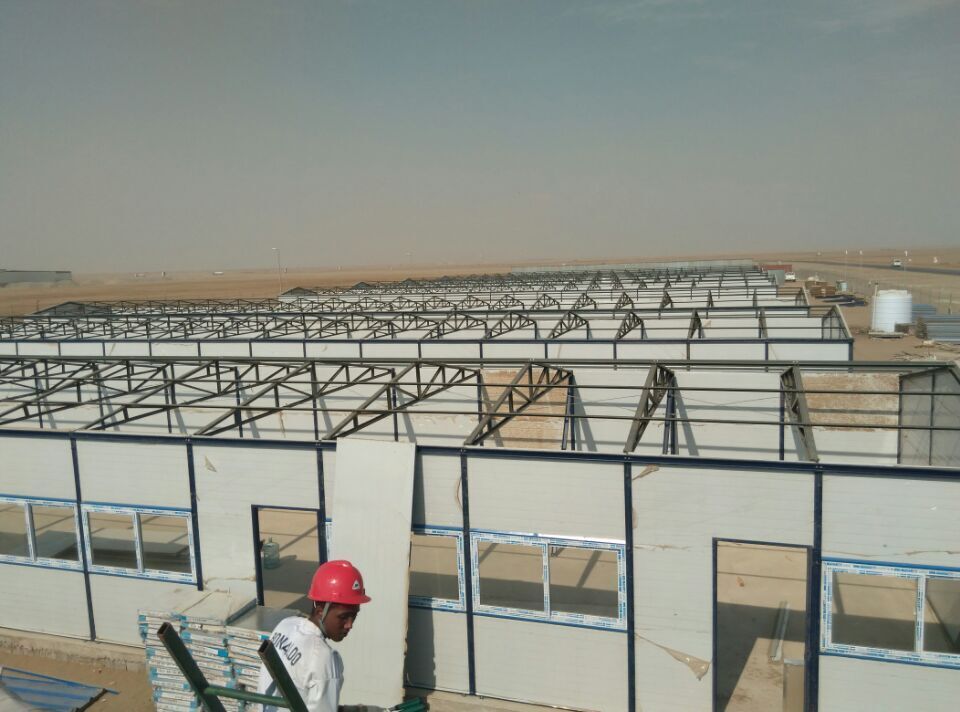
2. Efficiency Bottlenecks of Traditional Oilfield Temporary Worker Housing
Traditional temporary housing solutions, including canvas tents and on-site welded color steel houses, have been used in oil and gas field camps for many years. Limited by backward construction technology and single structural design, these solutions have inherent efficiency bottlenecks and performance defects, which can no longer adapt to the rapid construction rhythm of modern oil and gas projects, becoming an important factor restricting project operational efficiency.
2.1 Cumbersome On-Site Construction Extends Camp Completion Cycle
Traditional color steel temporary houses adopt full on-site cast-in-place and welding construction modes, involving multiple complex and time-consuming processes such as site leveling, foundation pouring, steel frame welding, wall panel installation, waterproof sealing, and interior decoration. The whole construction cycle of a small-scale oilfield camp lasts 20 to 30 days, and large-scale worker camps even require more than one month of construction time. Most oil and gas field sites are located in remote areas with inconvenient transportation and scarce local construction resources. Enterprises need to transport a large number of building materials, mechanical equipment, and professional construction workers across long distances, which not only increases logistics and labor costs but also further delays the construction progress of temporary camps.
Canvas tents can be deployed in a short time, but they are only suitable for ultra-short-term emergency rest and cannot meet the long-term living and office needs of oilfield workers. Tents lack stable structural support, complete closed space, and basic thermal insulation and wind resistance performance, and are easily damaged by extreme field weather, unable to serve as standardized long-term temporary housing for oilfield camps.
2.2 Dependent on Professional Workers and Mechanical Equipment
The construction of traditional welded temporary houses requires professional welders, electricians, and decoration workers, as well as supporting mechanical equipment such as cranes and welding machines. The high dependence on professional personnel and equipment makes camp construction easily restricted by external conditions. In remote oilfield areas with backward infrastructure, it is difficult to recruit sufficient professional construction teams and lease mechanical equipment, resulting in slow construction progress and uncontrollable construction quality. Once the construction team is insufficient or equipment fails, the camp construction cycle will be further prolonged, affecting the synchronous progress of worker entry and project construction.
2.3 Disposable Structure Leads to Repeated Construction Delays
Traditional temporary houses adopt fixed welding integrated structures, which are non-detachable and non-reusable. After the completion of phased oilfield projects, the camps can only be demolished and discarded. When new oilfield exploration and development projects are launched, enterprises need to restart all construction procedures from scratch. Repeated construction not only causes serious resource waste and cost increase but also leads to repeated delays in camp construction, seriously restricting the continuous and efficient operation of oil and gas field engineering projects.
2.4 Low Construction Quality Restricts Long-Term Stable Use
Affected by on-site environment, manual operation differences, and limited construction conditions, the construction quality of traditional temporary houses is unstable. Problems such as uneven wall assembly, poor waterproof sealing, irregular electrical wiring, and unqualified fireproof performance frequently occur. These quality problems lead to frequent maintenance and renovation of the camp in the later stage, which not only consumes additional manpower and material resources but also affects the normal living and office use of workers, resulting in low overall operational efficiency of the camp.
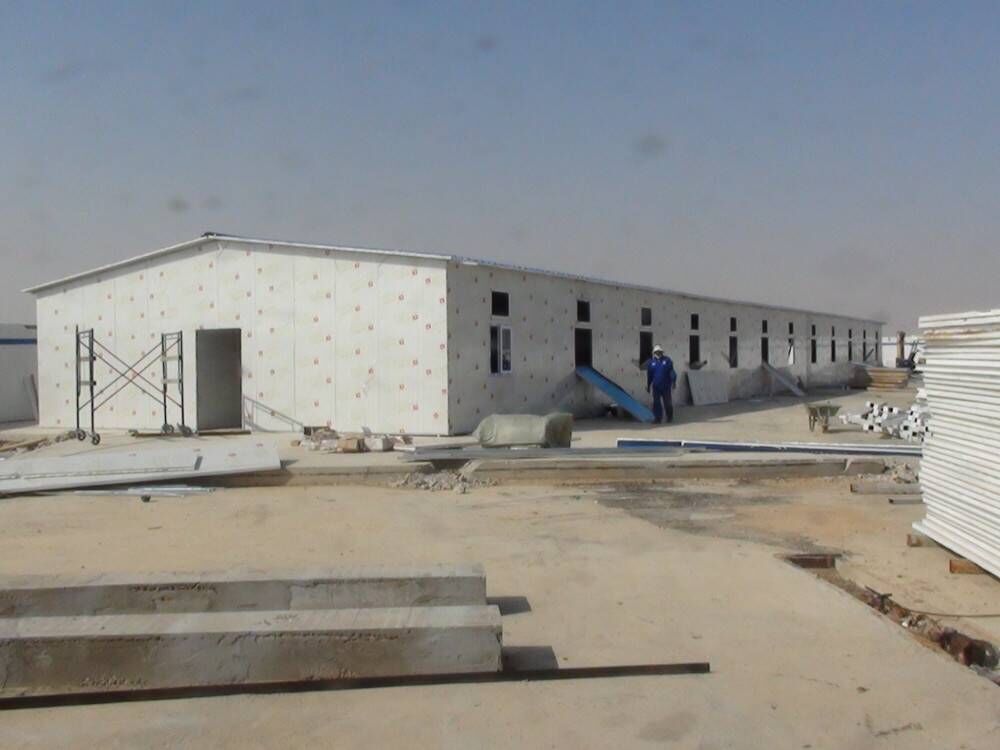
3. Core Advantages of Easy Assembly Sandwich Panel Houses in Accelerating Oilfield Housing
Easy assembly sandwich panel houses are new-type modular prefabricated buildings specially optimized for temporary engineering scenarios. Adopting factory integral prefabrication and on-site bolted assembly design, they completely abandon the cumbersome on-site welding and pouring process of traditional temporary houses, realizing qualitative leaps in construction efficiency, deployment speed, and operational flexibility. While greatly shortening the construction cycle of oilfield temporary housing, they maintain high-standard safety, comfort, and environmental adaptability, perfectly solving the efficiency pain points of traditional oilfield camp construction.
3.1 95% Factory Prefabrication Realizes Zero On-Site Secondary Processing
All core components of easy assembly sandwich panel houses, including high-strength steel frames, fireproof sandwich wall panels, waterproof roof panels, door and window accessories, and internal electrical and water pipeline systems, are fully prefabricated and assembled in standardized factories. The factory completes fine processing, quality inspection, and overall matching of all components, realizing finished product delivery. After the products are transported to the oilfield site, there is no need for on-site cutting, welding, painting, concrete pouring, and secondary decoration, completely eliminating the time-consuming and error-prone on-site processing links of traditional construction.
This factory integrated production mode centralizes complex production processes in a standardized workshop environment, which not only ensures stable and consistent product quality but also greatly compresses the on-site construction cycle, laying a solid foundation for the rapid completion of oilfield temporary housing camps.
3.2 Tool-Free Bolted Assembly Improves On-Site Construction Efficiency
The biggest efficiency advantage of easy assembly sandwich panel houses lies in their simple and fast on-site assembly mode. All components are designed with unified standard interfaces and supporting bolt connections, realizing pure manual dry assembly without professional construction skills and large mechanical equipment. Ordinary workers can quickly master the assembly method after simple training, effectively solving the problem of dependence on professional construction teams in remote oilfield areas.
In actual oilfield construction scenarios, a single standard worker dormitory unit can be fully assembled and put into use within 3 to 4 hours by 2 to 3 workers. A medium-sized oilfield camp with dozens of dormitory units, offices, and supporting functional rooms can be completely built and meet the occupancy conditions within 3 to 5 days. Compared with the 20 to 30-day construction cycle of traditional temporary houses, the construction efficiency is increased by more than 6 times, which can fully meet the urgent housing needs of rapid worker entry after oilfield project initiation.
3.3 Low Foundation Requirements Adapt to Rapid Site Layout
Oil and gas field sites are mostly located in complex terrain such as wilderness, desert, and beach, with uneven ground and poor foundation conditions. Traditional temporary house construction needs to carry out foundation leveling, concrete hardening, and slope treatment, which takes a lot of time and manpower. Easy assembly sandwich panel houses have lightweight overall structure and low bearing requirements for the foundation, and only need simple ground leveling to complete the layout and assembly, without complex foundation construction procedures. This advantage greatly simplifies the site preparation process, further shortens the camp construction preparation cycle, and realizes rapid layout and rapid occupancy of temporary housing in complex oilfield terrains.
3.4 Detachable and Reusable Design Supports Rapid Project Iteration
Different from the disposable fixed structure of traditional temporary houses, easy assembly sandwich panel houses adopt fully detachable modular design. All components are connected by independent standard bolts, which can be quickly disassembled, sorted, flat-packed, and transported after the completion of oilfield phased projects. The disassembled components have low damage rate and high integrity, with a reuse rate of more than 90%, and can be directly reused in new oilfield project camps.
This cyclic reusable mode avoids repeated design, material procurement, and on-site construction of traditional camps, realizes rapid reconstruction and deployment of temporary housing in new projects, greatly improves the iteration efficiency of oilfield project camps, and effectively solves the problem of repeated construction delays in multi-project continuous operation of energy enterprises.

4. Reliable Comprehensive Performance While Ensuring Rapid Construction
While achieving ultra-high construction efficiency, easy assembly sandwich panel houses do not sacrifice product safety, comfort, and durability. Relying on high-performance sandwich materials and optimized structural design, they have excellent fire resistance, wind and earthquake resistance, thermal insulation, and anti-corrosion performance, which can fully adapt to extreme oilfield environments and high-risk industrial scenarios, ensuring that rapid housing construction is based on high-standard quality and safety.
4.1 A-Level Fireproof Performance Adapts to High-Risk Oilfield Scenarios
Aiming at the flammable and explosive characteristics of oil and gas fields, the sandwich panel core material of the house adopts high-quality rock wool or glass wool fireproof material, reaching international A-level non-combustible fire protection standard. The material has high temperature resistance and flame retardant properties, will not burn or release toxic smoke when encountering open fire or electrical short circuit, and can effectively block fire spread. Compared with the flammable foam core material of traditional temporary houses, it completely eliminates camp fire hazards caused by building materials. The standardized embedded electrical wiring and complete leakage protection system further ensure the electrical safety of the camp, meeting the strict safety production specifications of oil and gas fields.
4.2 Excellent Weather Resistance Copes with Extreme Field Environments
The composite sandwich structure integrates thermal insulation, heat insulation, sound insulation, anti-corrosion, and waterproof functions, with strong all-weather environmental adaptability. The high-efficiency thermal insulation layer can effectively isolate external extreme temperature changes, keep indoor temperature constant in high-temperature deserts and ultra-low-temperature plateaus, and solve the problems of stuffy heat in summer and freezing cold in winter in traditional temporary houses. The outer wall adopts anti-corrosion color steel plate with special coating treatment, which can resist long-term wind and sand erosion, coastal salt spray corrosion, and ultraviolet aging, with stable structural performance and long service life, fully adapting to the complex and harsh climatic conditions of global oil and gas fields.
4.3 Humanized Design Guarantees Workers’ Living Comfort
The house adopts scientific spatial layout and humanized functional design, with reasonable storey height and indoor activity space, avoiding the cramped and depressing space of traditional temporary housing. Large-size lighting windows and cross-ventilation systems ensure sufficient natural light and fresh indoor air. The multi-layer sound insulation structure can effectively isolate external field operation noise and wind and sand noise, creating a quiet and comfortable rest environment. At the same time, it can be flexibly equipped with independent storage lockers, constant-temperature water supply systems, and clean ventilation facilities, effectively improving the living quality of field workers and stabilizing the on-site construction team.
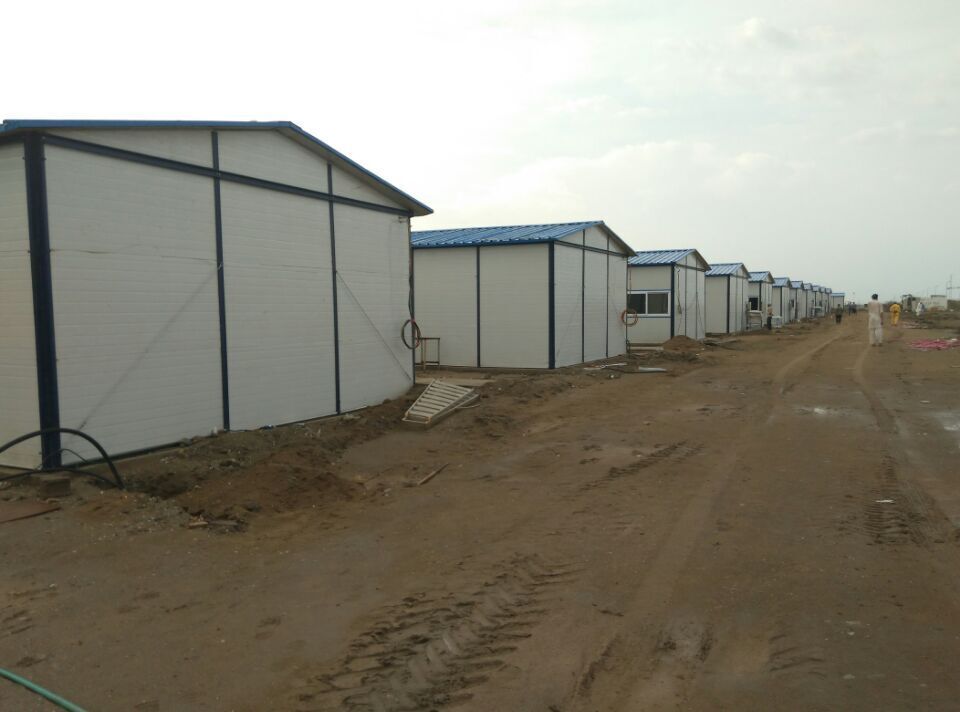
5. Diversified Application Scenarios for Accelerating Oilfield Housing Deployment
With the dual advantages of ultra-fast assembly efficiency and reliable comprehensive performance, easy assembly sandwich panel houses can flexibly adapt to various oil and gas field project types, covering short-term emergency exploration, long-term large-scale development, and remote emergency operation scenarios, and efficiently solve the temporary housing problems of different oilfield projects.
5.1 Short-Term Exploration and Drilling Emergency Camps
For short-cycle oilfield geological exploration, temporary drilling, and field investigation projects, the rapid assembly advantage of sandwich panel houses is fully exerted. The lightweight modular units can be quickly deployed in remote field areas to build temporary dormitories, offices, and material storage rooms, meeting the short-term housing needs of mobile exploration teams. After the completion of the exploration task, the houses can be quickly disassembled and transferred, realizing zero-delay withdrawal and zero-waste reuse, and greatly improving the operational efficiency of short-term emergency projects.
5.2 Long-Term Large-Scale Oilfield Comprehensive Camps
For large-scale oil and gas field development projects with long construction cycles and large workforce, sandwich panel houses can be horizontally spliced and multi-layer stacked to build standardized comprehensive camps. The efficient batch assembly mode can complete the construction of large-scale camp groups in a short time, meeting the centralized housing needs of hundreds of field workers. The stable structural performance and durable environmental adaptability support long-term continuous operation of the camp, realizing rapid construction and long-term stable use of large-scale oilfield camps.
5.3 Remote Emergency Maintenance and Rescue Camps
In sudden oilfield equipment failure, accident rescue, and emergency repair tasks, time is extremely precious. Easy assembly sandwich panel houses can be rapidly transported and assembled in remote barren areas to build emergency temporary camps in a short time, providing timely rest and logistical support for emergency operation teams. The fast deployment capability effectively shortens the emergency response cycle of oilfield projects and ensures the efficient progress of emergency maintenance and rescue work.
6. Comprehensive Project Value of Efficient Temporary Housing Solutions
The application of easy assembly sandwich panel houses greatly optimizes the camp construction mode of oil and gas field projects, bringing multi-dimensional value improvement for energy enterprises in project progress control, cost management, safety production, and team stability.
In terms of project progress, the ultra-fast assembly efficiency completely solves the problem of lagging temporary housing construction, realizes synchronous entry of workers and synchronous progress of main engineering projects, effectively avoids project delay losses caused by insufficient accommodation conditions, and significantly improves the overall construction efficiency of oil and gas projects.
In terms of cost control, factory prefabrication reduces on-site labor and mechanical equipment investment, and rapid assembly shortens the project preparation cycle. The reusable design avoids repeated construction investment and construction waste disposal costs, greatly reducing the full-life-cycle operating cost of oilfield camps and improving the economic benefits of projects.
In terms of safety production, high-standard fireproof, wind-resistant, and anti-corrosion performance eliminates various potential safety hazards of traditional temporary camps, meets the industrial safety specifications of oil and gas fields, and ensures the safe and stable operation of on-site camps.
In terms of team management, the rapid completion of comfortable and standardized living camps improves workers’ rest quality and job satisfaction, reduces workforce turnover rate, stabilizes the on-site construction team, and provides stable human resource guarantee for the sustainable development of oil and gas field projects.
In terms of green development, the full dry construction mode produces no construction dust, sewage, and waste, and the recyclable materials conform to the low-carbon and green development trend of the global energy industry, helping energy enterprises build environmentally friendly and standardized field projects.
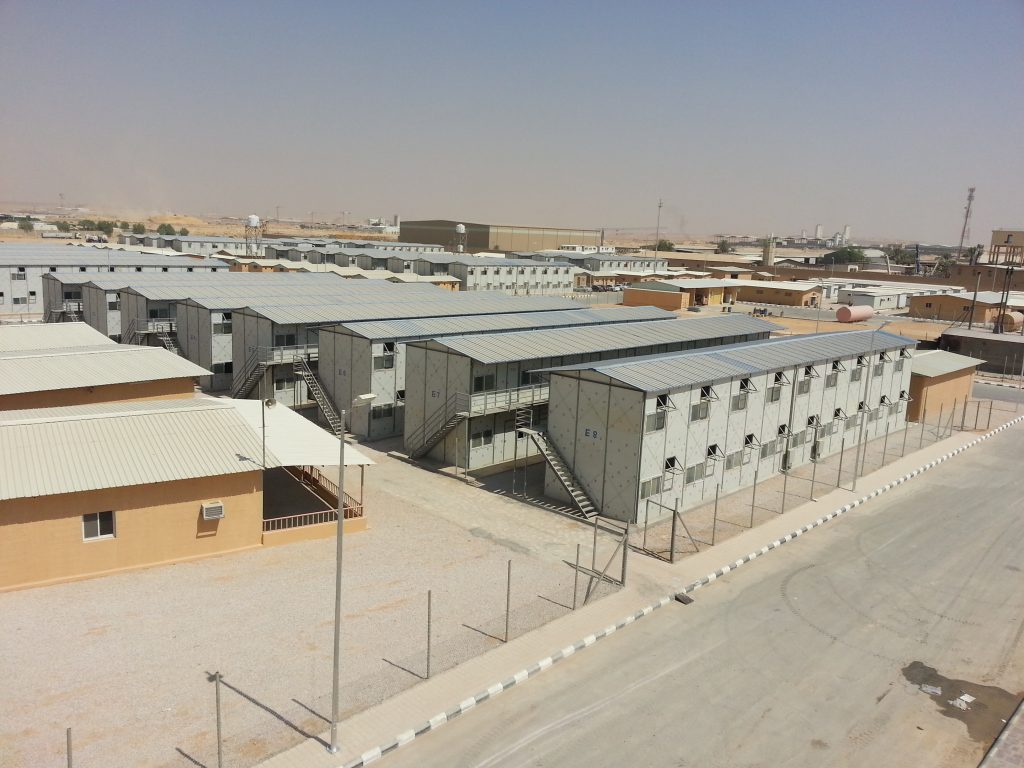
7. Conclusion
Temporary worker housing is an indispensable logistical support guarantee for the construction and operation of oil and gas field projects, and the construction speed and quality of temporary camps directly affect the project progress, safety production, and team stability. Traditional tents and welded color steel houses have long restricted the efficient operation of modern oilfield projects due to their long construction cycle, cumbersome operation, poor safety performance, and non-reusable defects, which cannot meet the fast-paced construction needs of the energy industry.
Easy assembly sandwich panel houses perfectly solve the efficiency bottleneck of traditional oilfield temporary housing with factory prefabrication, tool-free bolted quick assembly, low foundation requirements, and detachable reusable advantages. They greatly shorten the construction cycle of oilfield worker camps, realize rapid deployment and rapid occupancy of temporary housing in various complex and extreme field environments. At the same time, relying on industrial-grade fireproof safety, excellent extreme weather adaptability, and humanized comfortable design, they ensure high-quality and safe living conditions while improving construction efficiency, realizing the organic unity of high efficiency, safety, comfort, and economy.
In the context of the rapid development of the global oil and gas industry and the continuous improvement of project refined management standards, efficient and reusable modular temporary housing will become the mainstream choice for oilfield camp construction. Easy assembly sandwich panel houses not only provide reliable rapid housing solutions for various oil and gas field projects but also promote the upgrading and innovation of the temporary construction mode of the energy industry. In the future, with the continuous optimization of material performance and assembly technology, this efficient temporary housing solution will further empower the efficient, safe, and green development of global oil and gas field engineering projects.
Related news
-
Lida Group Delivers Easy Assembly Sandwich Panel House for Oil Gas Field Worker Camps
2026-06-29 17:21:00
-
Easy Assembly Sandwich Panel House Ideal for Oil Gas Field Worker Temporary Accommodation
2026-06-29 17:12:16
-
Lida Group Provides Oil Gas Field Worker Accommodation with Temporary Construction Solutions
2026-06-29 17:02:51
contact us
- Tel: +86-532-88966982
- Whatsapp: +86-13793209022
- E-mail: sales@lidajituan.com
