



Sustainable Prefabricated Container House and Prefab Dormitory Solutions from Lida Group
2026-Jun-10 15:41:17
By Admin
1. Introduction
The global construction industry is undergoing a profound green transformation driven by dual-carbon goals, environmental protection policies, and sustainable development strategies worldwide. Traditional on-site construction modes have long been criticized for high resource consumption, massive construction waste, high carbon emissions, and severe environmental disturbance. According to global construction industry data, traditional building construction accounts for nearly 40% of global material consumption and 30% of total carbon emissions, becoming a key field restricting global ecological low-carbon development. In particular, temporary construction camps, staff dormitories, and outdoor supporting facilities, which are essential auxiliary parts of engineering projects, have long adopted disposable construction modes, resulting in frequent building demolition, massive waste accumulation, and repeated resource investment, forming an unsustainable development cycle.
Against this green industry background, sustainable prefabricated modular buildings have become the mainstream development direction of the global construction industry. As a world-leading professional manufacturer and solution provider of modular prefabricated buildings, Lida Grouphas long taken green, low-carbon, and circular development as its core product research and development concept. Focusing on the pain points of high energy consumption, high waste, and low reusability of traditional temporary buildings, Lida Group has independently developed a full set of sustainable prefabricated container houses and prefab dormitory solutions. Breaking the disposable and high-pollution limitations of traditional temporary facilities, these products realize green upgrades covering factory production, on-site deployment, long-term operation, and cyclic reuse, achieving organic unity of environmental benefits, economic value, and social value. This article comprehensively analyzes the design concept, core sustainable advantages, technical support, diversified application scenarios, and industrial significance of Lida Group’s sustainable prefabricated container and dormitory solutions.
2. Sustainability Pain Points of Traditional Temporary Construction Facilities
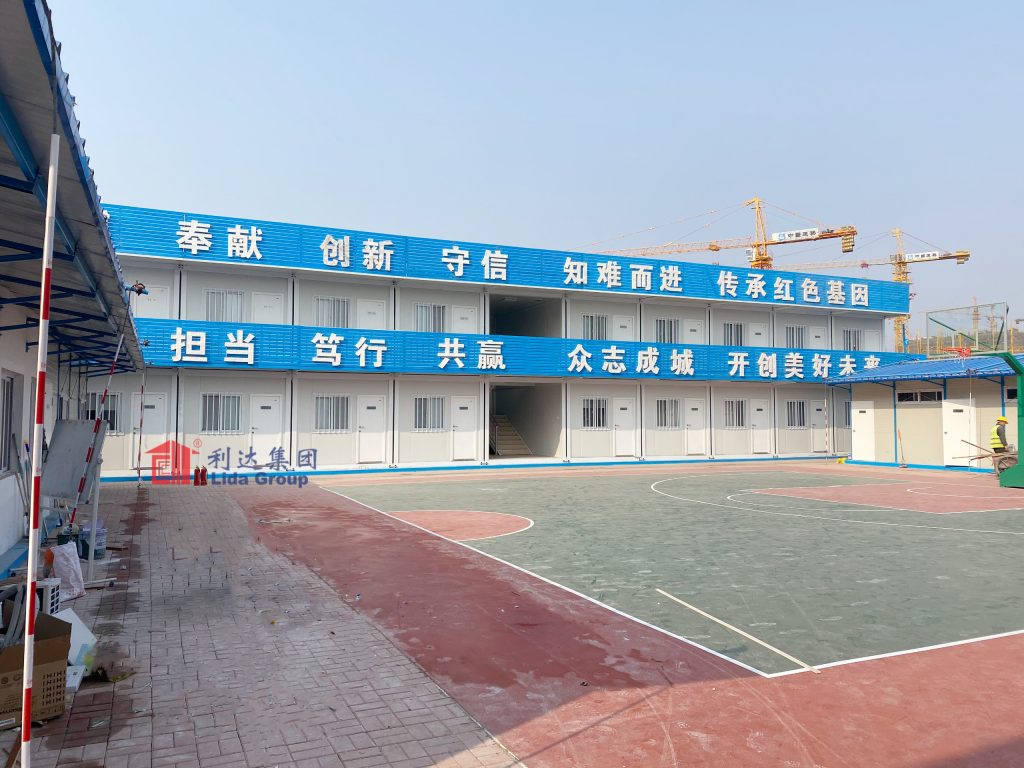
Traditional temporary container houses and on-site dormitories widely used in global engineering projects have prominent unsustainable problems in the whole life cycle, which are inconsistent with the current global green construction and low-carbon development trends and bring multiple negative impacts on project operation and ecological environment.
First, high resource waste and low material utilization rate. Traditional temporary masonry houses and simple color steel dormitories adopt disposable design and cannot be disassembled and reused after project completion. A large number of construction materials such as bricks, cement, and color steel plates are directly abandoned, generating tons of construction waste for each project. Ordinary low-quality container houses use non-recyclable composite materials and inferior steel structures, which are prone to deformation and aging after single use, resulting in extremely low material recycling rate and serious resource waste.
Second, high carbon emissions in the whole construction cycle. Traditional temporary buildings rely entirely on on-site pouring, masonry, and welding construction. A large number of mechanical equipment operations, material transportation, and on-site manual construction produce massive carbon emissions, dust, and noise pollution. In addition, traditional dormitories have poor thermal insulation and energy-saving performance, requiring long-term high-power operation of air conditioning and heating equipment during use, resulting in high daily energy consumption and indirect carbon emission increase.
Third, serious environmental disturbance and poor ecological compatibility. On-site construction of traditional temporary facilities will damage the original site vegetation and terrain, and the construction waste generated is difficult to degrade, causing long-term impact on the regional ecological environment. Most traditional temporary buildings lack professional environmental protection design, and domestic sewage and garbage generated during operation cannot be effectively treated, easily causing environmental pollution to remote construction sites and outdoor camps.
Fourth, high comprehensive cost and low sustainable benefit. Although the one-time investment of traditional temporary buildings is low, the repeated construction, frequent maintenance, and waste disposal costs in the later stage are extremely high. The disposable use mode leads to repeated investment of engineering enterprises, with poor long-term economic benefits and no sustainable development value, which cannot meet the ESG assessment standards of modern international engineering projects.
3. Core Sustainable Design Concepts of Lida Group’s Prefab Solutions
Lida Group’s sustainable prefabricated container houses and prefab dormitories take “low-carbon production, energy-saving operation, cyclic reuse, and zero environmental pollution” as the core design concepts, realizing comprehensive optimization of the whole life cycle from raw material selection, factory production, on-site deployment, daily operation to final recycling, and building a closed-loop sustainable development system for modular buildings.
In terms of raw material selection, all products prioritize high recyclability, low-carbon, and environmentally friendly new materials. The main load-bearing structure adopts high-quality hot-dip galvanized recycled steel, which has the characteristics of low carbon emission in production, high structural stability, and 100% recyclable recycling. The wall and thermal insulation materials use A1-level fire-proof and environmentally friendly inorganic materials, which do not contain harmful substances, have no volatile pollutants, and can be completely recycled and reused after disassembly. All decorative materials meet international environmental protection standards, realizing zero formaldehyde and zero pollution, ensuring both ecological safety and indoor living health.
In terms of production mode, Lida Group adopts intelligent factory centralized prefabrication to replace traditional extensive on-site construction. The standardized and precise industrial production mode greatly improves material utilization rate, reduces leftover materials and production waste, and realizes 98% recycling of production scrap materials. The fully enclosed factory production environment avoids dust and noise pollution caused by on-site construction, effectively reducing production carbon emissions and environmental disturbance.
In terms of operation and recycling, the product adheres to the design concept of modular assembly and cyclic reuse. The bolted splicing structure realizes zero-damage disassembly and repeated relocation, supporting cross-project and cross-region cyclic use. After the end of the product’s service life, all steel structures and core components can be recycled and remanufactured, realizing zero construction waste discharge in the whole life cycle.
4. Full-Life-Cycle Low-Carbon and Environmental Protection Advantages
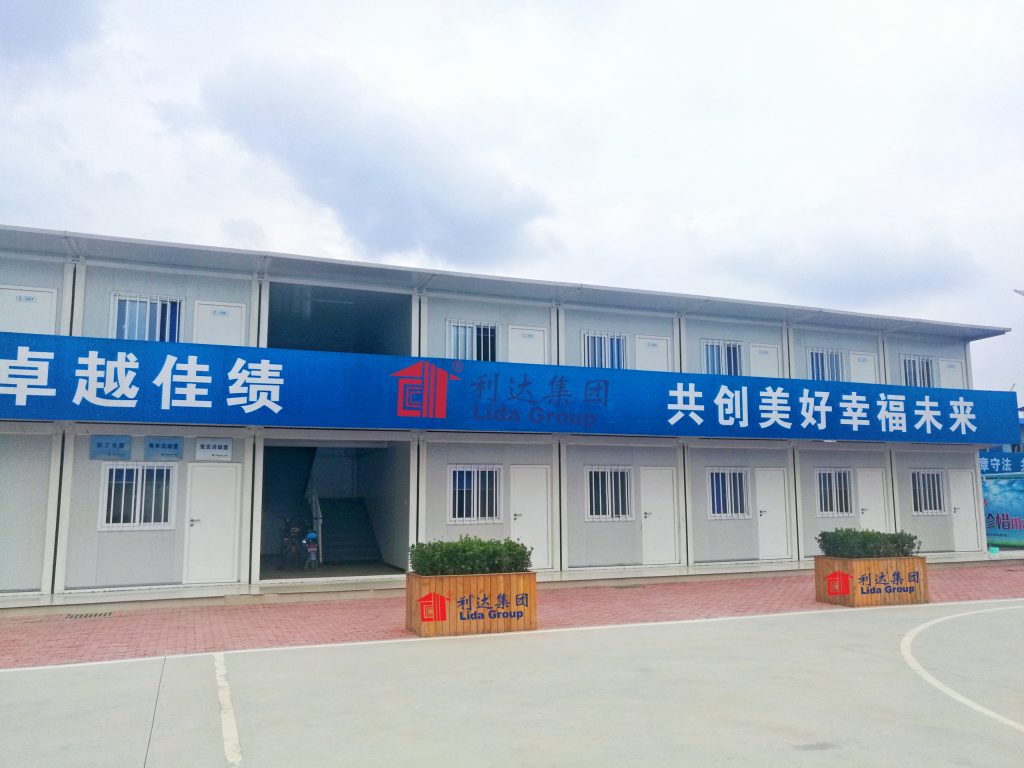
Different from traditional temporary buildings that only focus on basic use functions, Lida Group’s sustainable prefab container and dormitory solutions realize all-round green upgrades in production, deployment, operation, and recycling, with prominent low-carbon environmental protection advantages.
4.1 Low-Carbon Industrial Production Reduces Manufacturing Emissions
Traditional building production and on-site construction produce a large amount of carbon emissions and material waste, while Lida Group’s industrial prefabrication mode greatly reduces the carbon footprint of the construction link. Through automated cutting, precise assembly, and standardized production management in intelligent factories, the material utilization rate is increased to more than 95%, which reduces material waste by more than 60% compared with traditional on-site construction. The centralized production mode avoids repeated transportation of scattered materials on the construction site, cutting transportation carbon emissions by nearly 40%.
Up to now, Lida Group’s sustainable prefab products have helped global projects reduce more than 120,000 tons of carbon emissions, equivalent to the carbon sequestration capacity of 3.1 million mature trees. The large-scale application of recycled steel materials has saved more than 80,000 tons of new steel production, effectively reducing the carbon emissions generated by steel smelting and raw material exploitation, and making important contributions to global industrial carbon reduction.
4.2 Zero-Pollution On-Site Deployment Protects Ecological Environment
Lida Group’s prefabricated container houses and dormitories complete nearly all production processes in the factory, and only simple hoisting, positioning, and splicing operations are required on the construction site. The whole on-site deployment process is dry operation, without concrete pouring, brick masonry, and paint construction, producing no construction waste, dust, or chemical pollution.
The product’s foundation-free installation design avoids large-scale site leveling and foundation excavation, protecting the original terrain and vegetation of the construction site. After the project is completed, the site can be completely restored to its original state without ecological damage, realizing zero disturbance to the regional ecological environment. This green deployment mode is especially suitable for ecological protection zones, mountainous scenic areas, and remote environmentally sensitive engineering projects, perfectly balancing project construction and ecological protection.
4.3 High-Efficiency Energy Saving Reduces Operational Carbon Emissions
To solve the problem of high energy consumption in daily operation of traditional temporary dormitories, Lida Group optimizes the product’s energy-saving structure in an all-round way. The high-density composite thermal insulation wall panels and fully sealed waterproof and heat preservation structure form an efficient constant temperature system, which can effectively isolate external high temperature and cold air, reducing the operating time and energy consumption of air conditioning and heating equipment. Compared with ordinary temporary buildings, the product reduces daily energy consumption by more than 35%, greatly lowering long-term operational carbon emissions.
At the same time, the product supports the integrated installation of green energy-saving systems such as solar power generation and rainwater collection and purification. The solar power system can provide clean electricity for indoor lighting, office, and daily life, realizing self-sufficient green energy supply; the rainwater collection system realizes secondary utilization of water resources, saving a large amount of domestic water. The intelligent energy-saving control system can automatically adjust indoor temperature and lighting according to the environment, further improving energy utilization efficiency and realizing low-carbon and energy-saving operation of the camp.
4.4 Circular Reuse Realizes Zero Waste Life Cycle
The biggest core advantage of Lida Group’s sustainable prefab solutions is the full closed-loop circular utilization system. The high-strength hot-dip galvanized steel structure has an ultra-long service life of more than 20 years and can withstand multiple disassembly, transportation, and reassembly without structural performance attenuation. A single set of container houses and prefab dormitories can be reused for more than 10 engineering projects, completely changing the disposable use mode of traditional temporary buildings.
After long-term cyclic use, the scrapped product components can be 100% recycled and remanufactured. The steel structure is recycled and returned to the factory for secondary processing, and non-metallic environmental protection materials are uniformly recycled and reused, with a comprehensive material recycling rate of more than 95%. The whole life cycle realizes zero construction waste discharge, effectively solving the problem of construction waste accumulation in the temporary building industry and creating a circular economic model of “production-use-recycling-remanufacturing”.
5. Humanized Sustainable Design of Prefab Dormitory Solutions
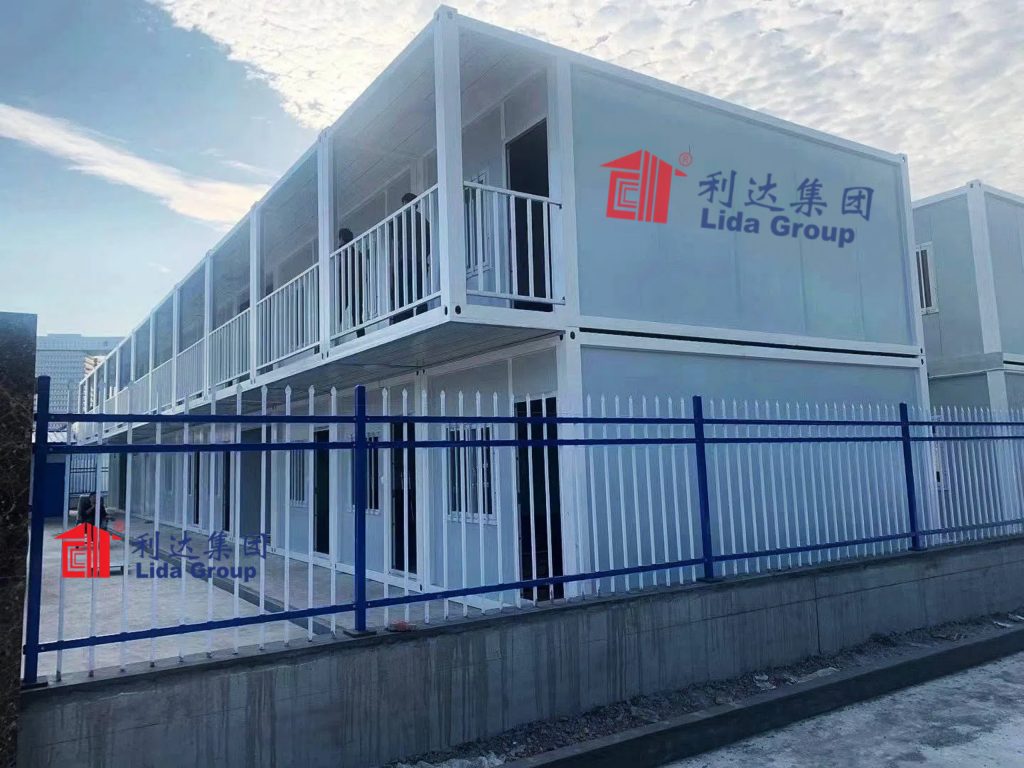
While realizing ecological sustainability, Lida Group’s prefab dormitory solutions also take humanistic sustainability as an important design goal, balancing green environmental protection and healthy living, and creating a high-quality, low-carbon, and comfortable living environment for on-site workers.
In terms of healthy living environment, all dormitory interior materials are non-toxic, harmless, and environmentally friendly, with no volatile harmful gases, avoiding indoor air pollution common in traditional temporary dormitories. The scientific ventilation and lighting design ensures sufficient natural light and fresh air circulation indoors, improving indoor air quality and effectively protecting the physical and mental health of residents. The professional sound insulation and noise reduction structure isolates outdoor construction noise and wind noise, creating a quiet and comfortable rest space.
In terms of sustainable functional configuration, the dormitory adopts modular flexible layout, which can freely adjust the indoor space and functional partitions according to the number of residents and usage needs. The pre-installed energy-saving lighting, low-power electrical equipment, and water-saving sanitary facilities effectively reduce daily energy and water consumption. The standardized public area design realizes centralized resource utilization, avoiding energy waste caused by scattered layout, and further improving the overall sustainability of the dormitory camp.
In terms of long-term use value, the durable and anti-aging design of the dormitory avoids frequent maintenance and component replacement, reducing resource consumption and environmental pollution caused by maintenance work. The stable and comfortable living environment reduces worker turnover, stabilizes the project workforce, and creates sustainable social value for engineering construction.
6. Diversified Sustainable Application Scenarios
Relying on excellent low-carbon environmental protection performance and cyclic reuse value, Lida Group’s sustainable prefabricated container houses and prefab dormitory solutions have been widely applied in multiple global scenarios, providing green and sustainable supporting facilities for various industries.
In infrastructure engineering camps such as highways, railways, and water conservancy, the green deployment mode avoids ecological damage in construction areas, and the cyclic reuse performance reduces repeated construction investment and construction waste. It fully meets the green construction assessment standards of large-scale infrastructure projects and helps enterprises complete ESG certification.
In remote mining and energy development projects, the energy-saving and low-emission design reduces the daily energy consumption and carbon footprint of remote camps. The zero-pollution operation mode avoids environmental pollution in ecologically fragile remote areas, realizing coordinated development of resource exploitation and ecological protection.
In urban municipal construction and temporary commercial projects, the fast assembly and zero-waste disassembly features adapt to the short-term and temporary use needs of urban projects. After the project ends, the facilities can be completely disassembled and reused without affecting the urban ecological environment and urban appearance, conforming to the urban green low-carbon development layout.
In emergency rescue and public welfare resettlement projects, the reusable green facilities can be quickly deployed for emergency use and recycled after the task is completed, avoiding resource waste caused by one-time emergency facilities and improving the sustainable utilization rate of public emergency resources.
7. Triple Value of Ecology, Economy and Society
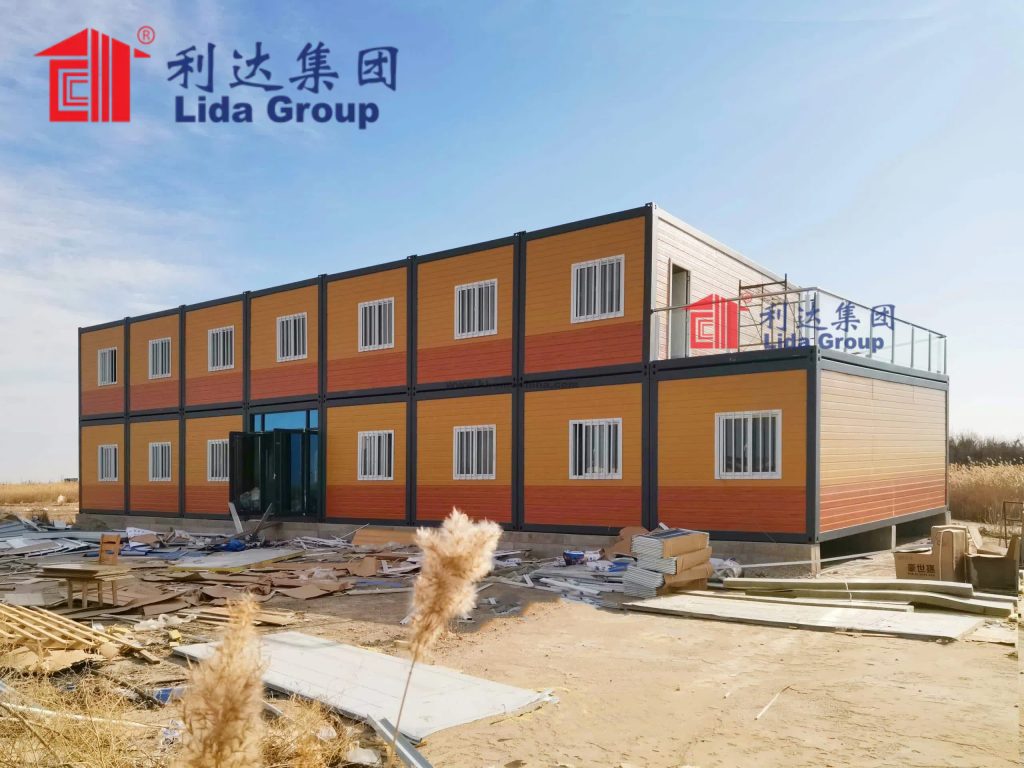
Lida Group’s sustainable prefab container and dormitory solutions bring triple comprehensive value of ecological environmental protection, economic cost optimization, and social sustainable development for global projects.
Ecological value: The full-life-cycle low-carbon design greatly reduces construction carbon emissions and resource consumption, realizes zero construction waste discharge and zero ecological disturbance, effectively protects the regional ecological environment, and helps global industries achieve carbon peaking and carbon neutrality goals.
Economic value: The ultra-long service life and high cyclic reuse rate save more than 60% of long-term temporary construction costs for enterprises. The energy-saving operation design reduces daily energy and water consumption expenses, and the low maintenance performance cuts later operation costs, bringing continuous and stable economic benefits for project operation.
Social value: The green and healthy living environment improves the living quality of construction workers and promotes the standardized and humanized development of engineering camps. The circular economic model drives the green upgrading of the global modular construction industry, promotes the sustainable development of the construction industry, and sets a benchmark for green temporary construction worldwide.
8. Conclusion
With the continuous deepening of global green low-carbon development, sustainable construction has become an inevitable trend in the development of the modern construction industry. Traditional temporary container houses and prefab dormitories are gradually eliminated by the market due to high energy consumption, high waste, high pollution, and non-reusable defects. Lida Group’s sustainable prefabricated container house and prefab dormitory solutions completely subvert the unsustainable development mode of traditional temporary buildings through innovative green design, low-carbon industrial production, energy-saving operation optimization, and full closed-loop cyclic reuse system.
Adhering to the core concept of ecological priority and sustainable development, Lida Group realizes comprehensive green upgrades in the whole life cycle of product production, deployment, use, and recycling. While ensuring fast assembly, structural safety, and comfortable living performance, the products greatly reduce carbon emissions and resource waste, balance ecological protection and project development, and create triple value of ecology, economy, and society for global engineering projects. The humanized low-carbon dormitory design not only meets the standardized accommodation needs of modern engineering camps but also protects the physical and mental health of workers, realizing the organic integration of green technology and humanistic care.
In the future, Lida Group will continue to focus on technological innovation in green modular buildings, further optimize product energy-saving performance and cyclic utilization efficiency, enrich sustainable customized solutions for different scenarios, and provide more high-quality, low-carbon, and eco-friendly prefabricated building products for global users. By continuously promoting the green transformation of the global temporary construction industry, Lida Group will contribute more strength to the sustainable and high-quality development of the global construction industry and ecological environmental protection.
Related news
-
Lida Group’s Living Container House Ideal for Remote Camps, Mining, and Emergency Shelter
2026-06-09 17:51:17
-
Prefab Container Campsite Dormitory Offers Fast Assembly and Long Service Life
2026-06-09 11:05:33
-
Lida Group Expands Range of Prefabricated Container House for International Projects
2026-06-08 17:31:58
contact us
- Tel: +86-532-88966982
- Whatsapp: +86-13793209022
- E-mail: sales@lidajituan.com
