



Lida Group’s Living Container House Ideal for Remote Camps, Mining, and Emergency Shelter
2026-Jun-09 17:51:17
By Admin
1. Introduction
Global industrial development, resource exploration, and public emergency response systems rely heavily on reliable temporary residential and operational facilities, especially in isolated, harsh, and high-risk areas. Remote construction camps, mining operation bases, and sudden emergency rescue scenarios share common and rigorous demands for accommodation facilities: rapid deployability, extreme environmental adaptability, structural safety, and flexible mobility. Traditional temporary accommodation solutions, including masonry buildings, simple color steel shelters, and disposable tents, have long failed to meet the comprehensive needs of these special scenarios due to their slow construction, poor durability, low safety, and non-reusable characteristics.
As a world-leading professional manufacturer of modular prefabricated buildings, Lida Group has long focused on the facility pain points of remote engineering, mining exploration, and emergency rescue fields. After years of technical research, product iteration, and global project verification, Lida Group’s customized living container houses have become highly recognized specialized solutions for remote camps, mining bases, and emergency shelters. Different from ordinary civilian container houses, this series of products is professionally optimized for harsh terrains, extreme climates, and high-efficiency emergency deployment needs, integrating super environmental adaptability, structural stability, rapid assembly, and flexible reuse. This article systematically analyzes the scenario pain points, core product advantages, targeted application values, and comprehensive benefits of Lida Group’s living container houses in remote camps, mining projects, and emergency shelter scenarios, illustrating why they have become the ideal modular building choice for global special engineering and public emergency fields.
2. Universal Facility Pain Points of Remote, Mining and Emergency Scenarios
Remote construction camps, mining operation bases, and emergency rescue sites have unique environmental and operational characteristics, which put forward higher requirements for temporary buildings than ordinary urban construction scenarios. Traditional temporary facilities have prominent functional defects in these three core scenarios, restricting project progress, increasing operational risks, and raising comprehensive costs.
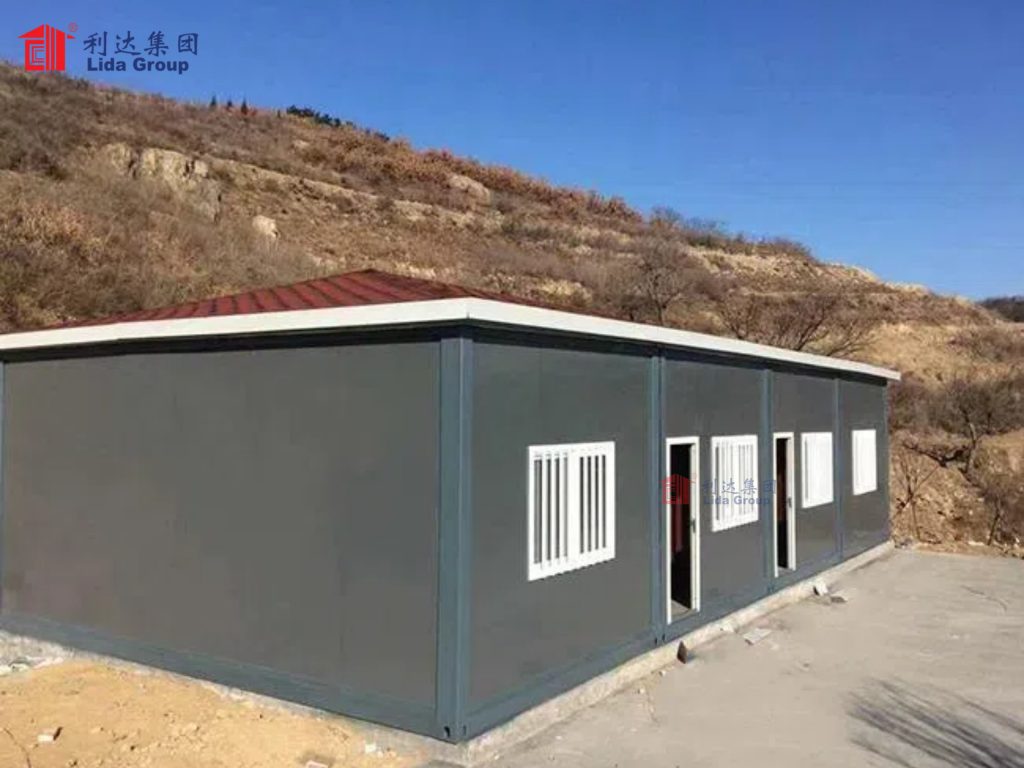
For remote field camps, the core pain points lie in difficult logistics, complex terrain, and harsh natural environments. Most remote engineering projects are located in mountainous areas, wilderness, desert edges, and suburban isolation zones with inconvenient transportation and uneven terrain. Traditional masonry buildings require large-scale material transportation and foundation pouring, which is time-consuming and costly. Simple temporary tents and color steel houses have poor wind resistance, heat insulation, and waterproof performance, unable to resist long-term outdoor wind, rain, and ultraviolet erosion, resulting in poor living conditions and short service life. In addition, remote projects are mobile and phased, and non-reusable traditional buildings will cause massive resource waste and repeated investment after project relocation.
For mining operation camps, facility safety and long-term durability are the primary challenges. Mining sites are mostly distributed in deserts, Gobi, alpine regions, and coastal mineral zones, featuring extreme temperatures, strong sandstorms, salt spray corrosion, and complex geological conditions. Ordinary temporary buildings are prone to structural rust, deformation, water leakage, and thermal failure after short-term use, requiring frequent maintenance and replacement. Meanwhile, mining projects have high safety standards for on-site facilities, and traditional simple shelters lack standardized fire protection, anti-seismic, and wind-resistant designs, bringing potential safety hazards to long-term staff residence and on-site operation.
For emergency shelter scenarios, rapid deployment and flexible adaptability are the most critical indicators. Natural disasters, accident rescues, and sudden public emergencies require temporary resettlement facilities to be completed and put into use within the shortest time to accommodate rescuers and affected populations. Traditional building modes with long construction cycles cannot meet emergency timeliness requirements. Moreover, emergency sites have uncertain terrain and variable demand scales, and fixed buildings cannot be flexibly adjusted and disassembled, resulting in low emergency response efficiency and serious resource waste after the crisis ends.
3. Core Optimized Performance of Lida Group’s Living Container Houses
Targeting the differentiated pain points of remote camps, mining projects, and emergency shelter scenarios, Lida Group’s living container houses have achieved all-round technical optimization in structural safety, environmental adaptability, deployment efficiency, and functional practicality. The product breaks the limitations of ordinary modular buildings and forms exclusive advantages suitable for harsh and emergency scenarios.
3.1 Ultra-High Structural Safety for Harsh Working Conditions
Lida Group’s living container houses adopt high-strength hot-dip galvanized steel frame structures made of high-quality structural steel, with integrated welding and overall reinforcement treatment at key stress nodes. The overall structure meets international high-standard anti-seismic, wind-resistant, and snow-pressure resistance requirements, capable of resisting level 12 strong winds, magnitude 8 earthquakes, and heavy snow accumulation. Different from ordinary thin steel container houses, Lida’s products have stronger compression and impact resistance, avoiding structural deformation and collapse caused by sandstorms, mountain gusts, and geological slight vibrations in mining and remote areas.
In terms of safety protection, the whole house adopts A1-level fire-proof non-combustible wall and ceiling materials, equipped with standardized fire extinguishing equipment, smoke alarm systems, and emergency escape indicators. The internal circuits adopt hidden leakage-proof wiring with overload and short-circuit protection functions, completely complying with international mining safety and emergency shelter construction standards, effectively eliminating fire and electrical safety hazards in high-risk operation scenarios.
3.2 Full-Climate Extreme Environmental Adaptability
To adapt to the diverse extreme climates of global remote and mining areas, Lida Group has equipped the container houses with a full-set weather-resistant and anti-corrosion protection system. The steel frame undergoes multi-layer anti-rust and anti-corrosion treatment including hot-dip galvanizing and high-temperature weather-resistant coating, which can effectively resist desert high-temperature ultraviolet aging, coastal salt spray erosion, alpine low-temperature frost damage, and mountain humid mildew. The high-density composite thermal insulation wall panels achieve efficient constant temperature adjustment, adapting to extreme temperature environments ranging from -40°C in cold regions to 50°C in deserts, realizing heat insulation in summer and heat preservation in winter.
The fully sealed integrated waterproof structure and high-elastic sealing strips at all assembly gaps completely solve the problem of rainwater leakage and indoor moisture. Whether in rainy mountainous areas, snowy high-latitude regions, or dry and windy desert zones, the product can maintain stable indoor living environment and structural performance for a long time, with a service life of more than 20 years, far exceeding traditional temporary facilities.
3.3 Ultra-Fast Assembly and Flexible Mobile Deployment
Lida Group’s living container houses adopt 95% factory prefabrication production mode. All internal water and electricity pipelines, lighting systems, thermal insulation structures, and basic decoration are completed in the factory. After being transported to the site, the units only need simple bolted assembly and positioning connection, with no need for complex foundation pouring and professional construction equipment. A single unit can be installed and put into use within 4 hours, and a complete emergency shelter or remote camp can be fully deployed within 3 to 5 days, which is dozens of times more efficient than traditional building modes.
The product supports dual transportation modes of integral hoisting and flat-pack packaging. Flat-pack units greatly save transportation space, solving the problem of difficult transportation in remote mountainous areas and complex road conditions. Meanwhile, the bolted splicing structure realizes zero-damage disassembly and repeated relocation. After the completion of remote and mining projects, the container houses can be disassembled, transported, and reused in new project sites, perfectly matching the mobile operation characteristics of field engineering and emergency task transfer.
3.4 Humanized Functional Design for Long-Term Livability
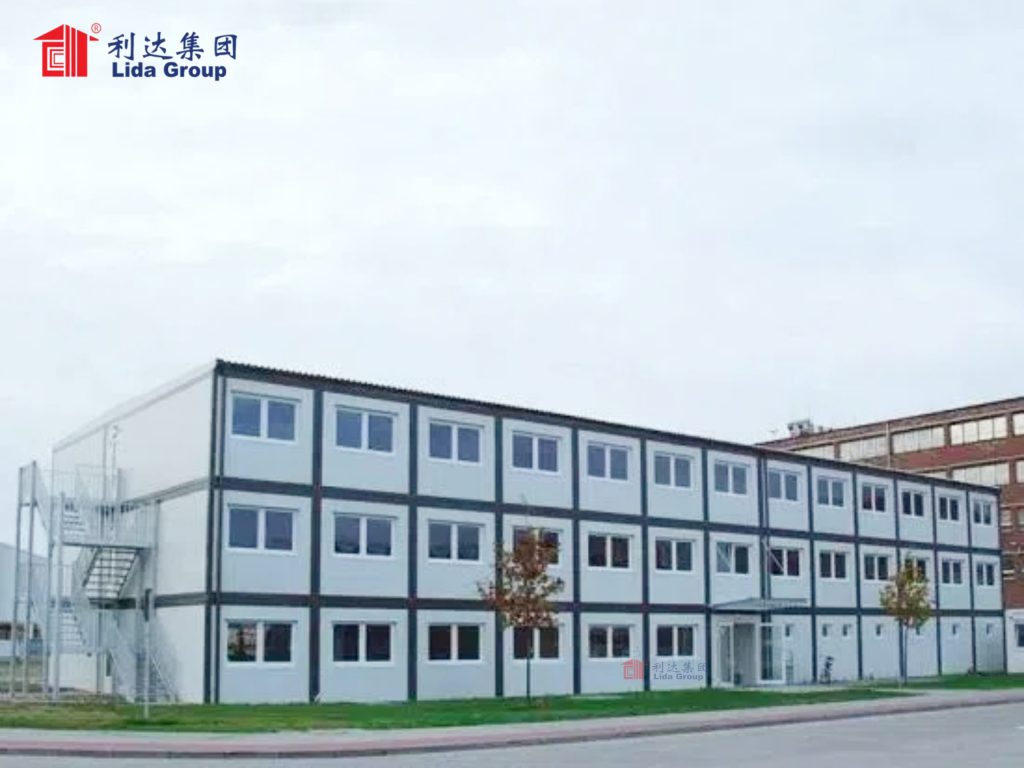
Aiming at the long-term residence needs of remote and mining staff and the temporary resettlement needs of emergency scenarios, Lida Group optimizes the humanized design of internal space. The spacious and flat indoor space is equipped with large-size energy-saving windows and a scientific ventilation system to ensure sufficient natural light and fresh indoor air. The professional sound insulation and noise reduction structure can isolate outdoor construction noise and wind noise, improving living comfort. The product can be pre-installed with complete supporting facilities such as air conditioning, beds, storage cabinets, and integrated sanitation facilities, realizing direct occupancy without secondary decoration, meeting the daily rest, office, and living needs of on-site personnel.
4. Targeted Application Advantages in Three Core Scenarios
With the integration of safety, durability, efficiency, and flexibility, Lida Group’s living container houses show irreplaceable application advantages in remote camps, mining operation bases, and emergency shelter scenarios, solving the actual pain points of each scenario in a targeted manner.
4.1 Ideal Solution for Remote Construction Camps
Remote engineering camps such as highway maintenance, railway construction, water conservancy projects, and field scientific research are faced with problems such as inconvenient transportation, complex terrain, scattered construction points, and poor living conditions. Lida Group’s living container houses perfectly adapt to the construction characteristics of remote projects. The foundation-free installation design can adapt to uneven ground such as slopes, sandy land, and tidal flats, eliminating the need for large-scale site leveling and foundation construction, greatly saving site preparation time and cost.
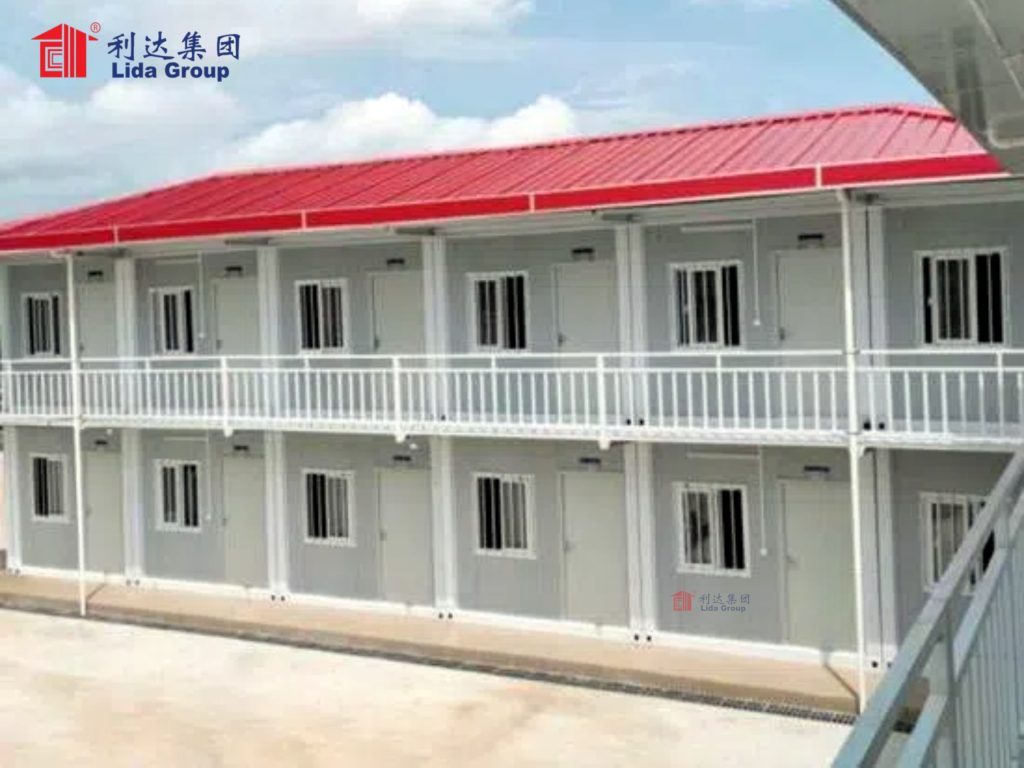
The flexible modular combination mode can freely adjust the number of dormitory units, office units, and public supporting units according to the number of on-site personnel, forming standardized and complete remote camp clusters. The excellent weather resistance ensures stable operation in long-term remote outdoor environments, improving the living comfort of field workers and reducing personnel turnover. The reusable performance allows the container houses to move with the construction progress, avoiding repeated construction of remote camps and saving a large amount of temporary construction costs for engineering enterprises.
4.2 Professional Durable Facilities for Mining Operation Camps
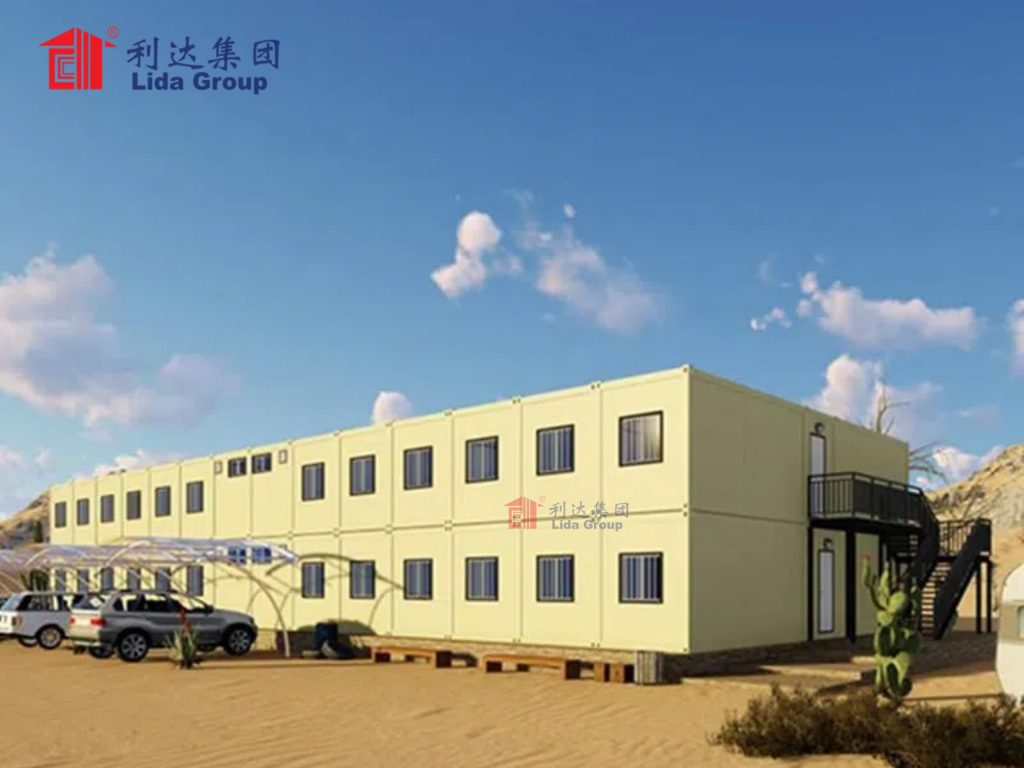
Mining projects including mineral exploitation, oil and gas exploration, and new energy resource development have extremely high requirements for the safety and durability of on-site camps. Lida Group’s living container houses are professionally customized for mining harsh environments, with enhanced anti-corrosion, wind-resistant, and sand-proof performance, which can resist long-term erosion of desert sandstorms, Gobi strong winds, and mining area dust pollution. The high-strength structural design can adapt to the slight geological changes of mining areas, avoiding structural loosening and damage.
In terms of safety management, the standardized fire-proof and electrical safety design fully meets the strict safety assessment standards of mining enterprises, effectively reducing on-site safety hazards. The long service life and low maintenance rate solve the problem of frequent replacement and high maintenance costs of traditional mining camp facilities. The centralized and standardized camp layout is conducive to the unified management of mining staff, improving the standardized operation level of mining sites, and has become the designated supporting facility for many global large-scale mining projects.
4.3 Efficient and Reliable Emergency Shelter for Public Emergencies
In sudden natural disasters, accident rescues, and public health emergencies, rapid and safe temporary resettlement facilities are the key to improving emergency response efficiency. Lida Group’s living container houses have outstanding rapid deployment capabilities, which can be transported to disaster-stricken areas and emergency sites in a short time and completed assembly within one day, providing safe and standardized temporary shelters for affected populations and rescue teams.
Different from simple tents with poor wind resistance and rain resistance, Lida’s container houses have independent stable structures and sealed living spaces, which can provide warm, dry, and safe living environments in rainy, snowy, and windy emergency environments. The modular design can be flexibly combined into emergency dormitories, medical observation rooms, command rooms, and material storage rooms, forming a complete emergency resettlement system. After the emergency task is completed, the container houses can be disassembled and stored for repeated use in subsequent emergency tasks, avoiding resource waste and improving the reuse rate of public emergency materials.
5. Comprehensive Economic and Social Value
Lida Group’s living container houses bring dual value of economic cost optimization and social benefit improvement for remote engineering, mining development, and emergency rescue fields. In terms of economic benefits, the product’s ultra-long service life and reusable characteristics eliminate repeated investment in temporary construction. Compared with traditional disposable temporary buildings, it saves more than 60% of long-term camp construction and maintenance costs for enterprises and public institutions. The factory prefabrication mode reduces on-site labor input and material waste, and the low daily maintenance rate further optimizes the full-cycle operating cost.
In terms of social benefits, the comfortable and safe living environment effectively guarantees the physical and mental health of remote construction workers and mining operators, stabilizing the talent team for infrastructure construction and resource development. In emergency scenarios, the rapid deployment capability greatly improves the emergency rescue and resettlement efficiency of public emergencies, reducing disaster losses and ensuring social stability. In addition, the green and recyclable modular building mode avoids construction waste pollution, conforms to the global green and low-carbon development concept, and realizes the coordinated development of engineering construction, resource exploitation, and ecological environmental protection.
6. Conclusion
Remote construction camps, mining operation bases, and emergency shelter scenarios have always been difficult points in the field of temporary building construction, restricting the efficient development of global infrastructure, resource development, and public emergency undertakings due to the limitations of traditional facility technology and performance. Lida Group’s living container houses completely break through the shortcomings of traditional temporary buildings such as slow construction, poor safety, weak environmental adaptability, and low reuse rate through professional structural optimization, full-climate environmental adaptation design, ultra-fast assembly technology, and humanized functional configuration.
Tailored for three core special scenarios, Lida’s container houses provide stable and comfortable long-term accommodation solutions for remote field engineering, solve the safety and durability problems of mining camp facilities, and deliver efficient and reliable temporary shelter guarantees for public emergency rescue. With outstanding structural safety, extreme weather resistance, flexible mobility, and high cost-effectiveness, the product has become a trusted modular building solution for global engineering enterprises and public emergency departments.
In the future, with the continuous expansion of global remote resource development and the continuous improvement of public emergency response systems, the market demand for high-performance scenario-specialized container houses will continue to grow. Lida Group will further optimize product performance, strengthen intelligent and humanized upgrades, enrich customized scenario solutions, and continue to provide more safe, efficient, and economical modular accommodation facilities for global remote engineering, mining development, and emergency rescue fields, promoting the high-quality development of the global modular construction industry and public emergency support system.
Related news
-
Prefab Container Campsite Dormitory Offers Fast Assembly and Long Service Life
2026-06-09 11:05:33
-
Lida Group Expands Range of Prefabricated Container House for International Projects
2026-06-08 17:31:58
-
Living Container House by Lida Group Combines Comfort, Mobility, and Cost-Effectiveness
2026-06-08 17:23:36
contact us
- Tel: +86-532-88966982
- Whatsapp: +86-13793209022
- E-mail: sales@lidajituan.com
