



Lida Group Launches Mobile Modular Container House for Flexible Workforce Housing
2026-Apr-27 14:35:51
By Admin
Global infrastructure development, mining operations, remote engineering projects, and emergency construction initiatives generate continuous and growing demand for temporary, reliable, and cost-effective workforce housing. Unlike permanent residential buildings designed for long-term fixed occupation, workforce accommodation faces unique industry challenges: frequent project location migration, fluctuating staff scales, harsh remote construction environments, tight project schedules, and limited on-site construction conditions. Traditional on-site brick-concrete dormitories and simple temporary tents struggle to meet modern workforce housing standards, suffering from long construction cycles, poor safety performance, fixed spatial layouts, non-reusable structures, and harsh living environments. These outdated accommodation solutions not only increase enterprise construction and operation costs but also affect staff living comfort and project team stability.
To solve the universal pain points of flexible workforce housing worldwide, Lida Group, a global leading modular building solution provider, officially launches its upgraded mobile modular container house, specially customized for engineering construction camps, mining energy bases, emergency rescue sites, large-scale event operation teams, and other mobile workforce scenarios. Breaking the limitations of traditional temporary accommodation, Lida Group’s new mobile modular container house integrates mobility, rapid deployability, structural durability, living comfort, flexible scalability, and reusable value. It provides standardized, high-quality, and all-scenario flexible housing solutions for global enterprises and engineering projects, effectively improving staff living conditions, optimizing project operation costs, and filling the market gap of high-standard mobile workforce accommodation.
With decades of professional modular building engineering experience, mature automated production systems, and cross-regional project delivery capabilities covering 152 countries, Lida Group deeply understands the diversified demands of mobile workforce housing. Different from ordinary generic container houses that only provide basic shelter functions, Lida Group’s newly launched mobile modular container house takes staff living experience, project flexibility management, full-cycle cost control, and environmental adaptability as core design concepts. Through structural optimization, functional upgrading, modular standardization, and personalized configuration, the product realizes comprehensive iteration of temporary housing quality, setting a new industry benchmark for modern flexible workforce housing.
1. Bottlenecks of Traditional Workforce Housing Solutions
Traditional workforce housing modes including simple tents, temporary brick houses, and ordinary low-end container houses have long restricted the standardized construction of project staff accommodation. These conventional solutions have obvious defects in structural safety, construction efficiency, mobility, living comfort, and cyclic utilization, unable to adapt to the fast-paced, flexible, and sustainable operation needs of modern engineering projects.
Temporary tents are the most primitive mobile housing form, featuring low cost and convenient transportation but extremely poor comprehensive performance. Tents lack stable structural frameworks, with weak wind resistance, rainproof performance, and thermal insulation capacity. In harsh environments such as strong winds, heavy rain, low temperature, and high temperature, tents cannot provide safe and comfortable living spaces. Meanwhile, tents have no fixed functional partitions, poor sealing performance, and insufficient privacy, failing to meet the basic living and rest standards of long-term resident staff. Moreover, tents are easily worn and damaged, cannot be reused multiple times, and generate large amounts of disposable consumable waste, resulting in repeated investment and resource waste for enterprises.
On-site constructed brick-concrete temporary dormitories solve the safety defects of tents but bring new operational burdens. Brick-concrete buildings require foundation excavation, material transportation, on-site pouring, and long curing cycles, with extremely slow construction speed, which cannot match the rapid deployment needs of short-cycle emergency projects and temporary engineering tasks. Most importantly, brick-concrete temporary buildings are fixed structures that cannot be disassembled and migrated. After project completion, temporary dormitories can only be demolished, producing massive construction waste and causing huge economic losses and ecological pressure. In addition, fixed brick-concrete houses have rigid layouts, unable to flexibly adjust accommodation scale according to dynamic changes in project staff numbers, resulting in idle housing resources or insufficient accommodation capacity.
Generic low-end container houses improve structural stability compared with tents and brick-concrete temporary buildings but still have prominent quality and functional defects. Most entry-level container products adopt simplified steel structures, single anti-rust treatment, and thin enclosure materials, resulting in poor weather resistance, serious internal condensation, insufficient thermal insulation and sound insulation performance, and short service life. Ordinary container houses have single functional design, lack supporting living facilities, and cannot be flexibly combined and stacked. Their rough finished quality and poor living comfort fail to meet modern enterprise staff management standards. Furthermore, many generic container houses have non-standard structural sizes and unstable connection performance, bringing potential safety hazards for long-term resident use.
2. Core Innovative Design of Lida Group’s New Mobile Modular Container House
Targeting the multiple bottlenecks of traditional workforce housing, Lida Group carries out systematic innovative upgrading from structural design, material configuration, modular combination, functional supporting, and mobile deployment, creating a professional mobile modular container house exclusive to flexible workforce housing scenarios. The new product perfectly balances rapid deployment, structural safety, living comfort, flexible scalability, and cyclic reusability.
2.1 Optimized High-Strength Mobile Steel Frame Structure
Structural stability and migration durability are the foundation of mobile workforce housing. Lida Group’s new container house adopts customized high-strength galvanized steel frame structures, abandoning thin and low-strength steel materials used in generic products. The integrated welded steel frame forms an integral load-bearing system with excellent ductility, compressive resistance, and impact resistance. Verified by professional tests, the optimized steel structure can resist level 12 strong winds and magnitude 8 earthquakes, adapting to complex and harsh construction site environments such as coastal wind-prone areas, desert sandstorm areas, and mountainous complex terrain.
All steel frame components adopt multi-layer anti-corrosion and weather-resistant protection processes including hot-dip galvanizing and electrostatic spraying. The composite protective layer effectively isolates salt spray erosion, ultraviolet aging, rainwater corrosion, and low-temperature frost damage. Even after repeated disassembly, transportation, and migration, the steel frame structure will not deform, rust, or loosen, maintaining stable structural integrity. Compared with ordinary container houses that are prone to structural fatigue and damage after secondary migration, Lida Group’s optimized structure realizes multi-cycle repeated use, greatly improving the full-life-cycle utilization rate of housing equipment.
2.2 Ultra-Fast Deployment and Flexible Mobile Assembly
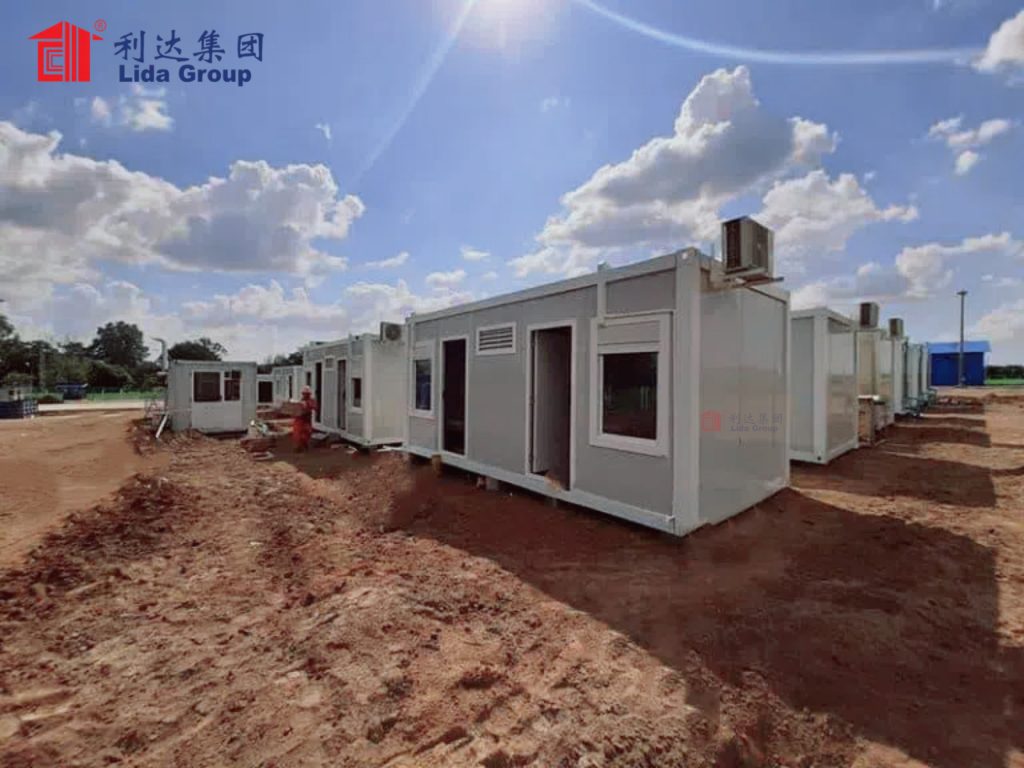
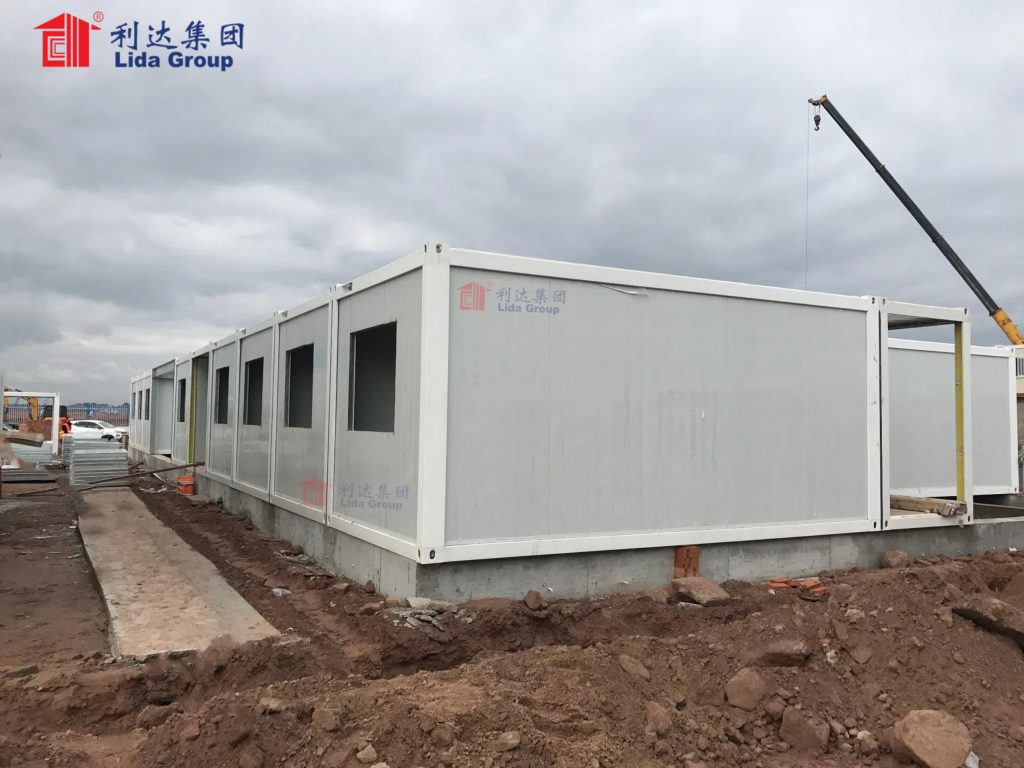
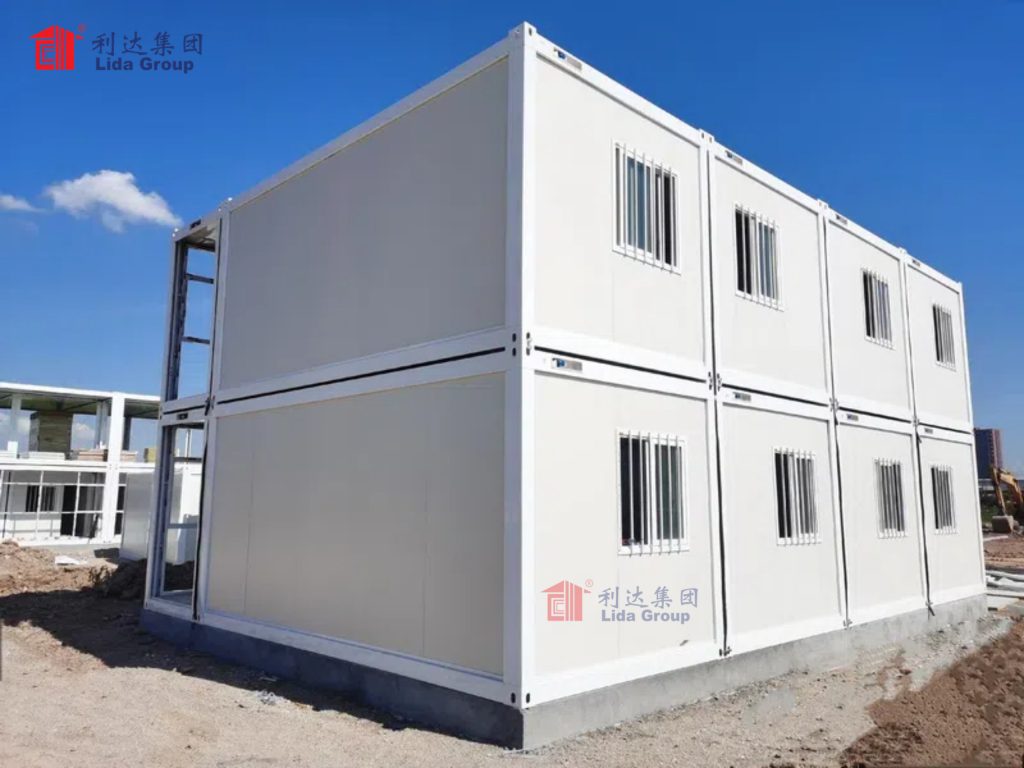
Focusing on the flexible mobile operation needs of engineering projects, Lida Group designs the container house as an integrated prefabricated modular structure. All house frameworks, wall panels, ceiling systems, floor structures, and internal pipelines are fully prefabricated in standardized intelligent factories. After being transported to the construction site, the finished units only need simple ground positioning and bolt fixing to complete deployment without on-site welding, painting, and pouring operations. A single standard container housing unit can be put into use within several hours, and a complete staff dormitory camp composed of dozens of units can be fully assembled within three days, shortening the construction cycle by more than 80% compared with traditional temporary buildings.
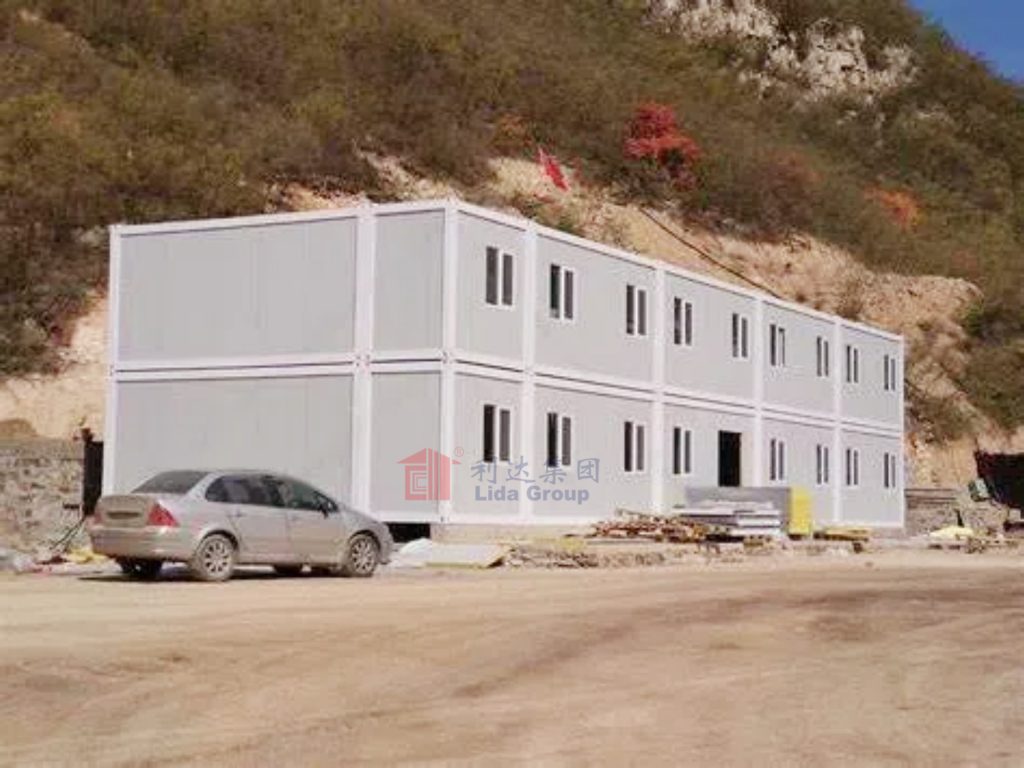
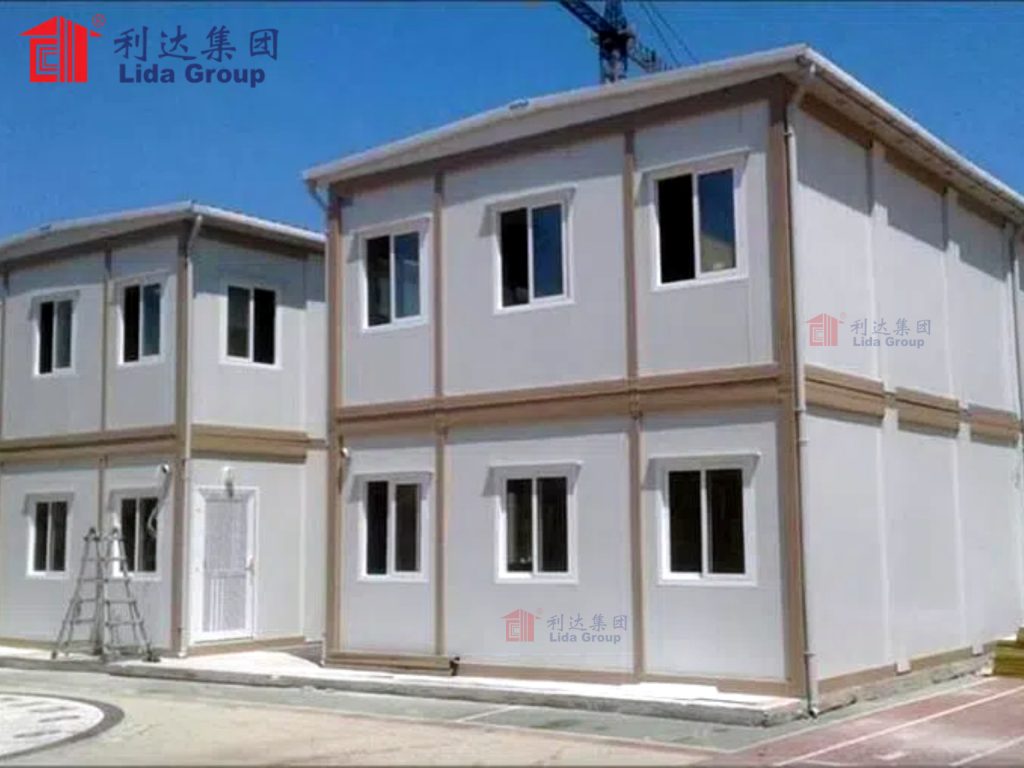
The standardized modular design supports free combination, layered stacking, and arbitrary layout adjustment. Enterprises can flexibly increase or decrease housing units according to project staff scale changes, realizing dynamic matching of accommodation resources and team size. After the completion of a single project, all container units can be quickly disassembled, transported to new project sites, and reassembled for secondary use. This highly flexible mobile deployment mode perfectly adapts to the cross-regional and mobile operation characteristics of modern infrastructure, mining, and emergency engineering projects.
2.3 Upgraded Humanized Living Configuration
On the premise of ensuring structural safety and mobility, Lida Group comprehensively upgrades the internal living configuration of mobile container houses to solve the problem of poor comfort of traditional temporary accommodation. The product is equipped with high-performance thermal insulation and sound insulation wall panels, effectively isolating external high and low temperature changes and on-site construction noise. The optimized sealing structure avoids internal condensation, wall mildew, and rainwater seepage, keeping the indoor environment dry, quiet, and constant in temperature all year round.
Each standardized housing unit supports personalized functional configuration, including integrated lighting systems, ventilation equipment, anti-theft doors and windows, waterproof floors, and independent power distribution systems. According to project demands, the container units can be customized with independent toilets, shower rooms, kitchen and dining areas, meeting rooms, office spaces, and rest lounges. Multi-functional modular units can be combined to form integrated staff camps integrating accommodation, office, catering, and entertainment, comprehensively improving staff living quality and meeting the humanized management needs of modern enterprises.
2.4 Lightweight and Low-Disturbance Site Adaptation Design
Most engineering construction sites have uneven terrain, limited construction space, and fragile ecological environments, putting forward high requirements for the site adaptability of temporary housing. Lida Group’s mobile modular container house features lightweight overall structure and low foundation requirements. Different from traditional temporary buildings that need reinforced concrete foundation treatment, Lida’s container units can be stably deployed on flat hardened ground, simple gravel ground, and temporary terrace foundations, minimizing on-site earthwork excavation and foundation construction.
The low-disturbance construction mode effectively reduces site vegetation damage, soil erosion, and ecological environment impact. After project completion, the disassembled container units leave almost no construction waste or building residues on the site, realizing zero ecological burden of temporary housing construction, which fully complies with global green construction and ecological protection standards.
3. Core Competitive Advantages for Flexible Workforce Housing
Lida Group’s newly launched mobile modular container house forms multi-dimensional comprehensive advantages in flexible deployment, safety guarantee, economic benefit, green environmental protection, and scenario adaptability, thoroughly solving various pain points of traditional workforce housing and becoming the optimal solution for modern mobile staff accommodation.
3.1 Unmatched Flexibility and Scalability
Flexibility is the most prominent core advantage of Lida Group’s new container house. Traditional fixed temporary buildings can only adapt to single project scenarios and fixed staff scales, lacking adjustment space. In contrast, Lida’s modular container units support arbitrary combination, layered stacking, and functional switching. Enterprises can quickly expand dormitory clusters during project peak periods and disassemble redundant units during off-peak periods to avoid resource idle waste. For cross-regional chain projects, mobile container houses can be repeatedly migrated and deployed across different construction sites, realizing cross-project cyclic reuse of housing resources and forming mobile and flexible workforce housing management modes.
3.2 Superior Structural Safety and Long-Term Durability
Safety is the primary assessment standard for staff accommodation. Lida Group’s integrated steel frame structure and standardized connection technology ensure excellent overall structural stability. The anti-seismic, wind-resistant, and pressure-resistant performance of the product meets international building safety codes and global engineering camp construction standards. The multi-layer composite anti-corrosion and weather-resistant treatment enables the container house to adapt to extreme environments such as high temperature, high humidity, severe cold, and sandstorms. Verified by long-term engineering practice, the service life of Lida’s mobile modular container house exceeds 15 years, and it can withstand dozens of disassembly and migration cycles while maintaining stable structural performance, far exceeding the durability of ordinary temporary housing products.
3.3 Excellent Full-Lifecycle Economic Benefits
Compared with traditional temporary housing modes, Lida Group’s mobile modular container house has outstanding full-cycle cost performance. Although the initial input is slightly higher than that of simple tents and low-end ordinary containers, it saves massive repeated construction investment and maintenance costs in the long run. The rapid assembly feature greatly shortens project preparation cycles and reduces on-site labor and mechanical leasing costs. The reusable design avoids repeated demolition and reconstruction expenses of fixed temporary buildings. Meanwhile, the low-failure and low-maintenance structural performance minimizes daily operation and maintenance costs of staff camps. For long-term multi-stage and cross-regional continuous engineering projects, the comprehensive cost saving rate of Lida’s container housing solutions exceeds 40%, bringing considerable economic benefits to enterprises.
3.4 Green and Low-Carbon Sustainable Performance
In the context of global green construction upgrading, energy conservation and environmental protection have become important indicators of high-quality engineering camp construction. Lida Group’s mobile modular container house adopts steel materials with a recycling rate of over 95%. All structural components can be completely disassembled, recycled, and reused without generating construction waste. The factory prefabrication and modular assembly mode realize zero dust, sewage, and noise pollution during on-site construction, reducing ecological damage to project sites.
The high-efficiency thermal insulation and energy-saving design reduces indoor temperature regulation energy consumption, effectively lowering the carbon emission of staff camps. Different from disposable temporary housing that generates massive solid waste after project completion, Lida’s cyclic reusable container housing system realizes coordinated development of engineering construction and ecological protection, meeting the green and low-carbon construction assessment requirements of global infrastructure projects.
3.5 Diversified Scenario Adaptability
Lida Group’s new mobile modular container house has extremely strong scenario universality, covering almost all flexible workforce housing scenarios. In infrastructure construction projects such as highway, railway, bridge, and building construction, it can be used as staff dormitories, on-site offices, and material storage rooms. In mining, oil, and gas energy development projects in remote areas, it provides stable and comfortable long-term accommodation for field operation teams. In post-disaster emergency rescue and temporary reconstruction projects, it can be rapidly deployed to provide accommodation and office support for rescue teams. In addition, it can also be applied to large-scale sports events, exhibition activities, field scientific research, and other temporary team accommodation scenarios, realizing multi-scenario universal application of a single product.
4. Global Engineering Application Verification
Since its official launch, Lida Group’s new mobile modular container house has been rapidly applied in multiple global cross-regional engineering projects, and its flexible deployment capability, stable structural performance, and humanized living quality have been fully verified by practical engineering scenarios.
In a cross-country highway construction project in Southeast Asia, the project spans multiple terrain environments including mountains, wetlands, and coastal areas, with scattered construction points and frequent team migration. Traditional fixed temporary buildings cannot adapt to the mobile construction mode, while simple tents have poor living conditions and low safety. The project adopted Lida Group’s mobile modular container houses to build standardized staff camps. All housing units completed rapid deployment within one week, realizing integrated configuration of dormitories, offices, and canteens. During the multi-year project construction cycle, the container houses were successfully migrated and redeployed many times. The structures remained intact with stable performance, effectively improving staff living satisfaction and project team stability, and greatly saving the repeated construction cost of temporary accommodation.
In a remote mineral development project in Central Asia, the construction site is located in a desert marginal area with strong ultraviolet radiation, large temperature difference between day and night, and frequent sandstorms, putting forward extremely high requirements on the weather resistance and safety of staff accommodation. Lida Group customized enhanced anti-sandstorm, thermal insulation, and anti-aging container housing products for the project. The optimized steel frame structure and sealing system effectively resist external harsh weather interference. The humanized internal configuration ensures dry, warm, and comfortable indoor living environment. After years of continuous operation, the camp housing facilities have almost no failure and maintenance problems, providing stable long-term accommodation guarantee for field operation teams.
5. Industry Value and Market Development Prospects
The continuous expansion of global infrastructure construction, energy development, and emergency engineering projects drives the steady growth of demand for flexible workforce housing. Traditional backward temporary housing modes have become an important factor restricting the standardized construction and refined management of modern engineering projects. As an innovative upgraded product, Lida Group’s mobile modular container house subverts the extensive temporary housing construction mode and promotes the standardized, humanized, and green upgrading of the global workforce housing industry.
For engineering construction enterprises, Lida’s flexible modular housing solutions realize controllable accommodation cost, rapid camp deployment, and flexible resource scheduling, helping enterprises optimize project operation management, improve team stability, and enhance overall project construction efficiency. For the entire construction industry, the product sets unified high-quality standards for mobile temporary housing, solves the common industry pain points of poor safety, low reusability, high energy consumption, and harsh living conditions of traditional temporary buildings, and guides the industry to move towards efficient, safe, green, and humanized development.
With the continuous acceleration of global construction industrialization and the continuous improvement of enterprise refined management concepts, flexible, reusable, low-carbon, and high-comfort modular container housing will gradually replace traditional temporary housing products and become the mainstream choice for modern workforce accommodation. As a leading enterprise in modular building innovation, Lida Group will continue to iterate product technology, optimize functional configuration, and launch more diversified and intelligent mobile housing solutions to meet the increasingly refined and multi-dimensional flexible housing needs of global projects.
6. Conclusion
Traditional workforce housing solutions including tents, fixed brick-concrete temporary buildings, and low-end generic container houses have long been trapped in multiple dilemmas such as slow deployment speed, poor structural safety, insufficient living comfort, non-reusable structures, and high comprehensive operating costs. These defects cannot adapt to the fast-paced, mobile, and refined operation management requirements of modern global engineering projects, restricting the improvement of enterprise project management level and staff living quality.
By launching the new mobile modular container house tailored for flexible workforce housing scenarios, Lida Group thoroughly solves the various pain points of traditional temporary accommodation through innovative structural design, humanized functional upgrading, standardized modular assembly, and green cyclic utilization technology. The product integrates rapid deployability, flexible scalability, extreme environmental adaptability, safe and comfortable living performance, low full-cycle cost, and eco-friendly advantages, realizing comprehensive upgrading of the quality and value of mobile workforce housing. Verified by numerous global cross-regional engineering practices, Lida Group’s modular container house has strong scenario universality, stable product performance, and excellent economic and ecological benefits.
In the future, with the continuous upgrading of global engineering construction standards and green environmental protection requirements, flexible and sustainable modular workforce housing will become an indispensable basic supporting facility for modern engineering projects. Lida Group will continue to focus on the innovation and iteration of mobile modular building technology, continuously optimize flexible workforce housing solutions, and provide global engineering enterprises with safer, more comfortable, more efficient, and greener temporary accommodation services, leading the high-quality and sustainable development of the global workforce housing industry.
Related news
-
Lida Group's Metal Frame Construction Delivers Lasting Value in Every High Quality House
2026-04-27 14:31:19
-
Sustainable and Strong: Steel Structure Building for High Quality House by Lida Group
2026-04-27 14:14:47
-
Why Choose Lida Group for Metal Frame Construction of Your High Quality House?
2026-04-27 14:10:49
contact us
- Tel: +86-532-88966982
- Whatsapp: +86-13793209022
- E-mail: sales@lidajituan.com
