



Lida Group Engineers Easy Operation Steel Construction to Deliver Low Cost Metal House Quickly
2026-Jun-03 17:55:41
By Admin
The global construction industry is facing an unprecedented dual challenge of efficiency improvement and cost control. With rising labor expenses, fluctuating raw material prices, and surging demand for affordable residential and industrial buildings worldwide, traditional construction methods can no longer balance low cost, rapid delivery, and simple on-site operation. Conventional low-cost metal house projects have long been trapped in a vicious cycle: simplified materials lead to poor structural quality, while standardized construction requires complex processes, skilled workers and long project cycles. This contradiction has severely restricted the large-scale promotion of economical metal buildings in rural reconstruction, emergency disaster relief, industrial accommodation, and remote area development.
As a world-leading steel structure and modular building manufacturer with over 30 years of professional engineering experience, Lida Group has targeted the core pain points of the metal construction industry. Instead of compromising construction quality for low cost or relying on complex processes for structural stability, the enterprise independently engineered a mature easy-operation steel construction system. Through digital engineering design, modular prefabrication optimization, innovative connection technology and full-process construction streamlining, Lida Group has realized the perfect integration of simple operation, ultra-fast delivery and low comprehensive cost for metal houses. This article systematically analyzes the industry bottlenecks, core engineering innovations, construction advantages, practical project performance and industrial value of Lida Group’s upgraded steel construction solution, demonstrating how it reshapes the new benchmark for global low-cost metal building construction.
1. Core Bottlenecks of Traditional Low-Cost Metal House Construction
Traditional low-cost metal house construction has obvious technical and procedural defects, which are the fundamental reasons for its difficulty in balancing speed, cost and operability. First and foremost, traditional steel building construction relies heavily on skilled field workers. Most conventional metal frame assembly, panel installation and structural fixing processes require professional construction skills. The global shortage of steel structure technicians and annual labor cost inflation have greatly increased the labor expenditure of low-cost projects, offsetting the original material cost advantages of metal buildings. Statistics show that skilled labor costs account for nearly 45% of the total investment in traditional metal house projects, becoming the largest uncontrollable cost item.
Secondly, traditional construction procedures are fragmented and inefficient, resulting in lengthy delivery cycles. Ordinary low-cost metal houses still retain partial on-site cutting, welding, drilling and polishing processes. These complex manual operations are not only time-consuming but also easily affected by bad weather, site conditions and human errors. A standard 200-square-meter metal residential house usually takes 25 to 30 days of on-site construction, while large-scale industrial metal buildings often require several months of continuous construction. Long delivery cycles delay project put-into-use time and generate additional costs such as site management and equipment rental.
Thirdly, the disordered operation mode leads to unstable project quality and high hidden costs. To control costs, most traditional low-cost metal building manufacturers adopt non-standardized component production and simplified structural design. The mismatched component size and backward connection technology lead to common quality problems such as loose frames, water leakage, poor thermal insulation and weak wind resistance. These defects bring frequent later maintenance and renovation costs, making the full-life-cycle cost of traditional metal houses far higher than the initial budget.
Finally, traditional construction has poor environmental adaptability. Complex operation processes and heavy mechanical equipment requirements make it impossible to carry out efficient construction in remote mountainous areas, post-disaster reconstruction sites and other harsh environments, limiting the application scope of low-cost metal houses in emergency and poverty alleviation construction scenarios. In short, the traditional industry lacks an engineering system that integrates simple operation, rapid construction, low cost and stable quality, which is the key problem that Lida Group’s innovative steel construction technology solves.
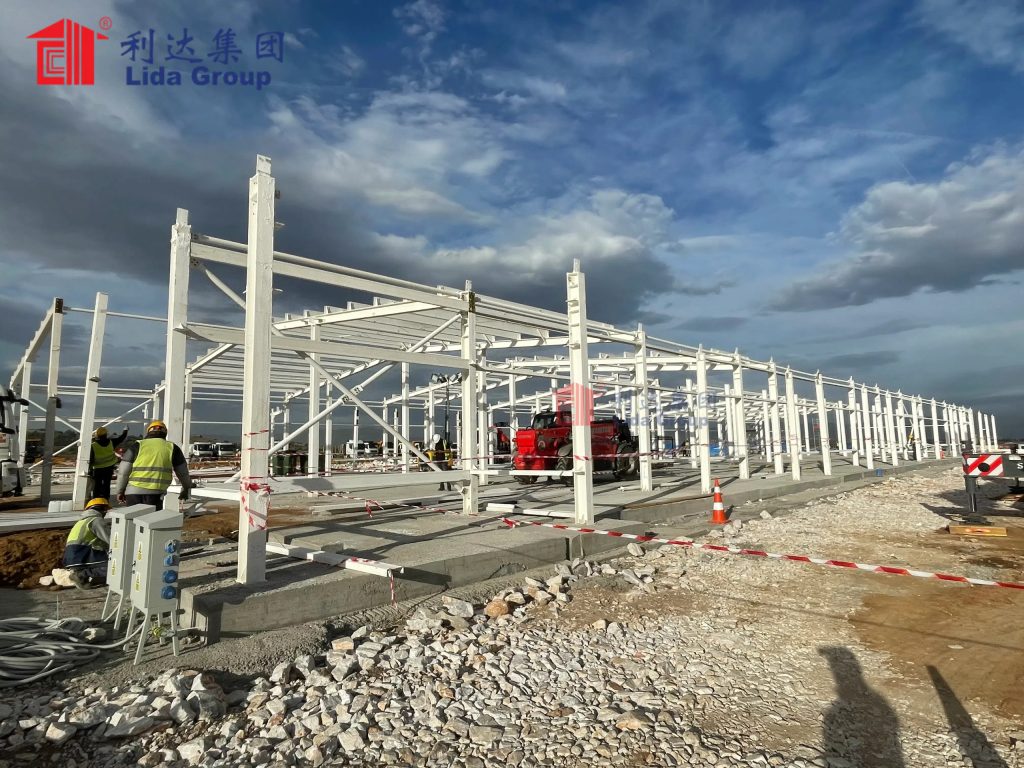
2. Lida Group’s Core Engineering Innovations for Easy-Operation Steel Construction
Lida Group’s easy-operation steel construction system is a set of systematic engineering solutions independently developed based on tens of thousands of global construction projects. The core engineering logic is to transfer all complex, high-precision and high-threshold construction links to factory automated production, leaving only simple assembly operations for on-site construction, so as to reduce operation difficulty, shorten construction cycle and control comprehensive cost without reducing building safety and durability.
2.1 Digital Modular Integrated Engineering Design
Different from the scattered component design of traditional metal buildings, Lida Group adopts full-house digital modular integrated engineering design. The professional engineering team uses BIM digital modeling technology to complete the overall structural planning, component matching and pipeline layout of metal houses in the early design stage. All steel frames, wall panels, roof panels, floor systems and functional accessories are designed with unified standard sizes and universal connecting interfaces, realizing 100% compatibility of all components. The digital design system can accurately predict structural stress, wind resistance, seismic performance and thermal insulation parameters, ensuring that low-cost metal houses fully meet international building safety standards.
This engineering design mode completely eliminates on-site secondary processing work. All component sizes and connection positions are precisely preset in the design stage, avoiding on-site cutting, drilling and modification operations. The standardized modular design also supports free combination and flexible expansion, which can adapt to residential, industrial, commercial and emergency housing scenarios, realizing the generalization and diversification of low-cost metal houses.
2.2 Patented Quick-Lock Steel Connection Technology
To completely simplify on-site operation, Lida Group has independently developed a patented quick-lock connection structure for steel components, replacing the traditional screw fixing and welding connection mode. The innovative tongue-and-groove locking structure is prefabricated on steel frames and enclosure panels. During on-site construction, workers only need to align and splice the components, and the embedded locking device can complete automatic clamping and fixing without welding, glue filling and professional tool operation. This technology fundamentally reduces the technical threshold of steel construction and solves the problem of unstable connection quality caused by manual operation errors.
In addition, the optimized locking structure reserves flexible expansion gaps, which can adapt to thermal expansion and contraction of steel materials in different temperature environments. It effectively avoids structural deformation, panel cracking and water leakage problems, greatly improving the overall stability and weather resistance of metal houses. While simplifying the operation, the quick-lock technology improves the construction precision by more than 90% compared with traditional manual operation, ensuring long-term safe use of the building.
2.3 Intelligent Factory Precision Prefabrication Engineering
Lida Group equips modern automated production lines and intelligent CNC processing equipment to realize full-process factory prefabrication of metal house components. All steel raw materials are processed through automatic cutting, bending, welding and anti-corrosion coating production lines, with a processing accuracy error controlled within 0.1mm. The factory completes pre-assembly inspection of key components to ensure that all parts are perfectly matched before leaving the factory, eliminating on-site assembly errors and rework problems.
The integrated factory prefabrication mode undertakes more than 80% of the whole construction work, greatly reducing the workload and technical difficulty of on-site construction. The automated production improves material utilization rate to over 98%, avoiding raw material waste in traditional on-site construction, and effectively reducing the manufacturing cost of metal house components. Meanwhile, the standardized factory production ensures uniform product quality, completely changing the uneven quality problem of traditional low-cost metal buildings.
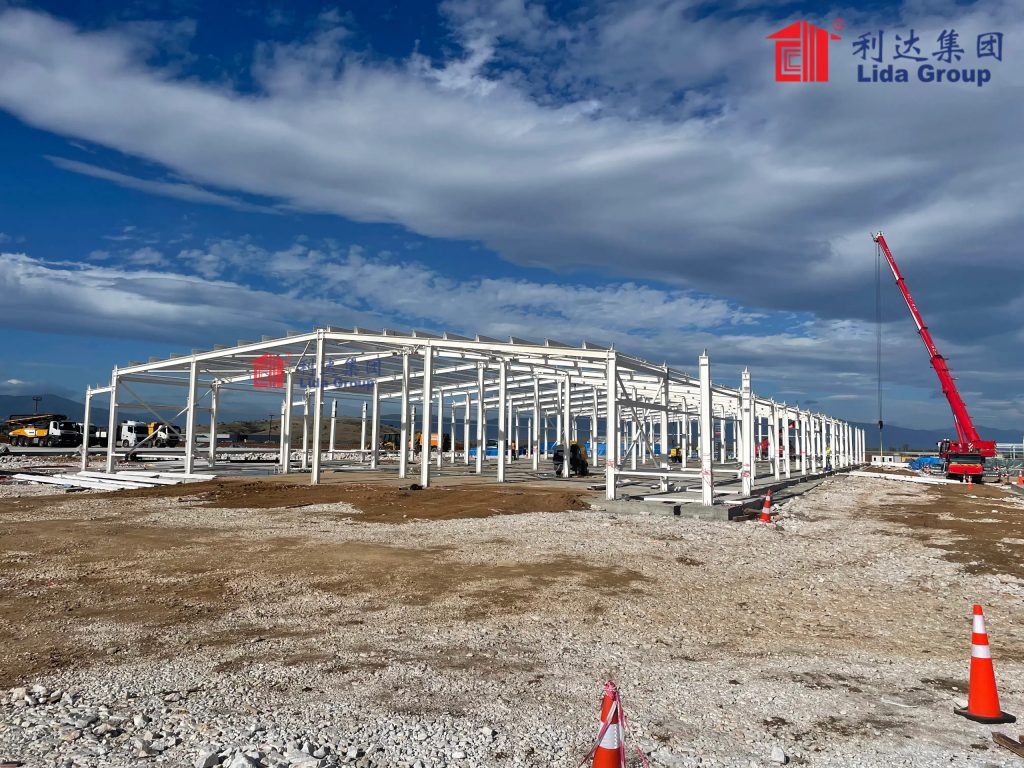
3. Streamlined Construction Workflow: Realize Ultra-Fast On-Site Delivery
Relying on innovative engineering technology, Lida Group has built a highly streamlined two-stage construction workflow of “factory prefabrication + on-site rapid assembly”, realizing qualitative leaps in construction efficiency and delivery speed. This workflow completely subverts the long-cycle construction mode of traditional metal houses and creates a fast delivery standard for low-cost steel structure buildings.
In the factory prefabrication stage, after the completion of digital design and parameter confirmation, the intelligent production line completes batch processing and pre-assembly of all components in an efficient manner. Compared with traditional manual workshop production, Lida’s automated production efficiency is increased by 10 times, and can complete the component production of 10 sets of standard residential metal houses every day. All components are packaged and transported in a classified and standardized manner, with clear installation labels, providing accurate guidance for on-site assembly.
The on-site assembly stage realizes zero-complex operation and ultra-fast delivery. After the components are transported to the site, ordinary construction workers without professional steel construction experience can complete the whole assembly work according to the labeled guidelines and quick-lock structure. A small team of 3 to 5 workers can complete the assembly and delivery of a 200-square-meter two-story metal residential house within 5 to 7 working days. Compared with the traditional 25-day construction cycle, the on-site efficiency is increased by more than 70%. For large-scale cluster projects such as industrial dormitories and emergency resettlement houses, Lida Group can realize batch delivery of dozens of buildings within one month, which is impossible for traditional construction modes.
Moreover, the simplified assembly process is not restricted by seasonal and weather conditions. The whole construction process does not produce construction waste, dust and noise pollution, which meets green construction standards. It can carry out normal construction in rainy, windy and low-temperature environments, ensuring stable project delivery progress throughout the year.
4. Full-Cycle Low-Cost Advantages Engineered by Lida Group
Different from the simple material cost reduction of traditional low-cost metal buildings, Lida Group realizes full-life-cycle cost optimization through engineering innovation and process optimization, achieving real high cost performance. The low-cost advantage covers raw material manufacturing, on-site construction, time cost and later operation and maintenance, fundamentally solving the problem of high hidden cost of traditional low-cost buildings.
First, engineering optimization reduces material and manufacturing costs. Digital modular design realizes precise material matching, avoiding redundant material configuration and waste. Automated batch production reduces unit manufacturing cost, and the lightweight steel structure design reduces foundation bearing requirements, saving nearly 50% of foundation construction cost compared with traditional buildings. The high-precision processing also reduces component damage and rework loss, further controlling upfront investment.
Second, simple operation greatly cuts labor and mechanical costs. Lida’s construction mode eliminates the demand for skilled steel structure workers and large welding, cutting equipment. The number of on-site construction personnel is reduced by more than 60%, and labor costs are saved by 35% to 40%. The cancellation of large mechanical equipment operation also reduces equipment rental, fuel and maintenance expenses, making the project upfront cost far lower than traditional metal buildings.
Third, ultra-fast delivery compresses time cost significantly. The shortened construction cycle enables customers to put the building into use in advance, accelerating capital recovery and creating economic benefits. For emergency housing projects, rapid delivery can provide safe living space for residents in the shortest time, reducing social and economic losses caused by housing shortages. Short construction cycles also reduce on-site management costs and safety risks, realizing invisible cost reduction.
Fourth, high-quality engineering design reduces later maintenance costs. Lida’s patented connection technology and high-quality anti-corrosion steel materials ensure that the metal house has a service life of more than 50 years. The stable structural performance avoids common quality problems such as water leakage and deformation, reducing maintenance frequency and cost. The excellent thermal insulation and energy-saving design also reduces daily energy consumption, bringing long-term economic benefits to users. In terms of full-life-cycle cost, Lida Group’s metal houses reduce comprehensive investment by 30% to 40% compared with traditional low-cost metal buildings.
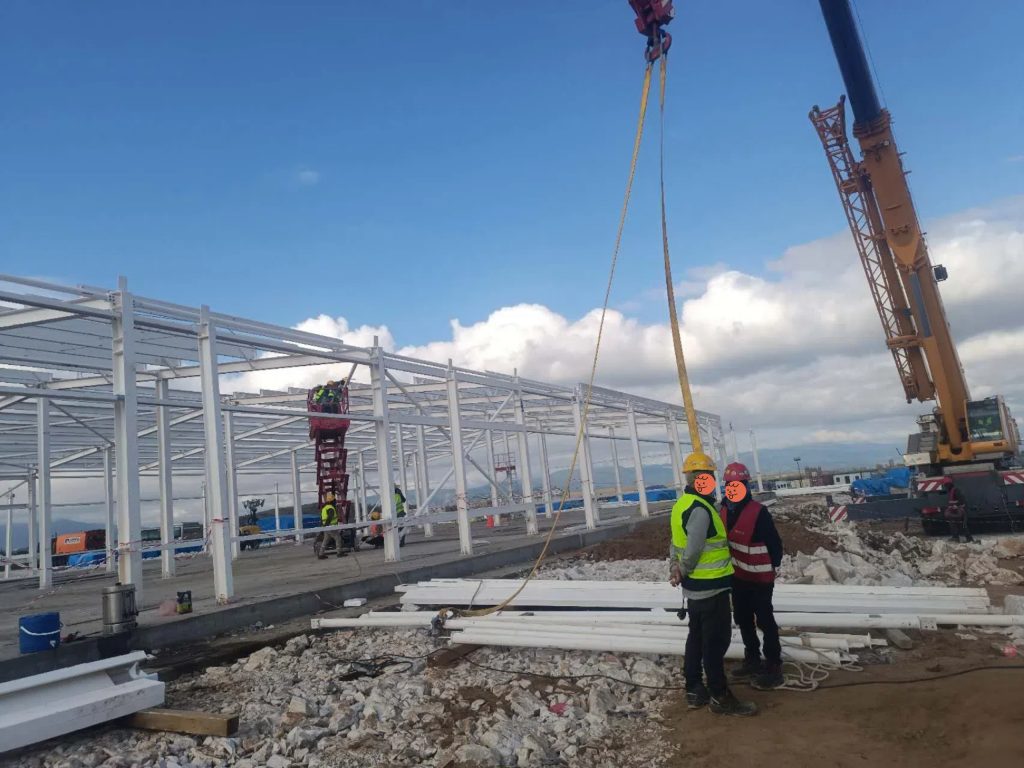
5. Global Project Practice Verification of Engineering Strength
Lida Group’s easy-operation and fast-delivery steel construction system has been fully verified in thousands of global engineering projects, covering more than 150 countries and regions, with outstanding performance in emergency rescue, rural construction, industrial supporting and remote area development scenarios.
In global emergency disaster relief projects, the technical advantages of simple operation and rapid delivery are fully demonstrated. After Typhoon Rai hit the Philippines, Lida Group completed the production and on-site assembly of 200 sets of resettlement house modules in only 30 days, cutting the traditional construction cycle by half. The local construction team without professional steel construction experience successfully completed the assembly work under the guidance of standardized operation guidelines, quickly providing safe and comfortable resettlement housing for disaster-stricken residents.
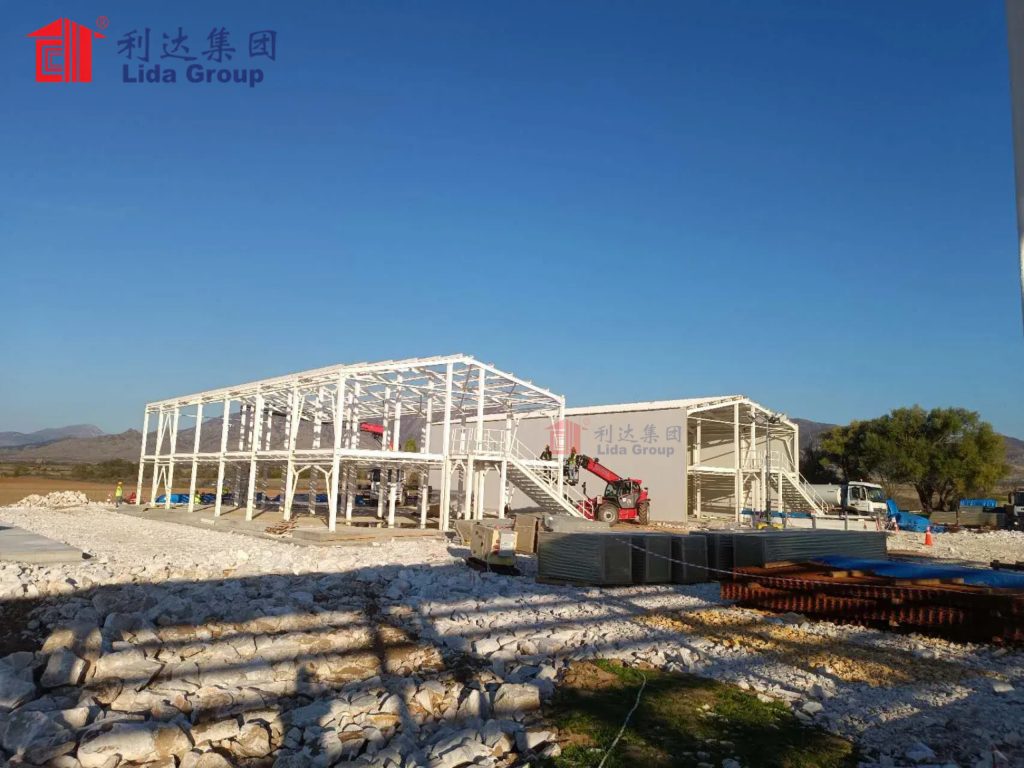
In remote industrial construction projects, Lida’s solution solves the construction difficulties of insufficient local technicians and limited equipment conditions. In the Chilean warehouse construction project, Lida Group’s modular components were quickly transported and assembled by local ordinary workers, completing the construction of multiple 5,000-square-meter large warehouses in only 12 weeks, which far exceeded the industry construction efficiency. The project was completed with low investment and stable quality, winning high recognition from local customers.
In rural affordable housing and urban temporary accommodation projects, Lida’s low-cost and easy-operation metal houses have solved the housing dilemma of low and middle-income groups. The standardized and customizable design adapts to different regional living habits and climatic environments, while the ultra-low construction cost reduces the economic pressure of users. A large number of practical projects have proved that Lida Group’s engineering system can always maintain efficient construction, low cost and stable quality in different complex environments.
6. Industrial Value and Standard Leading Role
For a long time, the global low-cost metal building industry has formed a solidified wrong cognition that “low cost equals low quality and complex operation”. Most manufacturers reduce costs by downgrading materials and simplifying structures, resulting in uneven product quality and poor user experience in the industry. Lida Group’s engineering innovation completely breaks this industrial dilemma, proving that through professional technical engineering, low-cost metal houses can also achieve simple operation, rapid delivery and high-quality performance.
Lida Group has formed a complete set of standardized construction specifications for easy-operation steel construction through long-term project practice and technical iteration, covering digital design standards, factory prefabrication specifications, on-site assembly procedures and quality inspection standards. These standardized systems fill the industry gap of low-cost metal building fine construction, raise the overall technical threshold and quality level of the industry, and guide the standardized and high-quality development of the global low-cost metal construction field.
In addition, Lida’s construction mode conforms to the global green building development trend. Factory prefabrication reduces on-site construction waste and dust pollution by more than 60%, and all steel materials can be recycled and reused, realizing low-carbon and environmentally friendly construction. While reducing construction costs and improving efficiency, it promotes the sustainable development of the construction industry, bringing good environmental and social benefits.
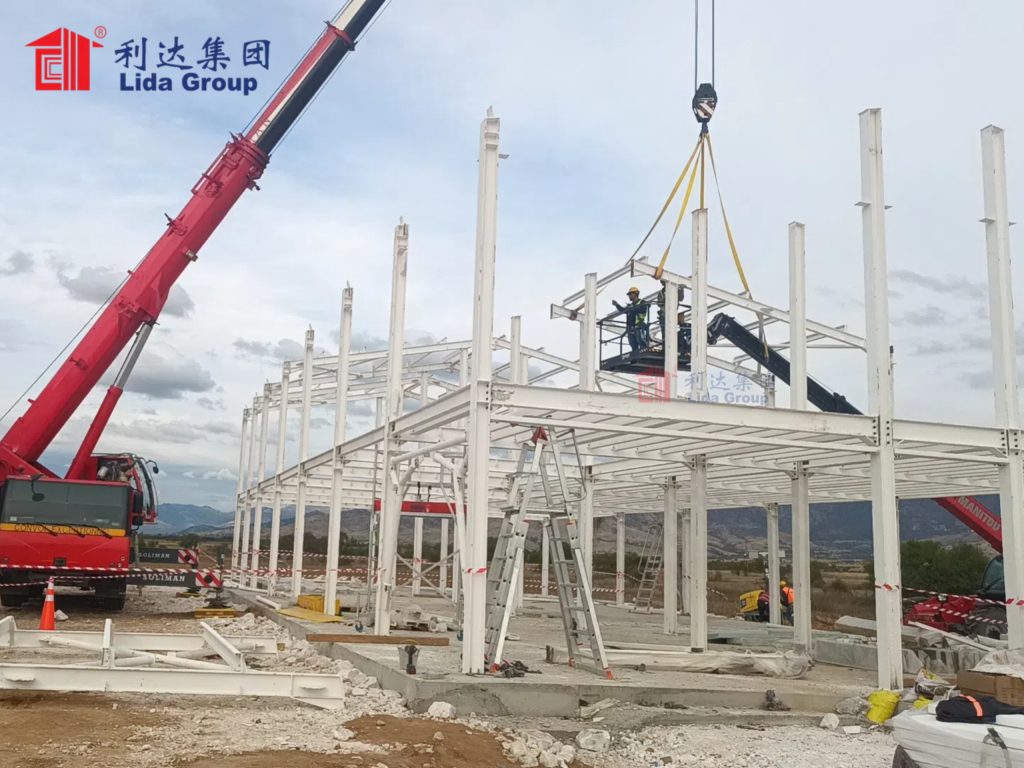
7. Future Technical Iteration and Development Prospect
With the continuous development of global construction industrialization and intelligent technology, Lida Group will continue to iterate and upgrade the easy-operation steel construction system. In terms of technical research and development, the enterprise will further integrate intelligent design systems, automatic assembly equipment and smart building technologies, realize more intelligent and unmanned auxiliary construction, and further reduce operation difficulty and construction cycle.
In terms of material engineering innovation, Lida Group will develop new high-strength, fire-proof, heat-insulating and ultra-corrosion-resistant composite steel materials to further improve the safety, comfort and service life of low-cost metal houses. At the same time, the enterprise will optimize the modular combination scheme to improve the customization flexibility of metal houses, making it adaptable to more personalized construction scenarios.
In terms of market promotion, Lida Group will continue to popularize its standardized easy-operation steel construction standards globally, provide high-quality and low-cost rapid construction solutions for more regions, and drive the overall upgrading of the global metal building industry. With the increasing global demand for affordable housing and rapid emergency construction, Lida’s innovative engineering system will have broader market application space.
8. Conclusion
Lida Group’s self-engineered easy-operation steel construction system has completely revolutionized the construction mode of traditional low-cost metal houses. Through digital modular design, patented quick-lock connection technology, intelligent factory prefabrication and streamlined assembly workflow, the enterprise successfully solves the core industry pain points of complex operation, slow delivery, high labor dependence and unstable comprehensive cost. It realizes the organic unity of ultra-low operation threshold, ultra-fast construction efficiency and full-cycle low cost, breaking the long-term industry prejudice that low-cost metal buildings cannot achieve high-efficiency and high-quality construction.
A large number of global engineering practices have fully verified the reliability and practicability of Lida Group’s innovative construction technology. Whether in emergency disaster relief, remote industrial construction or rural affordable housing projects, the system can deliver high-standard metal houses quickly and economically, effectively solving the global demand for affordable and rapid construction. While creating significant economic value for customers, Lida Group has established a new industrial standard for easy-operation and low-cost rapid steel construction, leading the standardized, green and efficient upgrading of the global metal building industry. In the future, with continuous technological iteration and global promotion, Lida Group will continue to empower the development of the construction industry and contribute more reliable solutions to global affordable housing infrastructure construction.
Related news
-
Lida Group Sets New Standard in Easy Operation Steel Construction for Low Cost Metal House Projects
2026-06-03 16:55:06
-
Affordable Living Solution: Low Cost Metal House with Easy Operation Steel Structure Building
2026-06-03 17:47:14
-
Lida Group Combines Affordability and Efficiency in Oil Field Worker Dormitory Projects
2026-05-28 17:14:15
contact us
- Tel: +86-532-88966982
- Whatsapp: +86-13793209022
- E-mail: sales@lidajituan.com
