



Lida Group Delivers Flat Packed Container House for Remote Construction and Mining Camps
2026-May-27 17:56:04
By Admin
Introduction
Large-scale infrastructure construction, mineral resource exploitation, and remote engineering projects are often located in isolated, inaccessible regions, including mountainous areas, desert basins, high-altitude plateaus, and coastal offshore zones. These remote sites share common operational characteristics: harsh natural environments, poor transportation conditions, limited local supporting facilities, and long-term continuous construction cycles. For project investors and construction contractors, building stable, safe, and cost-effective on-site camps for workers and management teams has always been a core operational challenge. On-site accommodation directly affects workforce stability, daily work efficiency, on-site safety management, and overall project construction progress.
Traditional temporary camp solutions, including brick-and-mortar buildings, welded color steel houses, and integrated shipping containers, are increasingly unable to adapt to the special needs of remote construction and mining projects. Fixed buildings require extensive local material procurement, heavy mechanical equipment, and long on-site construction cycles, which are impractical in roadless and resource-scarce remote areas. Welded temporary houses suffer from poor durability, severe corrosion, weak weather resistance, and high maintenance costs. Pre-assembled integral containers incur exorbitant long-distance logistics expenses and cannot be flexibly adjusted and transferred with project progression. These traditional drawbacks lead to increased project costs, delayed camp settlement, poor worker living conditions, and low asset utilization rates.
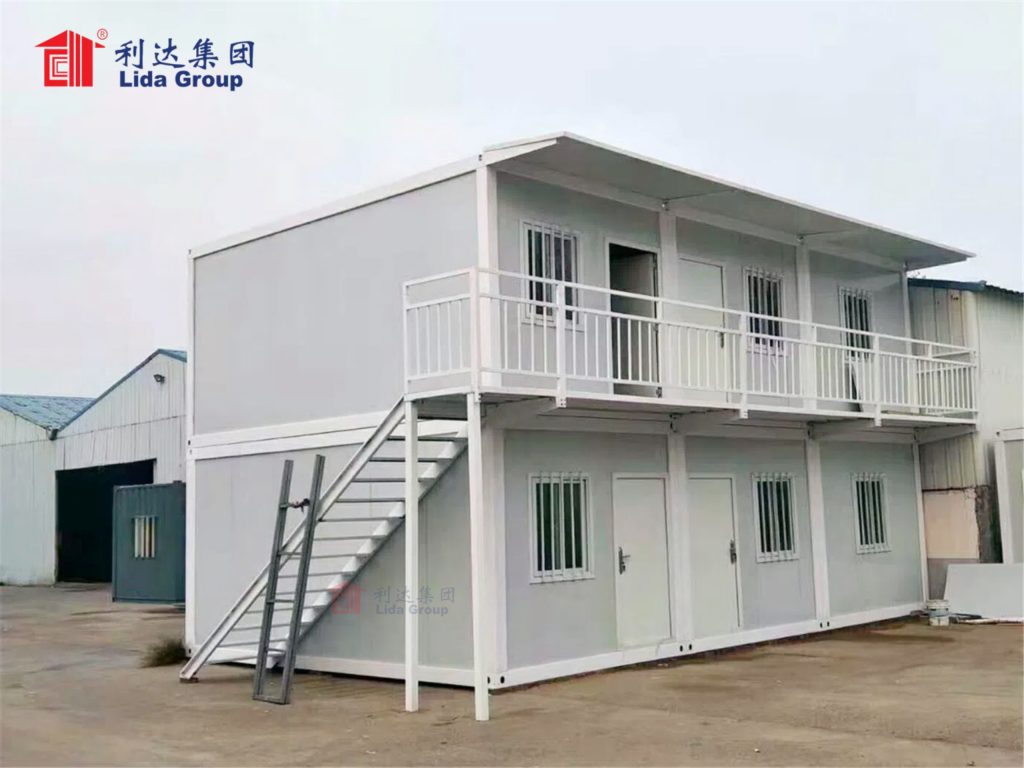
As a professional global supplier of modular construction solutions tailored for engineering and mining scenarios, Lida Group targets the harsh environmental conditions and special construction demands of remote camps, launching customized flat packed container house solutions. Optimized exclusively for remote construction and mining camp deployment, Lida’s flat packed container houses feature collapsible flat packaging, ultra-convenient transportation, tool-free rapid assembly, industrial-grade corrosion resistance, and extreme weather adaptability. They fully solve the transportation difficulties, slow deployment, poor durability, and high comprehensive costs of traditional camp buildings. This article comprehensively analyzes the practical pain points of traditional remote mining and construction camps, core technical advantages of Lida’s flat packed container houses, scenario-based optimization design, full-lifecycle economic value, and on-site application effects, demonstrating how Lida’s professional modular housing systems provide reliable, efficient, and economical long-term camp guarantees for global remote engineering and mining projects.
1. Core Challenges of Traditional Remote Construction and Mining Camp Housing
Remote construction and mining projects differ greatly from urban engineering scenarios. Complex terrain, extreme climates, inconvenient logistics, and long project cycles create multiple unique challenges for temporary camp construction. Traditional housing solutions have prominent inherent defects in transportation feasibility, construction efficiency, environmental adaptability, structural durability, and cyclic usability, restricting standardized camp operation and refined project management.
1.1 Extreme Transportation Difficulties and High Logistics Costs
Most mining and remote construction sites are far away from urban areas, lacking hardened roads and large-scale transportation passage conditions. Traditional integral welded houses and fully assembled container units have fixed bulky volumes, making large-tonnage vehicle transportation impossible in mountain roads, rugged dirt roads, and plateau narrow passages. Construction materials for brick-concrete camps require batch transportation over long distances, with frequent secondary handling and manual relay transportation, resulting in extremely high logistics costs. In contrast, flat packed modular houses completely change the transportation model. However, traditional products lack flat folding design, leading to low single-vehicle loading capacity, serious transportation space waste, and logistics expenses accounting for more than 30% of total camp construction investment. For cross-border remote mining projects, international freight and road transfer costs further amplify project burden.
1.2 Harsh Field Environments Lead to Short Service Life and Frequent Failures
Remote mining and construction sites feature typical extreme working conditions: high-altitude low-temperature hypoxia, strong ultraviolet radiation in plateau areas, high-temperature drought and sandstorms in desert mining areas, and high humidity and salt spray erosion in coastal mountainous construction zones. Traditional temporary camp houses adopt thin low-quality steel plates and simple single-layer anti-rust paint treatment. Without industrial anti-corrosion and weather-resistant protection systems, steel frames quickly rust, deform, and loosen. Color steel wall panels age rapidly, resulting in water leakage, heat insulation failure, and air leakage. In severe cases, structural instability endangers living safety. Most traditional camps can only be used stably for one to two years, requiring frequent maintenance, partial replacement, and even overall reconstruction during long-cycle mining projects, causing continuous hidden cost consumption and management troubles.
1.3 Slow On-Site Construction Delays Workforce Settlement
Remote project sites lack complete construction supporting conditions, professional construction teams, and large hoisting equipment. Traditional temporary houses require foundation pouring, on-site welding, wall assembly, and electrical and water pipeline laying, involving complex wet construction and high-altitude outdoor operations. Affected by bad weather such as strong winds, heavy snow, and continuous rainfall, the construction cycle is extremely unstable. A complete medium-sized mining camp often requires two to four weeks of construction time, seriously delaying worker settlement and project preparation progress. Slow camp deployment directly restricts manpower input and equipment commissioning, dragging down the overall construction schedule of remote projects.
1.4 Non-Reusable Design Causes Serious Resource Waste
Most remote mining and infrastructure projects are phased and mobile. After resource exploitation or project completion, traditional welded fixed camps cannot be disassembled and transferred. They can only be demolished and discarded on-site, producing massive construction waste and causing severe resource waste. For mining enterprises with multiple remote mine sites and engineering companies undertaking cross-regional projects, repeated camp construction investment forms huge invalid capital consumption, with extremely low asset reuse rate and poor long-term economic benefits.

2. Core Technical Advantages of Lida Group’s Flat Packed Container Houses for Remote Camps
Targeting the multiple pain points of remote mining and construction camp construction, Lida Group optimizes flat packed container houses in structural design, transportation mode, on-site assembly, environmental adaptability, and durable performance. Through professional modular innovation and industrial standardized manufacturing, Lida’s products form exclusive technical advantages suitable for extreme remote scenarios, fully adapting to the special construction and living needs of remote camps.
2.1 Flat Collapsible Structure Solves Remote Transportation Bottlenecks
The core advantage of Lida’s flat packed container house lies in its innovative fully collapsible flat packaging design. All steel frames, wall panels, roof components, and auxiliary accessories can be completely disassembled and folded into flat stacked structures, minimizing unit packaging volume. Compared with traditional integral containers, the stacking and loading efficiency is increased by more than 300%. A single standard shipping container can load dozens of flat-packed house units, greatly reducing international ocean freight and long-distance road transportation costs. The flat stacked packaging has small footprint and strong traffic adaptability, suitable for narrow mountain roads, plateau dirt roads, and unimproved temporary road conditions in remote mining areas. It does not require large hoisting and transportation equipment, supporting small vehicle segmented relay transportation, completely solving the logistics difficulty of remote camp material delivery.
2.2 Industrial Anti-Corrosion and Extreme Weather Resistant Structure
To adapt to extreme environments of remote mining and construction sites, Lida’s flat packed container houses adopt high-strength zinc-aluminum-magnesium alloy steel frames and hot-dip galvanized anti-corrosion technology. All load-bearing steel components undergo industrial high-temperature galvanizing treatment to form a dense metallurgical protective layer, featuring excellent salt spray resistance, ultraviolet aging resistance, wind and sand erosion resistance, and low-temperature frost resistance. The overall structure passes finite element mechanical simulation tests, meeting international high wind resistance, heavy snow load, and seismic safety standards. The optimized fully sealed waterproof and dustproof structure effectively prevents sandstorm infiltration, rainwater leakage, and humid corrosion. Whether in high-altitude cold plateaus, high-temperature dry deserts, or humid coastal mining areas, Lida’s flat packed houses maintain stable structural performance, with a service life of more than 15 years in harsh remote environments, far exceeding traditional temporary camp facilities.
2.3 Tool-Free Rapid Assembly Adapts to Primitive Construction Conditions
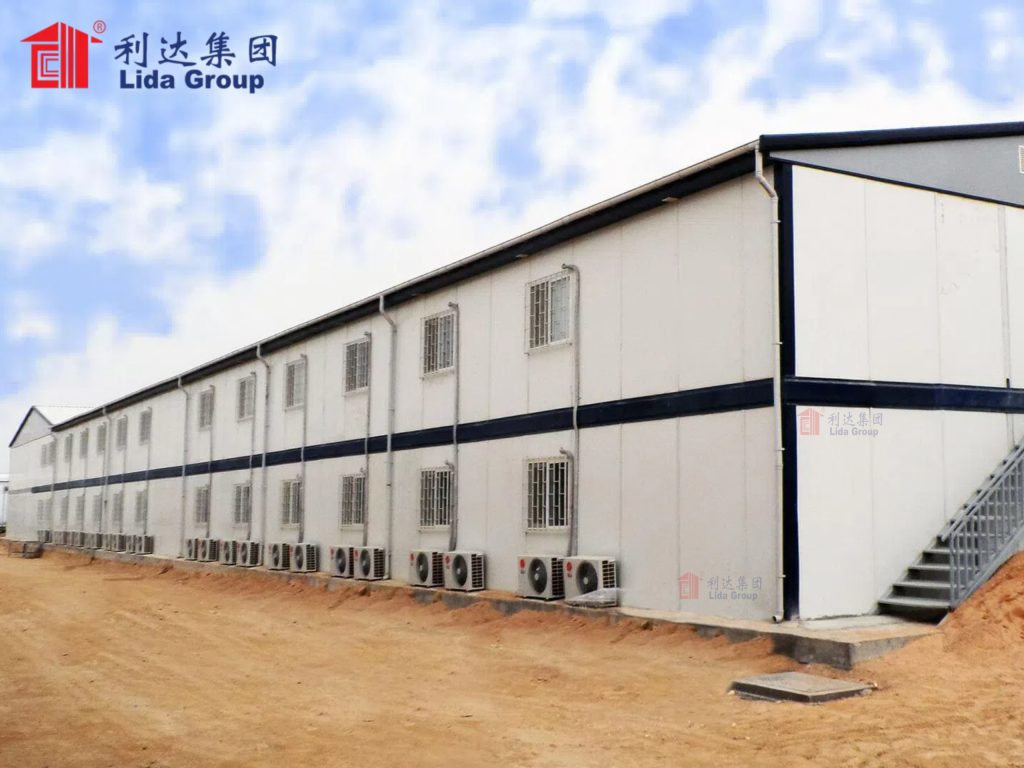
Lida Group’s flat packed container houses adopt standardized full-bolt assembly structure, abandoning complex on-site welding and wet construction processes. More than 95% of structural processing, interior decoration, and pipeline pre-embedding are completed in factory standardized workshops. After transportation to remote sites, ordinary workers can complete unit assembly, positioning, and fixing with only simple hand tools, without professional welding technicians, large mechanical equipment, and supporting construction facilities. A single standard dormitory unit can be assembled and put into use within one hour, and a large-scale camp with hundreds of units can be fully deployed within three to five days. This ultra-fast assembly mode completely adapts to the primitive construction conditions of remote sites without complete infrastructure, realizing rapid workforce settlement and efficient camp construction.
2.4 Lightweight Foundation-Free Design Reduces On-Site Construction Difficulty
Different from traditional buildings that require flat hardened ground and concrete foundation pouring, Lida’s flat packed container houses support flexible laying on uneven remote site terrain. The lightweight high-strength structure has low foundation bearing requirements, adaptable to slightly sloped terrain, gravel ground, and compacted dirt ground in mining areas. It eliminates foundation concrete pouring, long curing cycles, and ground leveling engineering, greatly reducing on-site construction workload and material demand. This foundation-free design saves a great deal of construction time and labor costs for remote camps, while avoiding environmental damage and vegetation destruction caused by large-scale foundation construction, conforming to green mining and eco-friendly remote construction standards.
3. Scenario-Based Optimization Design for Mining and Remote Construction Camps
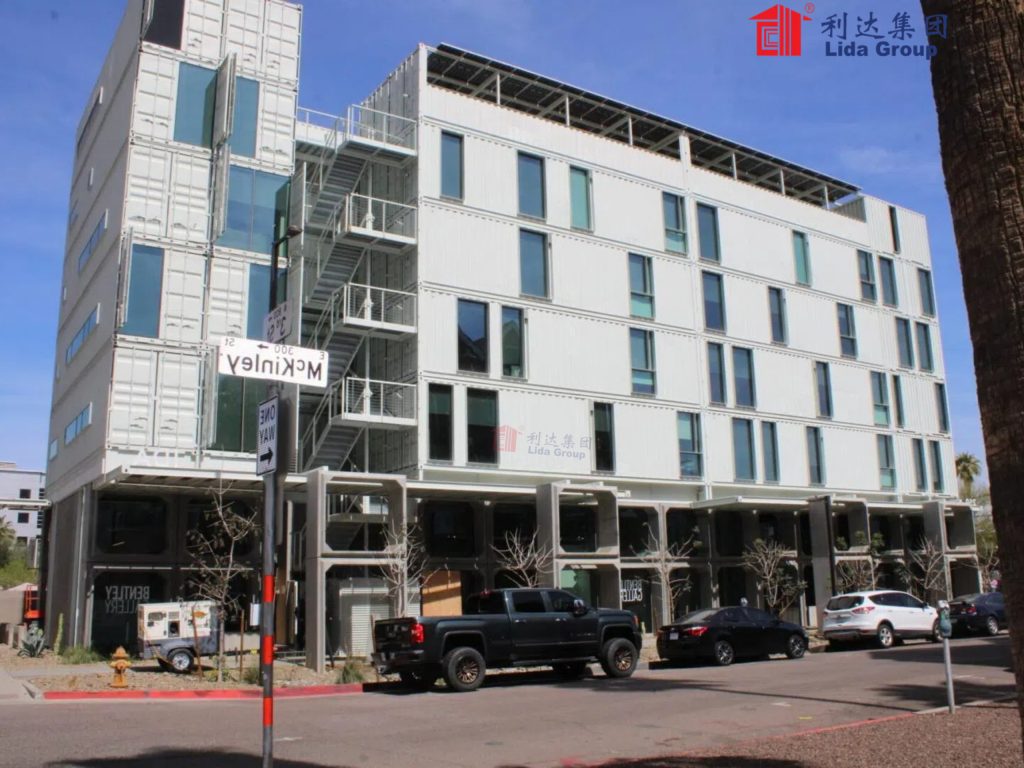
Lida Group does not adopt unified fixed design for flat packed container houses but carries out targeted functional optimization and spatial configuration according to the living, office, and supporting needs of remote construction and mining camps, forming a complete set of professional camp solutions integrating accommodation, office, catering, and storage.
3.1 Humanized Worker Dormitory Configuration
Aiming at the long-term resident characteristics of mining and remote construction workers, Lida optimizes the dormitory living system. The internal space is scientifically planned with reasonable layout, equipped with anti-corrosion beds, storage cabinets, and waterproof and moisture-proof floors. High-density thermal insulation and sound insulation materials are filled in wall panels and roofs to solve the problems of extreme heat in desert summers and severe cold in plateau winters, creating constant-temperature indoor living conditions. Equipped with anti-dust ventilation windows and fresh air circulation systems, the indoor air is kept clean and smooth, effectively isolating external sandstorms and construction dust. The independent lighting and safe electrical system meet daily charging and living electricity needs, improving worker rest quality in harsh remote environments.
3.2 Integrated Office and Management Functional Area
To meet the daily management, meeting, and office needs of remote project teams, Lida’s flat packed container units can be freely spliced and combined into centralized office areas, meeting rooms, project command stations, and management offices. The spacious and tidy indoor space is equipped with pre-buried network lines and multi-functional socket systems, supporting office equipment operation and remote project data transmission. The sealed and dustproof design ensures clean indoor office environment, avoiding equipment failure caused by mining dust and sand erosion. The standardized office camp provides a stable working environment for project management personnel and ensures orderly progress of remote project scheduling and safety supervision work.
3.3 Complete Supporting Public and Storage Facilities
Lida’s camp solution supports flexible expansion of diversified supporting functional areas, including public toilets, shower rooms, canteens, material storage rooms, tool rooms, and on-site security rooms. The modular combination mode realizes integrated matching of living, catering, storage, and security functions, forming a fully functional closed-loop camp system suitable for long-term remote operation. The special storage container units adopt enhanced dustproof and moisture-proof design, which can safely store mining tools, mechanical accessories, engineering materials, and daily supplies, solving the problem of difficult material storage and management in open remote mining areas.
4. Outstanding Full-Lifecycle Economic Benefits for Remote Projects
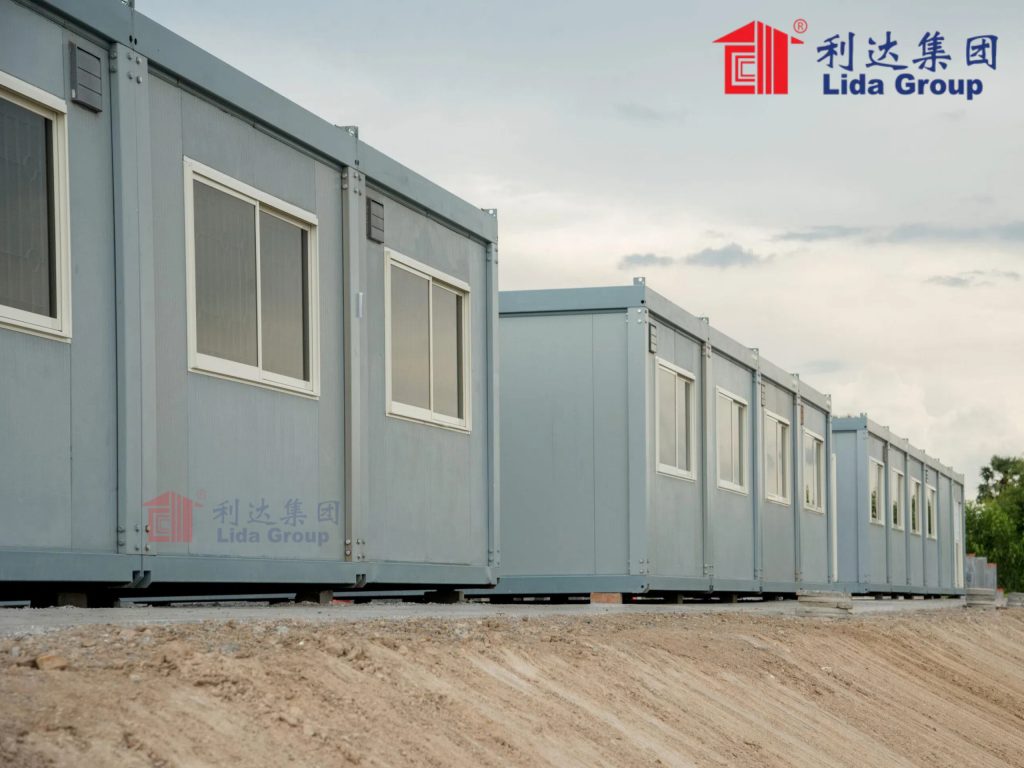
For remote construction and mining projects with large investment and long cycles, the full-lifecycle comprehensive cost of camp facilities directly affects project profit margins. Lida Group’s flat packed container houses create significant economic advantages through low logistics cost, zero foundation construction, low maintenance consumption, and reusable asset value.
4.1 Greatly Reduced Remote Logistics and Deployment Costs
The flat collapsible stacking design maximizes single-vehicle loading capacity, reducing unit logistics cost by more than 60% compared with traditional integral containers. The foundation-free and tool-free assembly mode eliminates material consumption and mechanical leasing costs for foundation construction, greatly cutting on-site deployment investment. The efficient and rapid construction shortens camp preparation cycle, accelerating project commencement progress and creating earlier project revenue for enterprises.
4.2 Ultra-Low Long-Term Maintenance Consumption
Lida’s industrial-grade anti-corrosion and weather-resistant structure avoids frequent rust removal, repainting, and component replacement of traditional temporary houses. The dustproof, waterproof, and aging-resistant performance ensures stable long-term operation of the camp, with annual maintenance cost less than 3% of the initial investment. Compared with traditional mining camps that require large-scale overhaul every one to two years, Lida’s solution saves massive long-term maintenance expenses and reduces camp management workload.
4.3 Reusable Realizes Cross-Project Cyclic Utilization
The fully detachable bolt structure enables Lida’s flat packed container houses to be quickly disassembled, folded, packaged, and transported after project completion. The high-strength steel structure can withstand more than eight repeated disassembly and assembly cycles without performance attenuation, supporting cross-mine and cross-project cyclic reuse. For mining enterprises and engineering companies with long-term multi-site layout, the reusable camp system converts one-time construction investment into sustainable fixed assets, completely eliminating repeated camp construction waste and greatly improving asset utilization rate.
5. Practical Application Value for Remote Mining and Construction Projects
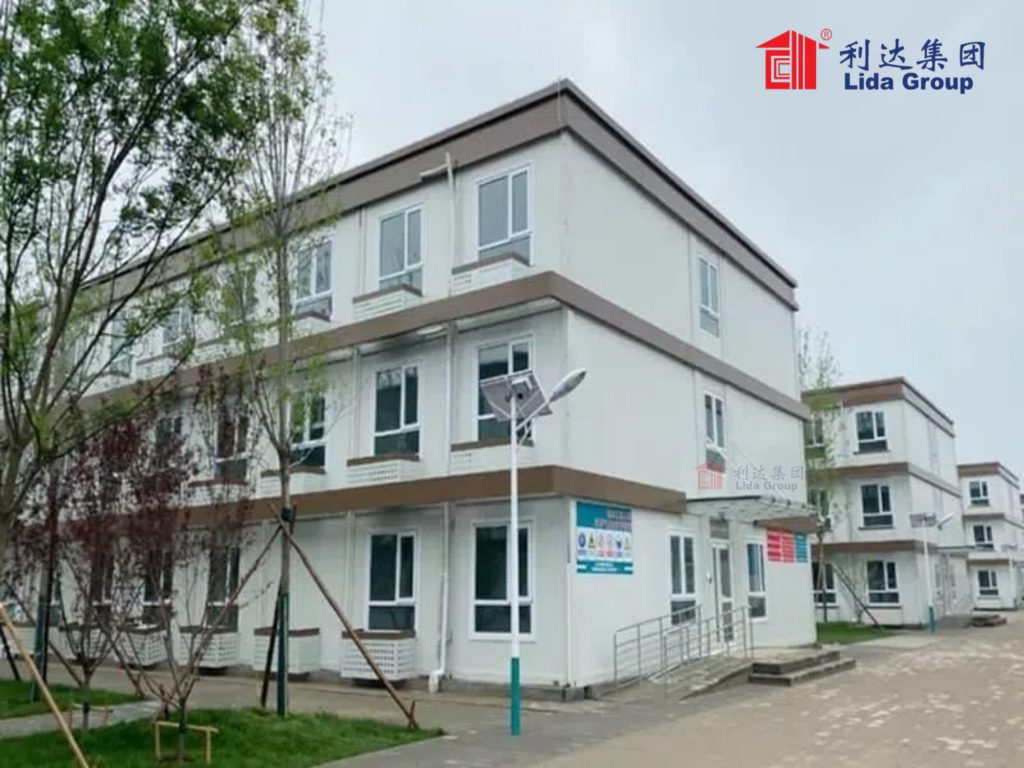
Lida Group’s flat packed container house camp solutions have been widely applied in global remote mineral exploitation, highway and railway construction, new energy base construction, and water conservancy engineering projects. In desert open-pit mines, the excellent windproof, sandproof, and high-temperature resistant performance ensures stable camp operation all year round. In high-altitude plateau engineering projects, the low-temperature resistant thermal insulation design solves the difficulty of winter camp living. In mountain road construction camps, flexible transportation and rapid assembly adapt to complex terrain and inconvenient traffic conditions.
Beyond economic cost advantages, Lida’s standardized and humanized camp environment effectively improves worker living comfort and job satisfaction, reducing workforce turnover caused by harsh accommodation conditions and stabilizing project manpower. The neat and unified modular camp layout realizes standardized and civilized on-site construction management, helping enterprises pass project safety assessments and civilized construction inspections, enhancing corporate brand image in global remote project competition.
6. Conclusion
Remote construction and mining projects have always faced prominent camp construction dilemmas: harsh natural environments, inconvenient transportation, difficult on-site construction, and high comprehensive operating costs. Traditional temporary housing solutions cannot balance rapid deployment, environmental adaptability, long-term durability, and economic efficiency, becoming a key shortcoming restricting the efficient development of remote engineering and mining industries.
By launching professional flat packed container house solutions tailored for remote camps, Lida Group completely breaks the industry’s traditional limitations. The innovative flat collapsible structure solves the transportation bottleneck of remote inaccessible areas; industrial anti-corrosion and extreme weather resistant design adapts to various harsh mining and construction environments; tool-free rapid assembly and foundation-free deployment adapt to primitive on-site construction conditions; and reusable modular design creates excellent full-lifecycle economic value. Lida Group’s flat packed container houses not only provide safe, comfortable, and fully functional long-term camp accommodation and office spaces for remote construction and mining teams but also effectively reduce project comprehensive costs, stabilize workforce teams, and standardize on-site management. As a mature, reliable, and cost-effective remote camp construction solution, Lida Group continues to empower the high-efficiency, standardized, and sustainable development of global remote infrastructure construction and mineral resource exploitation industries.
Related news
-
Discover the Versatility of Living Container House Designs from Lida Group
2026-05-27 17:47:34
-
Prefabricated Container Worker Dormitory Solutions by Lida Group Enhance On-Site Living
2026-05-27 17:17:57
-
Lida Group Offers Low Cost Metal House Using Corrosion-Resistant Steel Structure Building
2026-05-27 16:36:07
contact us
- Tel: +86-532-88966982
- Whatsapp: +86-13793209022
- E-mail: sales@lidajituan.com
