



From Dormitories to Rest Lounges: Turnkey Container Solutions for Oilfield Operations by Lida Group
2026-Oct-26 15:50:47
By Admin
Introduction
Remote oil and gas operations have always lived or died by one quiet variable: whether the workforce is properly housed, fed, rested and looked after, hundreds of kilometres from the nearest town. A drilling rig, a production platform onshore, a pipeline construction spread or a turnaround camp can mobilise hundreds, sometimes thousands, of contractors in a matter of weeks. Where those people sleep, eat, shower, take their breaks and recover between shifts is not an afterthought. It is the infrastructure that determines whether a project stays on schedule, stays within budget and stays incident-free.
For decades, operators met this challenge with prefabricated steel buildings, timber huts and, in the worst cases, tents. Those approaches worked at a small scale and a slow pace, but they no longer match the realities of today’s oilfield projects. Men and women are mobilised faster, camps are built and abandoned more frequently, sites move as drilling progresses, and health, safety and environment (HSE) expectations have become far stricter. The industry has responded by adopting container-based modular buildings as the default workforce-accommodation system, and Lida Group has positioned itself as a turnkey supplier capable of delivering that entire ecosystem, from the first dormitory module to the last rest lounge.
This article explains why containerised camp solutions have become the standard for oilfield operations, walks through the full range of facilities a modern remote camp requires, and describes how Lida Group designs, manufactures, delivers and installs turnkey projects that allow operators to focus on production rather than on construction.
The Accommodation Challenge in Remote Oilfield Operations
Oilfield camps are unlike almost any other construction programme. They are temporary by design but must be built to permanent standards. They appear in environments as different as the Arabian Desert, the Siberian taiga, the West African coast and the North Slope of North America, each with its own temperature range, dust load, humidity, wind and seismic conditions. They house rotational workforces living two weeks on and two weeks off, six days a week, twelve hours a day, and therefore must support not only sleeping but the full cycle of human life: meals, showers, laundry, medical care, communication with families, recreation and quiet recovery.
Three structural pressures define the brief. First, speed: a camp that is not ready when the crews arrive delays spud-up, rig move and production handover, and every idle day on a multi-rig programme is expensive. Second, reliability: equipment and accommodation must function continuously in places where a replacement part may take a week to arrive. Third, people performance: fatigue, heat stress, poor sleep and bad food are well-established contributors to incidents, absenteeism and turnover. A camp is therefore a production asset, not a cost centre.
These pressures explain why operators increasingly reject ad-hoc, locally built camps in favour of engineered, factory-produced, containerised systems that can be procured as one package from a single responsible supplier.
Why Traditional Camp Construction No Longer Keeps Up
Conventional stick-built or masonry camps suffer from three weaknesses that have become decisive in modern project cycles.
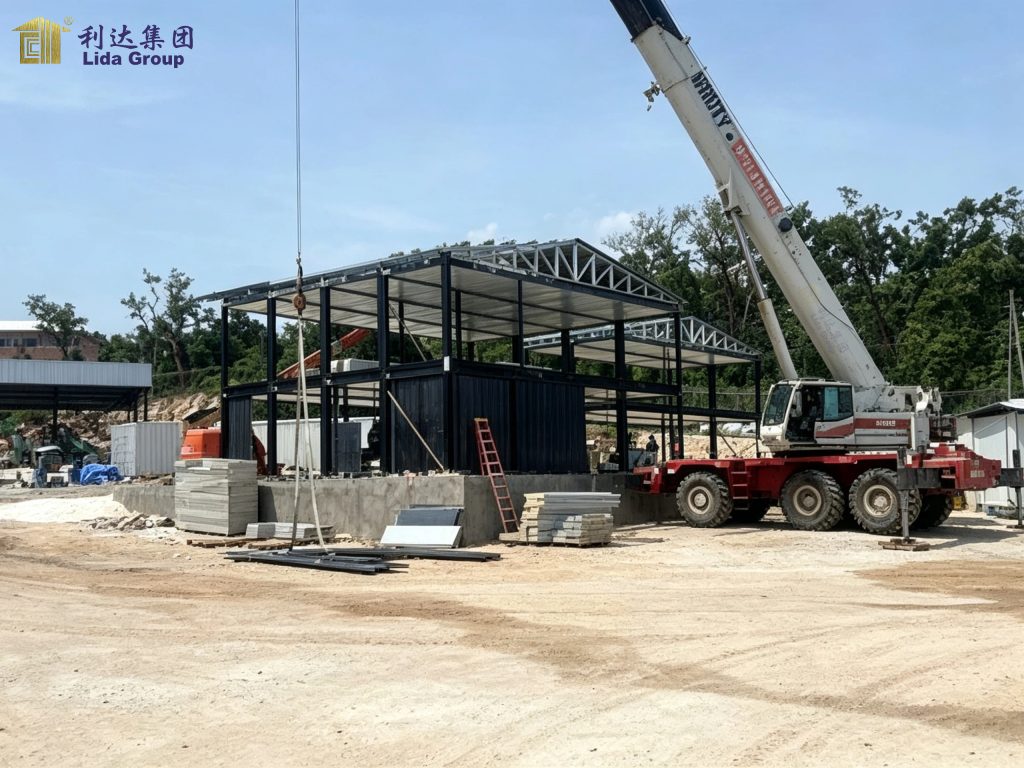
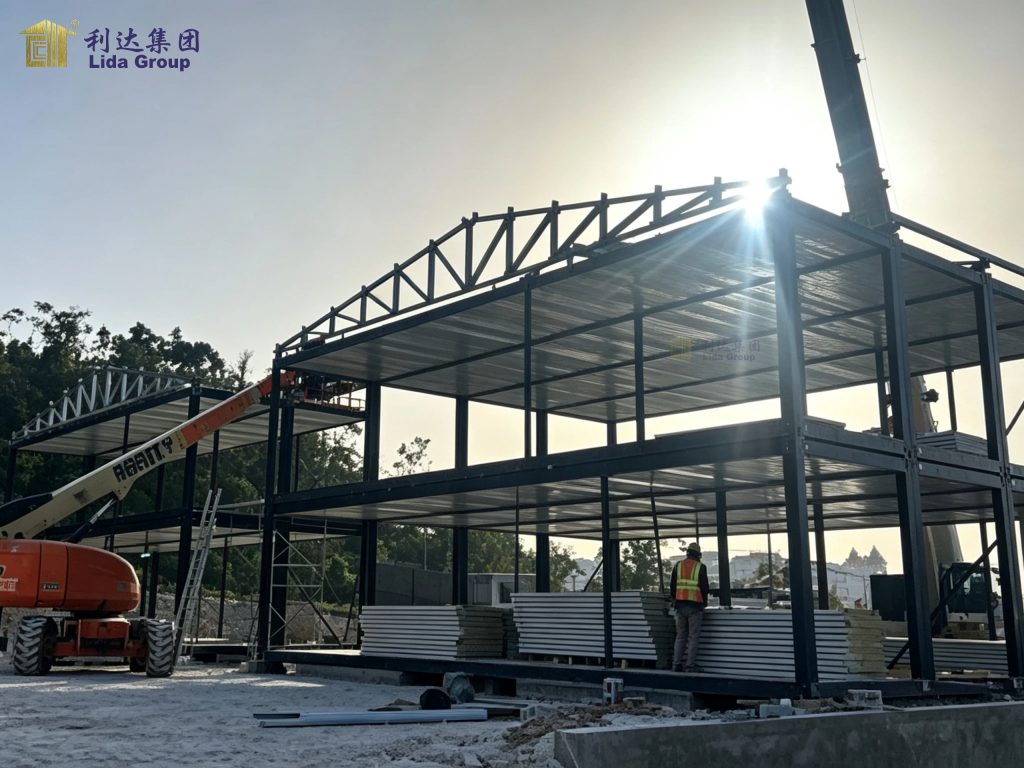
First, they are slow. On-site construction in remote locations depends on local labour, wet trades, curing times and weather windows. A camp for five hundred people can easily take six to nine months to erect, long before the first rig is on site. In contrast, a containerised camp is manufactured in parallel with civil works, and on-site assembly is largely dry fitting: cranes set modules, electricians and plumbers connect pre-run services, and the facility opens in weeks rather than months.
Second, they are difficult to reconfigure or relocate. Oilfields move. A drilling campaign starts in one block and finishes in another; a pipeline camp follows the right-of-way kilometre by kilometre; a turnaround crew appears for six weeks and disappears. A masonry building is effectively destroyed when it is taken down. A flat-pack or rigid container building can be lifted onto a truck, driven to the next site and rebuilt with a small crew, often more than ten times over its service life.
Third, quality is inconsistent. On-site workmanship, especially in jurisdictions with limited specialised trades, varies from block to block. Factory-controlled production, under a single quality-management system, delivers identical insulation values, identical fire ratings and identical electrical safety across every module, every order and every continent.
What “Turnkey” Actually Means for an Oilfield Operator
The word turnkey is often overused. In the context of remote workforce camps, it has a precise meaning. A turnkey supplier takes responsibility for the entire built envelope and its internal fit-out, starting from the operator’s headcount and shift pattern and ending with a site that the client can literally put into the key and walk into on moving day.
In practice, this means the supplier handles space planning (how many beds, how many seats in the dining hall, how many showers per hundred workers), structural and foundation design, thermal and acoustic specification, mechanical and electrical services, water and sewage treatment interface, furniture and fittings, kitchen equipment, laundry machines, even bedding and tableware. The operator supplies the land, the power, the water and the sewer connection. Everything else is one scope, one contract, one warranty, one point of contact.
For an oil major, an engineering, procurement and construction (EPC) contractor or an oil-services company, this is where the real value sits. It removes the coordination risk between ten different subcontractors, collapses the schedule, and makes the cost predictable before the steel is even cut.
Inside Lida Group’s Container Portfolio for Oilfield Camps
A functional remote camp is a small village. Lida Group’s product range is organised to cover every building type that village requires, all built on the same modular container platform so that they look consistent, install on the same footing system and share the same spare-parts logic.
Dormitory Units
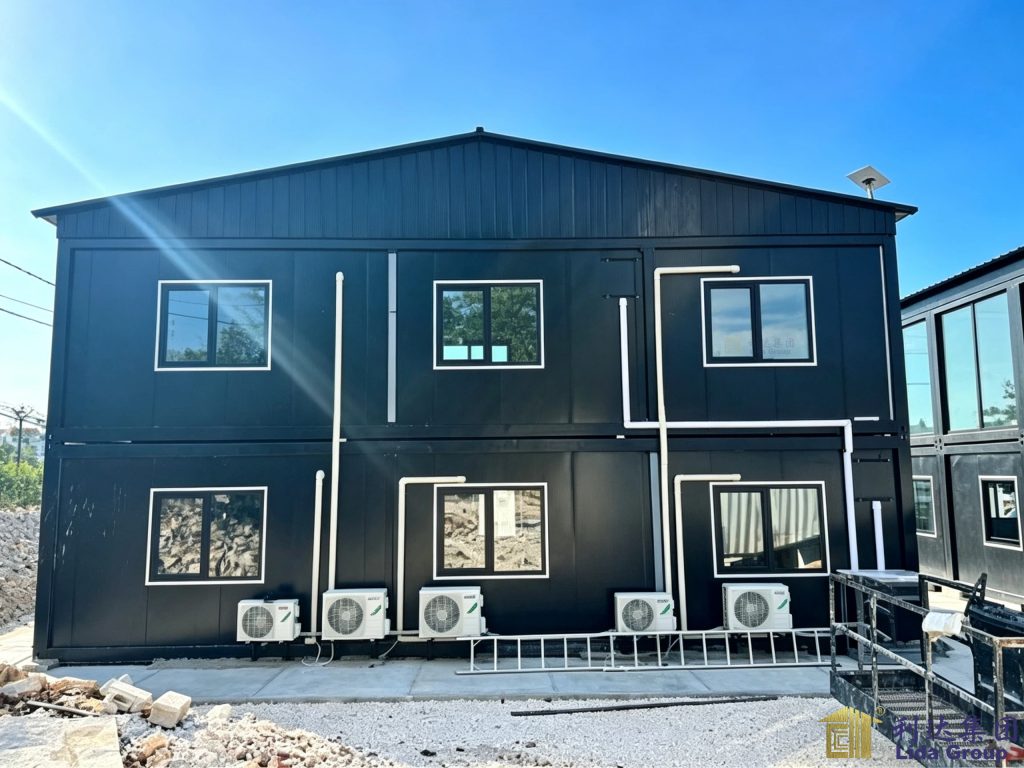
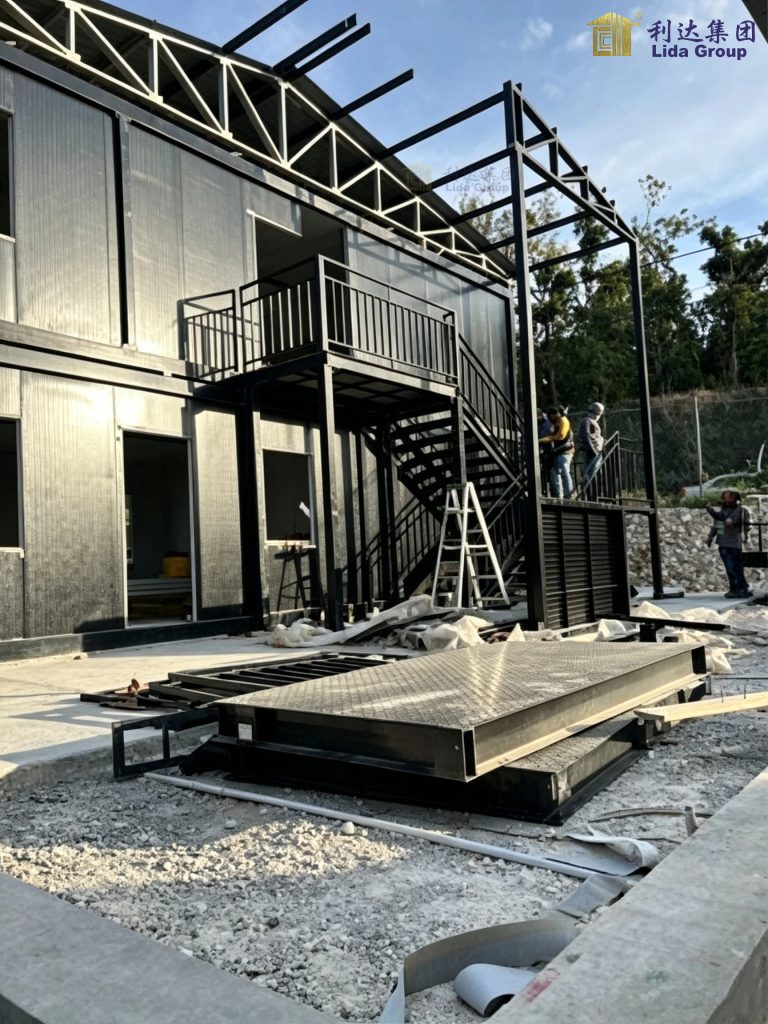
The dormitory is the heart of the camp. Lida Group supplies single, double, four-bay and eight-bay accommodation modules based on flat-pack and detachable container frames, finished with insulated wall and roof panels that deliver stable indoor temperatures from minus forty degrees to plus fifty. Each room comes with beds, lockers, reading lights, individual power outlets, air-conditioning or heating units as the climate requires, and ensuite or shared ablution options depending on the class of accommodation. Modules can be stacked two or three high and joined side by side to create long accommodation blocks with covered external walkways, protecting workers from sun, rain and sand while they move between their rooms and the central facilities.
Rest Lounges and Welfare Spaces
Recovery between twelve-hour shifts is as important as sleep. Increasingly, operators are specifying proper rest lounges rather than bare dayrooms. Lida Group delivers lounge modules fitted out as comfortable common rooms with sofas, television and satellite reception, Wi-Fi, reading corners, prayer rooms where required, and quiet areas designed for workers to call home or simply decompress. These spaces are intentionally larger and lighter than the old “recreation room” model, with glazing, ventilation and soft furnishings that reduce the psychological isolation of remote duty. For long rotational crews, a well-designed lounge measurably improves morale and reduces attrition.
Catering and Dining Blocks
Feeding several hundred rotational workers three meals a day, seven days a week, is a logistical operation in its own right. Lida Group’s catering modules combine a commercial-grade kitchen (cooking, refrigeration, dishwashing, food-preparation and dry-storage areas) with a dining hall sized to clear the full headcount within two seatings or one, depending on the shift pattern. The buildings are designed around commercial hygiene standards, with stainless-steel surfaces, grease extraction, hand-washing stations and separate clean and dirty flow paths. The dining hall itself is sized with wide aisles, tray rails and durable seating that can withstand two thousand meals a day, year after year.
Site Offices and Control Rooms
A camp is also an office. Project management, HSE, logistics, finance and the drill-site liaison team all need air-conditioned, well-lit workspaces close to the accommodation. Lida Group supplies office modules configured as open-plan bullpens, private manager rooms, meeting rooms fitted for video conferencing, and document-control rooms. For permanent production sites, these same modules can be delivered as instrument shelters and control rooms with upgraded insulation, UPS-conditioned power and raised flooring, meeting the electrical and seismic expectations of process-plant buildings.
Ablution, Laundry and Utility Blocks
Showers, toilets, urinals, washing machines and dryers are the pieces of camp infrastructure that workers judge most harshly. A blocked shower or an out-of-action washing machine on a remote site becomes a HSE and morale incident within hours. Lida Group delivers fully plumbed ablution and laundry modules, pre-fit in the factory with commercial sanitary ware, hot-water calorifiers, grease traps and sewage pumps, so that on-site work is reduced to connecting two hoses. Modules are separated by gender, sized to the relevant occupancy ratios, and designed to be easy to clean and easy to isolate for maintenance without taking the whole block out of service.
Medical, First Aid and Emergency Response
Most remote camps above a certain size require a clinic or at least a well-equipped first-aid station staffed around the clock. Lida Group supplies clinic modules configured as consultation rooms, treatment bays, a small observation area and a pharmacist’s store, with handwashing, sterilisation and separate clean/dirty circulation. In the event of an evacuation or a major incident, these modules are positioned close to the helipad or the main gate and laid out so that stretchers and emergency teams can move without crossing worker circulation routes.
Engineered for Extreme Field Conditions
A container that looks the same in a catalogue as another container is not the same building once it reaches the desert. Lida Group engineers each order against the actual site brief.
Thermal performance is the first variable. Wall and roof panels are selected by calculated U-value, not by a default thickness. In Gulf-region projects, reflective roof coatings, shaded external walkways and dedicated HVAC oversizing are standard. In cold-climate projects, double-skin panels, heated floors in ablution blocks and door-air curtains prevent pipes from freezing and keep bedroom temperatures comfortable even when outside temperatures sit below minus thirty. Wind and dust loading drives frame and cladding specification in desert and coastal zones, while seismic bracing governs connection design in active fault regions. Corrosion protection is addressed for coastal and offshore-support camps through hot-dip galvanised frames, stainless-steel fixings and coated roofing, so that the buildings survive salt air for decades rather than years. Fire safety is built in: fire-resistant wall cores, rated doors between blocks, protected escape routes and compliant electrical distribution all follow the relevant international codes and the operator’s own HSE specification.
The Turnkey Delivery Process
A turnkey project follows a disciplined sequence, and the discipline is what compresses the schedule.
It begins with a requirements interview: headcount, shift pattern, nationalities, climate zone, required facilities, budget and programme. From this, Lida Group’s engineering team produces a camp master plan showing block layout, roads, services, waste areas and the walkable distance between bedrooms and the dining hall. Once the layout is agreed, structural and services design is completed, material orders are placed, and production begins in the factory while the client prepares the site and foundations in parallel.
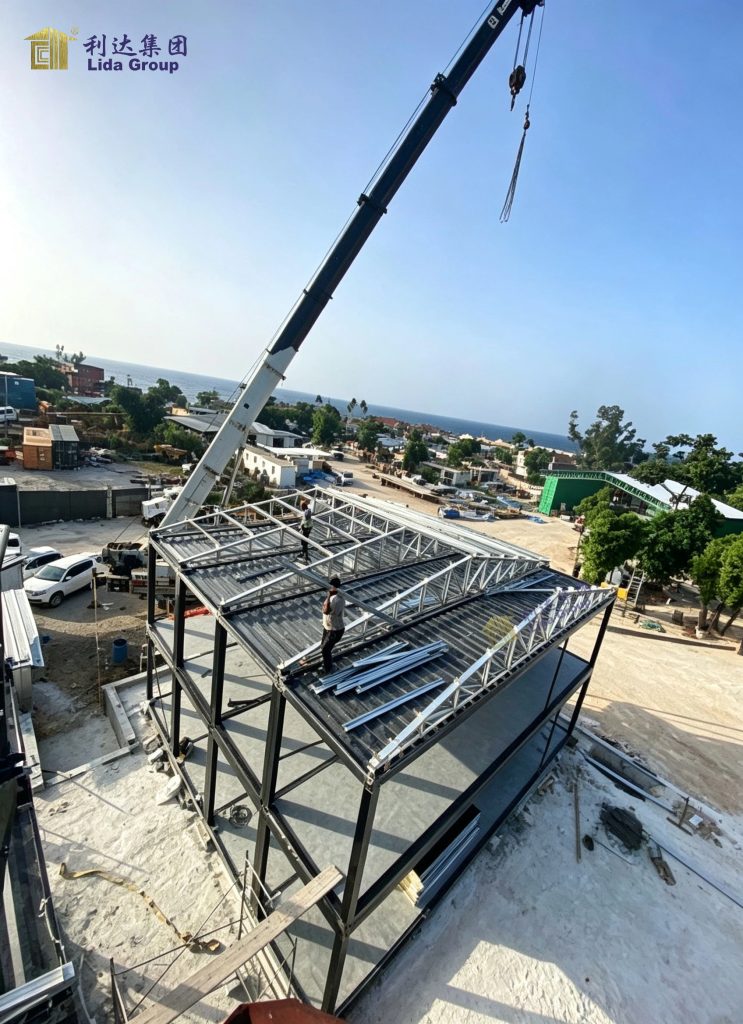
Modules are pre-assembled and inspected at the works, partially dismantled (for flat-pack designs) or loaded as complete rigid units, and shipped by sea, rail or road. On arrival, a Lida Group installation team supervises local crews to lift, stack, join and weather-seal the blocks, connect power, water and sewage, and commission every room, kitchen appliance and HVAC unit. Handover takes place on a checklist agreed in advance, followed by a short defects-liability period and, if the client wishes, training for the site team on routine maintenance.
The net result is that a camp for three hundred to five hundred workers can be occupied eight to fourteen weeks after contract award, depending on location and logistics.
Scalability and Reconfiguration as the Field Evolves
Oilfield populations are never static. A drilling camp starts with a hundred workers and grows to four hundred as the rig count rises; a production camp shrinks as commissioning gives way to operations; a pipeline camp relocates along the right-of-way every few months. Because every Lida Group module is the same width, height and connection interface, blocks can be extended, split, restacked or relocated without redesign. A two-storey accommodation wing can become a single-storey office wing. A canteen module can move to the next spread and reopen within days. This modular reuse is the single biggest financial advantage of containerised construction over permanent buildings, and it is why the model has spread from oil and gas into mining, construction, disaster response and remote labour housing worldwide.
Health, Safety and Compliance Built into the Box
HSE performance in a remote camp is decided by details: non-slip floors in ablution blocks, emergency lighting on every walkway, smoke detection in every bedroom, separated pedestrian and vehicle routes, secure storage of cleaning chemicals, and a kitchen designed to prevent cross-contamination. Lida Group designs these features into the standard product rather than treating them as add-ons, and provides the documentation, test certificates and operating manuals that allow the operator to pass its own internal audits and those of its host-government regulator.
Total Cost of Ownership Over the Camp Life
Buying a camp is not a one-line capital expense; it is a capital expense plus years of operating energy, maintenance and eventual reuse or disposal. Containerised buildings score well on all three. Factory insulation and correctly sized HVAC units keep running-energy consumption predictable, which matters enormously in locations where diesel is expensive. Standardised panels, doors and fittings mean that a spare part shipped to the site actually matches the building. And when the project ends, the modules retain most of their value, either redeployed to another Lida Group client’s camp or returned to the operator’s own asset pool for the next campaign. A building that can be moved and reused ten times, rather than demolished once, has a fundamentally different cost curve from a permanent structure.
Conclusion
Remote oilfield operations have outgrown the makeshift camp. Today, the workforce that drills, completes and produces wells expects accommodation that is safe, climate-controlled, hygienic and genuinely restful; operators expect a camp that opens on time, runs reliably and can be moved when the field moves; and HSE management expects every building to be engineered, certified and auditable. Turnkey container solutions deliver all three requirements in a single, factory-controlled package.
From sleeping dormitories through rest lounges, dining halls, offices, clinics and utility blocks, Lida Group supplies the complete set of modular facilities that a modern remote camp needs, engineered for the specific climate and loaded onto trucks ready to plug in. By taking responsibility for the whole scope, from master plan to handover, Lida Group lets oilfield operators concentrate on what they do best: finding and producing hydrocarbons, while the people who do it live and work in buildings that were designed for exactly that environment. In an industry where downtime is measured in hundreds of thousands of dollars a day, a properly delivered turnkey camp is not a luxury. It is one of the most reliable production tools an operator can put on site.
Related news
-
Built for Remote Fields: Weather-Resistant Prefab Accommodations for Mining & Oil Operations
2026-10-22 16:18:12
-
From Harsh Deserts to Freezing Sites: Durable Steel Structures & Dormitories by Lida Group
2026-10-21 16:12:15
-
Rapid Deployment: Why Mining Giants Are Switching to Lida Flat Pack Containers for Site Accommodation
2026-09-28 15:34:16
contact us
- Tel: +86-532-88966982
- Whatsapp: +86-13793209022
- E-mail: sales@lidajituan.com
