



Efficient Prefabricated Container Worker Dormitory Now Available from Lida Group
2026-May-22 17:09:13
By Admin
Introduction
The global construction industry is increasingly pursuing lean operation, schedule efficiency, and standardized on-site management. As the core supporting facility of all engineering projects, worker dormitories directly affect team stability, construction progress, and on-site safety management level. Traditional temporary accommodation solutions, including makeshift shanties, on-site built temporary houses, and ordinary simple tents, have long plagued construction enterprises with low construction efficiency, unstable quality, poor living comfort, and high comprehensive costs. These conventional housing modes rely heavily on on-site manual construction, require long preparation cycles, and generate massive construction waste, which cannot keep pace with the fast-paced, high-efficiency operation demands of modern construction projects.
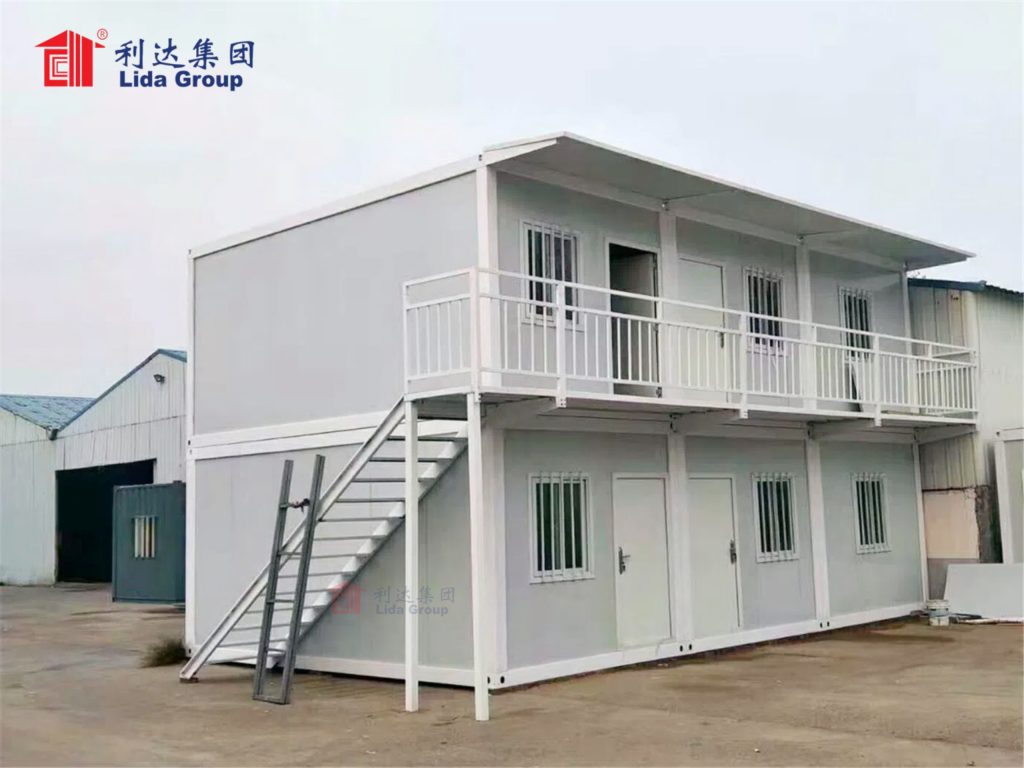
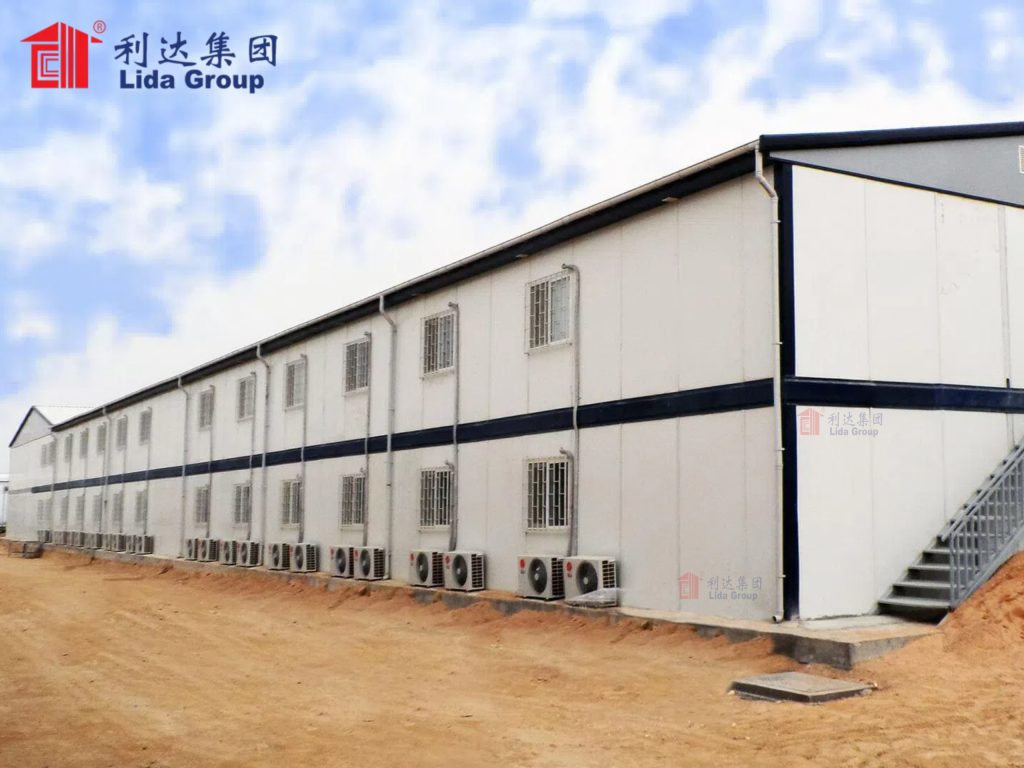
To solve the efficiency bottleneck of on-site worker accommodation, Lida Group, a world-renowned expert in modular prefabricated building manufacturing, has officially launched its new-generation Efficient Prefabricated Container Worker Dormitory. Optimized for rapid deployment, standardized production, on-site adaptability, and long-term cyclic utilization, this upgraded dormitory product focuses on “efficiency” as its core competitiveness. It realizes full factory prefabrication, simplified on-site assembly, and flexible modular combination, completely subverting the inefficient construction mode of traditional temporary housing. Suitable for various construction sites, municipal projects, mining operations, and short-term engineering projects, Lida Group’s new prefabricated container dormitories provide construction enterprises with time-saving, labor-saving, cost-saving, and safe high-standard accommodation solutions. This article elaborates on the efficiency pain points of traditional worker dormitories, core efficient design advantages of Lida Group’s new products, standardized production and delivery systems, humanized functional configuration, multi-scenario application value, and comprehensive project benefits.
1. Efficiency Pain Points of Traditional On-Site Worker Dormitories
Most traditional construction site dormitories adopt scattered on-site construction modes, which have prominent defects in construction efficiency, deployment flexibility, quality control, and later reuse. These shortcomings not only delay project preparation progress but also bring invisible management and economic losses to engineering projects.
1.1 Long Construction Cycle and Low Time Efficiency
Traditional temporary brick houses and assembled simple dormitories require complete on-site construction procedures, including foundation leveling, material transportation, welding assembly, wall pouring, and interior decoration. The whole construction process is easily affected by weather changes, site conditions, and worker proficiency. It usually takes 15 to 30 days to complete a small-scale dormitory area, while large-scale worker camps take more than one month to be put into use. For urgent construction projects with tight schedules, the slow construction of dormitories often delays worker settlement, restricts project startup progress, and causes unnecessary time delays for the overall engineering cycle.
1.2 High Labor Dependence and Low Construction Efficiency
Traditional dormitory construction requires a large number of skilled workers such as welders, bricklayers, and decorators, with high labor threshold and strong dependence on professional manpower. In the peak construction season, the shortage of skilled workers often leads to slow construction progress and uneven construction quality. In addition, on-site construction involves multiple cross-operation processes, which are prone to process conflicts and rework problems, further reducing overall construction efficiency and increasing uncontrollable on-site management risks.
1.3 Fixed Layout and Poor Flexible Adaptability
Traditional temporary dormitories are fixed buildings with non-adjustable spatial layout and scale. The number of dormitories and functional areas are determined at the initial stage of construction and cannot be dynamically adjusted according to the phased changes of project workforce. When the number of construction workers increases in the peak construction period, there is a shortage of accommodation; when the project enters the finishing stage and the workforce decreases, redundant dormitory resources are wasted. Moreover, fixed temporary buildings cannot be transferred and reused after project completion, resulting in extremely low resource utilization efficiency.
1.4 Disordered On-Site Construction and Low Quality Efficiency
The scattered on-site construction mode of traditional dormitories lacks unified production standards and quality supervision. Different construction teams have inconsistent operation specifications, leading to uneven wall flatness, unstable structural firmness, and substandard waterproof and heat insulation effects. The unstandardized construction quality not only affects workers’ living experience but also brings potential safety hazards such as water leakage, structural looseness, and poor fire resistance. Meanwhile, on-site construction generates a large amount of construction waste, dust, and noise, which reduces the environmental management efficiency of the construction site and fails to meet modern green construction standards.

2. Core Efficient Design Advantages of Lida Group’s Prefabricated Container Dormitories
Aiming at various efficiency pain points of traditional dormitories, Lida Group’s new efficient prefabricated container worker dormitories carry out targeted technical optimization and structural innovation in the whole industrial chain from factory production to on-site deployment. With standardized prefabrication, simplified assembly, flexible modular combination, and integrated functional design, the products achieve comprehensive improvement in construction efficiency, deployment efficiency, and utilization efficiency.
2.1 Full Factory Prefabrication Improves Overall Construction Efficiency
Different from the semi-finished production mode of ordinary prefabricated houses, Lida Group’s efficient container dormitories realize 100% factory integrated prefabrication. All structural frames, wall panels, roof systems, floor structures, internal electrical circuits, lighting systems, and basic decorative parts are completed in the intelligent factory. After offline assembly and quality inspection, the finished modules are delivered to the construction site for direct placement and splicing. This mode completely transfers the complex construction process from the variable outdoor site to the standardized indoor factory, avoiding the impact of bad weather and on-site environmental restrictions on construction progress. It cuts the on-site construction cycle of dormitory camps from one month to several days, greatly improving the overall preparation efficiency of project supporting facilities.
2.2 Simplified Tool-Free Assembly Reduces Labor Dependence
To solve the problem of high labor dependence in traditional construction, Lida Group optimizes the assembly structure of container dormitories and adopts a fully bolted connection and tool-free assembly design. All modules are reserved with standardized butt joints and marked with unified positioning codes, realizing precise docking without professional welding and cutting operations. Ordinary untrained workers can complete the assembly work according to the detailed visual operation manual and online guidance videos. A team of 3 to 4 workers can finish the assembly and commissioning of a single dormitory unit within 3 hours, and a standard camp accommodating hundreds of workers can be fully completed and put into use within 2 to 3 weeks. This efficient assembly mode reduces on-site labor demand by more than 70% and effectively solves the problem of insufficient skilled workers on construction sites.
2.3 Flexible Modular Combination Improves Deployment Efficiency
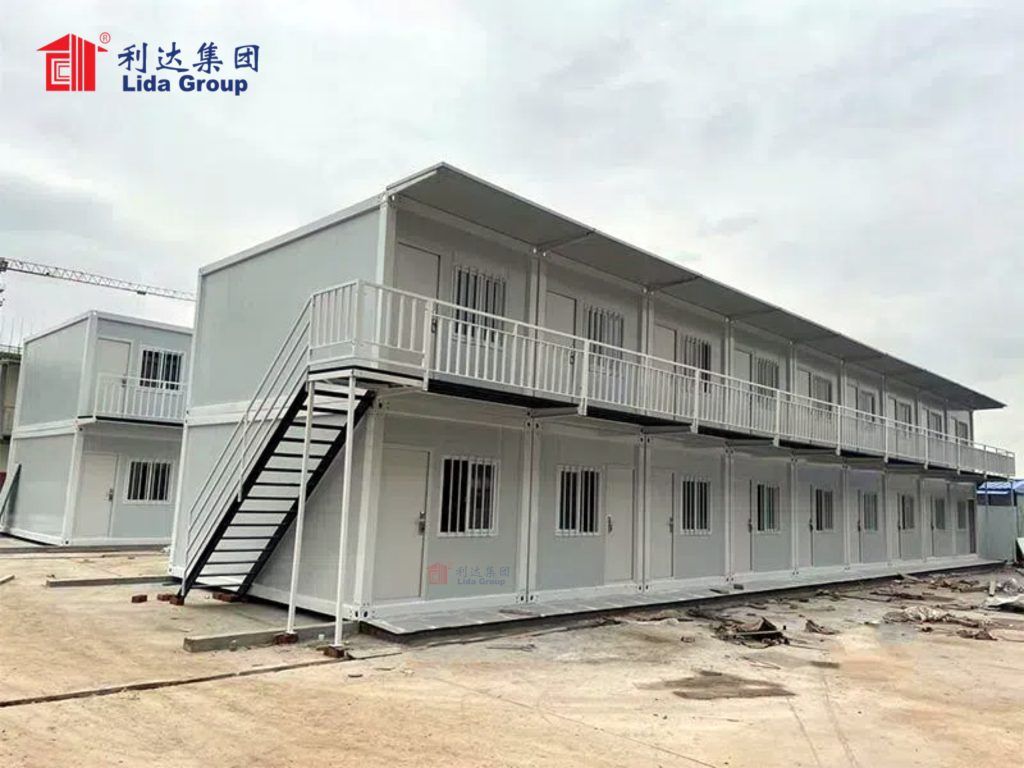
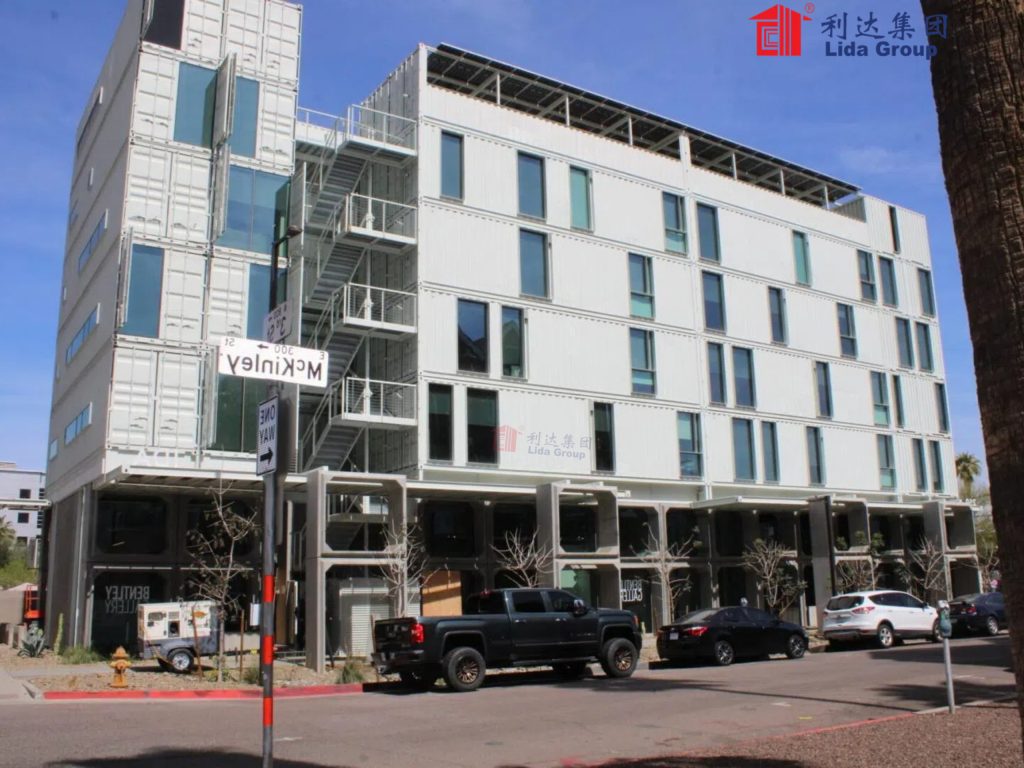
The new prefabricated container dormitories adopt a highly flexible modular design, with single standard units supporting free horizontal splicing and vertical stacking. Construction enterprises can flexibly adjust the number of dormitory modules and functional areas according to the actual workforce scale and project progress. In the peak construction period, additional modules can be quickly added to meet accommodation demands; in the later stage of the project, redundant modules can be disassembled and stored in time to avoid resource waste. Meanwhile, the integrated modular design supports the rapid combination of dormitory areas, office areas, canteen areas, and sanitary areas, realizing the one-stop rapid construction of the whole on-site living camp. This scalable and adjustable deployment mode greatly improves the dynamic adaptation efficiency of on-site accommodation facilities.
2.4 Flat-Pack Transportation Optimizes Logistics Efficiency
To further improve cross-regional deployment efficiency, Lida Group supports dual delivery modes of finished integrated transportation and flat-packed split transportation. For sites with convenient transportation, finished modules can be directly delivered and placed to realize instant occupancy; for remote sites with limited transportation conditions, flat-packed disassembly delivery is adopted. The flat-packed structure reduces the overall transportation volume by more than 75% compared with traditional integrated containers, enabling ordinary cargo vehicles to complete transportation tasks without professional hoisting and large-scale transport equipment. It effectively reduces logistics costs and transportation cycles, realizing efficient and convenient cross-region and cross-city rapid deployment of dormitory facilities.
3. Standardized Intelligent Production Ensures Efficient and Stable Quality
High efficiency must be based on stable and reliable quality. Lida Group relies on intelligent standardized production bases and perfect quality control systems to ensure that all efficient prefabricated container dormitories maintain consistent high quality while achieving efficient production and delivery, avoiding quality defects and rework efficiency loss caused by irregular on-site construction.
3.1 Automated Assembly Line Production Improves Output Efficiency
Lida Group’s modular building production base adopts fully automated cutting, precise welding, integrated spraying, and one-stop assembly production lines. The whole production process realizes digital monitoring and standardized operation, with precise component size and stable structural performance. The intelligent production mode greatly improves production efficiency, realizing batch customized production of hundreds of dormitory modules every day. It can quickly respond to large-scale order demands of major engineering camps and complete batch delivery in a short time, ensuring the synchronous progress of project construction and accommodation preparation.
3.2 Strict Full-Process Quality Inspection Avoids Efficiency Loss
Each batch of container dormitory modules undergoes multi-layer quality inspection, including structural strength test, fire resistance grade test, waterproof and anti-corrosion performance test, and electrical safety detection. All products comply with ISO9001 quality management system and ISO14001 environmental management system international certifications. The unified factory quality standard completely solves the problems of uneven quality and frequent after-sales maintenance of traditional on-site construction. Qualified finished products can be directly put into use after arriving at the site, without secondary transformation and maintenance, effectively saving time and labor costs caused by quality problems and improving the overall operation efficiency of the construction site.
4. Humanized Efficient Functional Configuration for On-Site Operation
While improving construction and deployment efficiency, Lida Group’s efficient prefabricated container dormitories focus on matching the efficient operation needs of modern construction sites, integrating humanized living functions and standardized management functions to help enterprises optimize on-site management efficiency and improve worker living experience.
4.1 Integrated Living Function Simplifies Site Layout
Each standard dormitory unit is pre-installed with complete ventilation, lighting, power supply, and heat insulation systems, with reserved interfaces for air conditioning, network, and water supply and drainage. The indoor space is scientifically planned, which can flexibly arrange 2 to 4 sets of beds and supporting storage facilities, meeting the daily rest and living needs of workers. Compared with traditional dormitories that require secondary decoration and facility installation, Lida Group’s prefabricated dormitories realize “delivery on arrival, immediate occupancy”, eliminating the tedious on-site decoration and facility debugging links and greatly simplifying the site layout process.
4.2 Supporting Functional Modules Improve Camp Operation Efficiency
To form a closed-loop efficient living camp, Lida Group supports the matching delivery of standardized supporting modules such as integrated toilets, shower rooms, canteens, office rooms, and leisure activity rooms. All supporting modules adopt the same standardized modular design, which can be quickly spliced and combined with dormitory units to form a fully functional living community. The unified and standardized camp layout is convenient for project managers to carry out unified sanitation management, safety inspection, and personnel scheduling, effectively reducing the difficulty of daily management and improving the overall operation and management efficiency of the construction site.
4.3 Weather-Resistant Design Reduces Maintenance Frequency
The dormitory adopts high-strength galvanized steel frame and high-density fireproof and heat-insulating sandwich wall panels, with excellent wind resistance, seismic resistance, waterproof, and anti-corrosion performance. It can adapt to various conventional and harsh construction site environments, maintaining stable structural and functional performance in high temperature, severe cold, rainy, and windy weather. The durable material configuration greatly reduces daily maintenance and replacement frequency, avoids frequent maintenance work affecting on-site normal operation, and realizes long-term efficient and stable operation of the dormitory camp.
5. Long-Term Efficient Economic and Application Value
Lida Group’s efficient prefabricated container worker dormitories not only improve the short-term construction efficiency of the project but also bring long-term efficient economic benefits and sustainable application value for construction enterprises, helping enterprises reduce costs and increase efficiency in multiple project cycles.
5.1 Reusable Design Improves Resource Utilization Efficiency
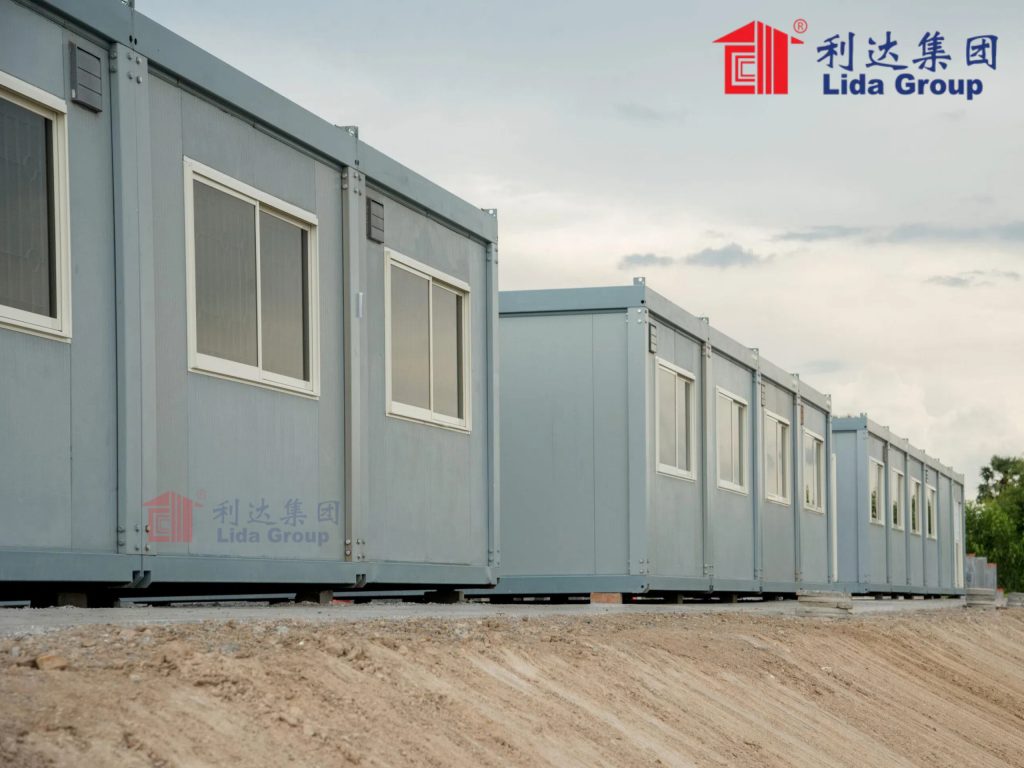
Different from the disposable attribute of traditional temporary dormitories, Lida Group’s container dormitories have a service life of more than 15 years and can be disassembled, transported, and reassembled for multiple times. After the completion of one project, the dormitory modules can be flat-packed and transferred to the next construction site for secondary use, without repeated investment in accommodation facilities. The cyclic reuse mode greatly improves the utilization efficiency of building resources, avoids resource waste and construction waste pollution caused by repeated construction and demolition, and creates significant economic and environmental benefits for enterprises.
5.2 Lean Cost Control Realizes Long-Term Efficiency Improvement
The efficient production and deployment mode of prefabricated dormitories comprehensively reduces project comprehensive costs. Factory centralized production reduces unit material costs; rapid assembly saves a large amount of on-site labor costs and mechanical equipment costs; reusable design eliminates repeated construction investment; low maintenance performance reduces later operation costs. Compared with traditional temporary housing, Lida Group’s container dormitories can reduce the comprehensive accommodation cost of enterprises by more than 30% in the whole project cycle, realizing lean cost control and long-term operational efficiency improvement.
5.3 Humanized Living Stabilizes Team Efficiency
The safe, comfortable, clean, and orderly living environment provided by standardized container dormitories effectively improves workers’ sense of belonging and job satisfaction, reduces worker turnover rate caused by poor accommodation conditions, and avoids project progress delays and recruitment cost increases caused by frequent personnel replacement. A stable construction team ensures continuous and efficient advancement of engineering work, indirectly improving the overall construction efficiency and project delivery quality of the enterprise.
6. Conclusion
In the era of efficient and standardized development of the global construction industry, traditional on-site built temporary worker dormitories can no longer meet the lean operation needs of modern engineering projects due to their long construction cycle, high labor dependence, poor flexibility, and low resource utilization efficiency. Lida Group’s newly launched Efficient Prefabricated Container Worker Dormitories completely break through the efficiency bottlenecks of traditional accommodation solutions with full factory prefabrication, simplified tool-free assembly, flexible modular deployment, and standardized quality control.
This series of products achieve comprehensive efficiency upgrades in production, transportation, assembly, management, and reuse, while ensuring safe, comfortable, and humanized living conditions for on-site workers. They help construction enterprises shorten project preparation cycles, save labor and logistics costs, optimize on-site standardized management, and stabilize construction teams. With outstanding efficient performance, reliable quality, and long-term sustainable application value, Lida Group’s prefabricated container dormitories have become the preferred efficient accommodation solution for various construction, municipal, mining, and field engineering projects. In the future, Lida Group will continue to optimize modular product efficiency and functional configuration, empower the high-efficiency and green development of the global construction industry, and provide more high-quality and efficient temporary housing supporting services for global engineering enterprises.
Related news
-
Lida Group Delivers Flat Packed Modular Container House for Remote Workforce Housing
2026-05-22 17:04:32
-
Prefabricated Container Worker Dormitory Solutions by Lida Group Enhance On-Site Living
2026-05-22 14:53:36
-
Discover the Versatility of Living Container House Designs from Lida Group
2026-05-22 16:54:35
contact us
- Tel: +86-532-88966982
- Whatsapp: +86-13793209022
- E-mail: sales@lidajituan.com
