



Custom Metal Frame Warehouse Solutions by Lida Group
2026-Jan-27 16:58:43
By Admin
In the era of global supply chain transformation and industrial upgrading, warehouses have evolved from simple storage spaces into core hubs that drive operational efficiency, support technological integration, and adapt to dynamic market demands. As enterprises across industries seek flexible, durable, and cost-effective storage infrastructure, metal frame warehouses have emerged as the preferred solution, outperforming traditional concrete structures in speed, scalability, and performance. Among the global leaders in this field, Lida Group stands out with its three decades of expertise in custom metal frame warehouse solutions, blending precision engineering, innovative technology, and end-to-end service capabilities to deliver projects that meet the unique needs of clients in 140+ countries. This article explores the core strengths, technical innovations, customization processes, and real-world impacts of Lida Group’s custom metal frame warehouse solutions, highlighting why it has become a trusted partner for industrial, logistics, and manufacturing enterprises worldwide.
1. The Evolution of Warehouse Construction: Why Metal Frames Dominate the Modern Industrial Landscape
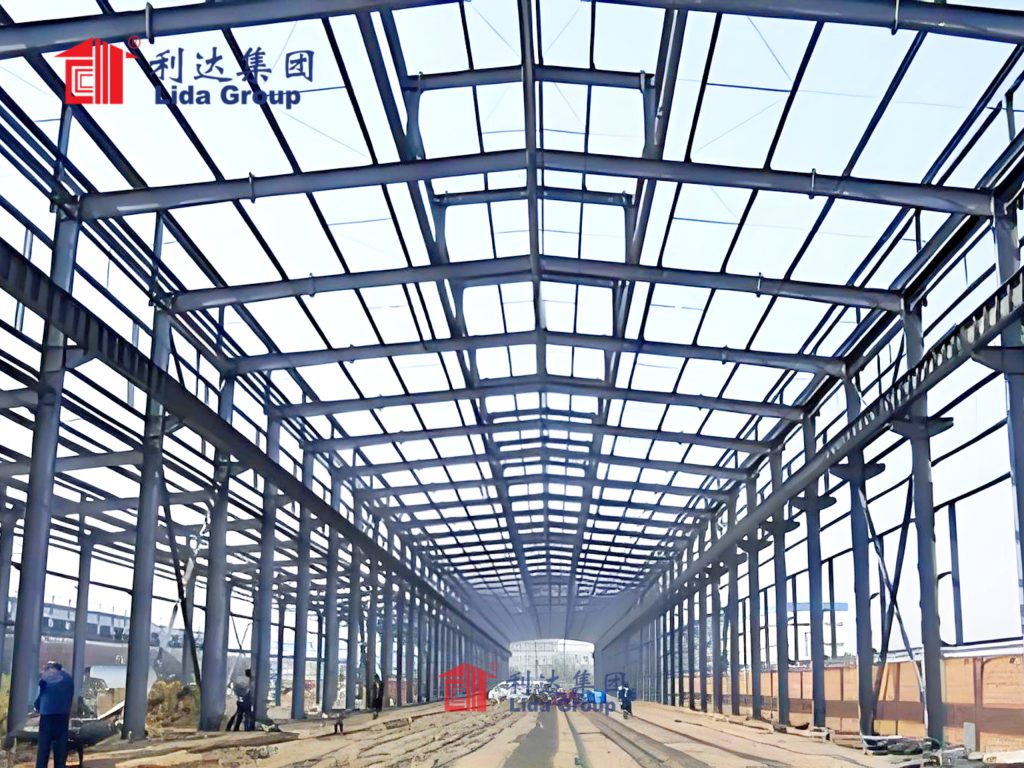
Traditional warehouse construction, relying heavily on concrete and brick, has long struggled to keep pace with the rapid changes in modern business operations. Long construction timelines, limited design flexibility, high maintenance costs, and poor adaptability to technological upgrades have rendered these structures obsolete in an era where speed-to-market and operational agility are critical. Metal frame warehouses, by contrast, have revolutionized industrial storage through their inherent advantages, addressing the core pain points of contemporary enterprises.
The global metal frame warehouse market is growing at a CAGR of 6.2% from 2023 to 2030, driven by the expansion of e-commerce, the rise of automated logistics systems, and the increasing emphasis on sustainability. Key factors contributing to the dominance of metal frames include: speed of construction, with projects completed 30-40% faster than concrete alternatives; superior structural strength, enabling column-free spans exceeding 60 meters to maximize usable space; cost efficiency, with prefabricated components reducing material waste to 2-3% compared to 10-15% for concrete; and sustainability, as steel boasts a 92% recycling rate and reduces carbon emissions by up to 50% over the building’s lifecycle. Lida Group has leveraged these advantages to develop custom solutions that go beyond standard metal frame warehouses, tailoring each project to the specific operational, environmental, and regulatory requirements of its clients.
2. Lida Group: A Legacy of Excellence in Custom Metal Frame Engineering
2.1 Company Overview: Three Decades of Global Leadership
Founded in 1993 as a small steel workshop in Shandong Province, China, Lida Group has grown into a global powerhouse in prefabricated steel structures, modular buildings, and custom warehouse solutions. With a mission to “redefine industrial construction through precision and innovation,” the group has completed over 5,000 projects across 152 countries, establishing a reputation for reliability, technical expertise, and customer-centric service. Today, Lida Group operates state-of-the-art manufacturing facilities producing over 1,000 tons of steel components monthly, supported by a team of engineers, designers, and logistics specialists dedicated to delivering turnkey solutions.
What sets Lida Group apart from competitors is its holistic approach to custom metal frame warehouses. Unlike suppliers that offer standardized products, Lida Group provides end-to-end services, from initial design consultation and structural engineering to manufacturing, transportation, on-site assembly, and post-construction maintenance. This integrated model ensures consistency in quality, reduces project timelines, and minimizes risks, making it the partner of choice for global giants in logistics, automotive, mining, and e-commerce.
2.2 Core Capabilities: The Foundation of Custom Solutions
Lida Group’s ability to deliver high-performance custom metal frame warehouses stems from four core capabilities: precision engineering, advanced manufacturing, digital transformation, and global logistics expertise.
Precision engineering is at the heart of Lida’s solutions. The group’s team of certified engineers utilizes cutting-edge structural analysis tools to design metal frames that meet the most stringent load-bearing, seismic, and environmental requirements. Whether supporting 20-ton cranes for heavy-duty workshops or ensuring millimeter-perfect flatness for automated storage and retrieval systems (AS/RS), Lida’s designs prioritize both performance and longevity. The use of high-strength steel alloys, such as S550MC and G550, enables structures to achieve 45% greater yield strength than conventional materials while reducing overall steel tonnage by 25% through computer-optimized geometries.
Advanced manufacturing facilities further enhance Lida’s custom capabilities. Robotic welding cells achieve tolerances of 0.1-0.2 mm, ensuring consistent quality across thousands of components. Automated plasma cutters, CNC brake presses, and coating systems process materials 8x faster than manual operations, enabling mass production of custom components without compromising precision. Factory-controlled fabrication also eliminates on-site weather delays and material waste, with 92% of each warehouse’s structure completed off-site before shipment.
Digital transformation has become a key differentiator for Lida Group. The adoption of Building Information Modeling (BIM) and digital twin technology allows for virtual prototyping, clash detection, and performance simulation before ground-breaking. Engineers can model decades of environmental stress, from seismic events to desert UV exposure, to optimize structural integrity and reduce costly field modifications. Computational fluid dynamics (CFD) and vibration analysis ensure that warehouses integrate seamlessly with automated equipment, such as AGVs and robotic sortation systems, by minimizing structural harmonics and optimizing airflow.
Global logistics expertise completes Lida’s service offering. The group’s in-house logistics team specializes in containerized component delivery, just-in-sequence scheduling, and cross-border compliance. Custom trailers for oversized members eliminate escort requirements, while pre-certified component kits reduce customs clearance time by up to 3 weeks. Whether delivering to a remote mining site in Brazil or a busy industrial park in Germany, Lida ensures on-time, on-spec delivery, even in challenging environments.
3. The Customization Process: Tailoring Metal Frame Warehouses to Unique Needs
Lida Group’s customization process is a collaborative journey, designed to translate each client’s operational goals into a functional, efficient, and durable metal frame warehouse. The process consists of five key phases, ensuring that every detail is aligned with the client’s requirements.
3.1 Needs Assessment and Site Analysis
The customization journey begins with a comprehensive needs assessment, where Lida’s team works closely with the client to understand their operational requirements, storage capacity needs, technological integration plans, and budget constraints. Key considerations include: the type of goods stored (e.g., perishables requiring cold storage, heavy machinery, or palleted goods); the use of automated systems (AS/RS, AGVs, cranes); environmental conditions (seismic zones, high winds, coastal salt spray, or extreme temperatures); and regulatory compliance (local building codes, LEED certification, or industry-specific standards like ANSI MH16.1-2023 for storage racks).
Following the needs assessment, Lida conducts a detailed site analysis, including soil testing, wind pattern mapping, seismic risk evaluation, and logistical access planning. For example, a warehouse in a seismic zone 4 area will require moment-resisting frames with energy-dissipating connections, while a coastal warehouse will use nano-ceramic coatings to provide ten-year corrosion protection. This phase ensures that the final design is not only functional but also resilient to local conditions.
3.2 Conceptual Design and Engineering
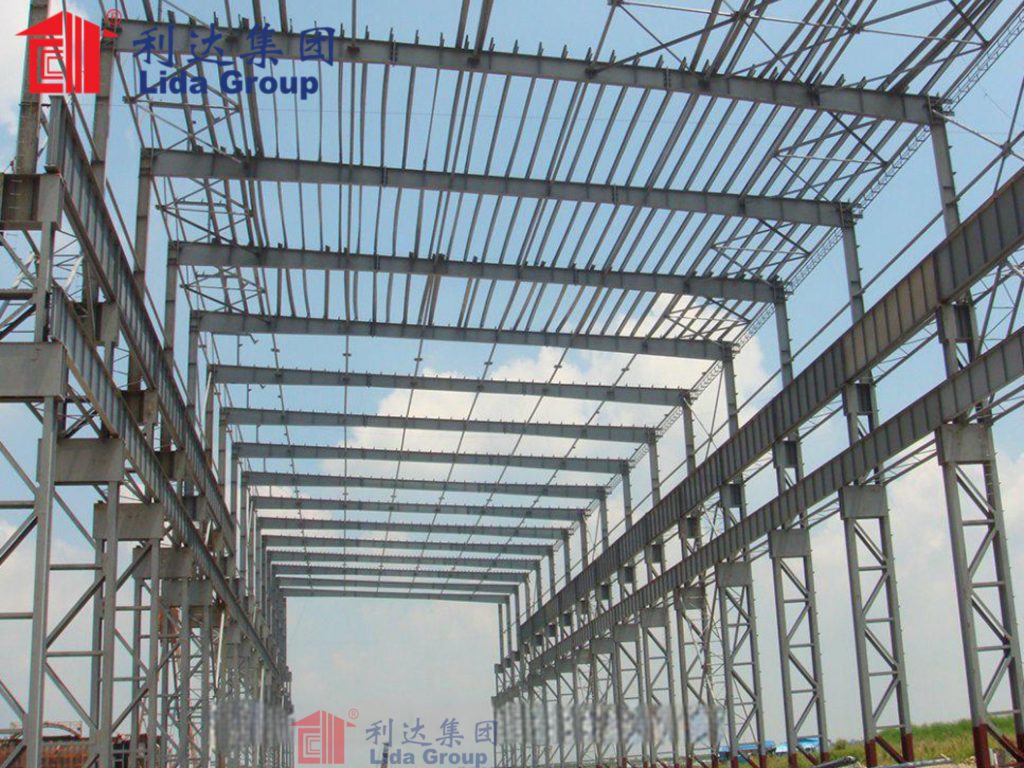
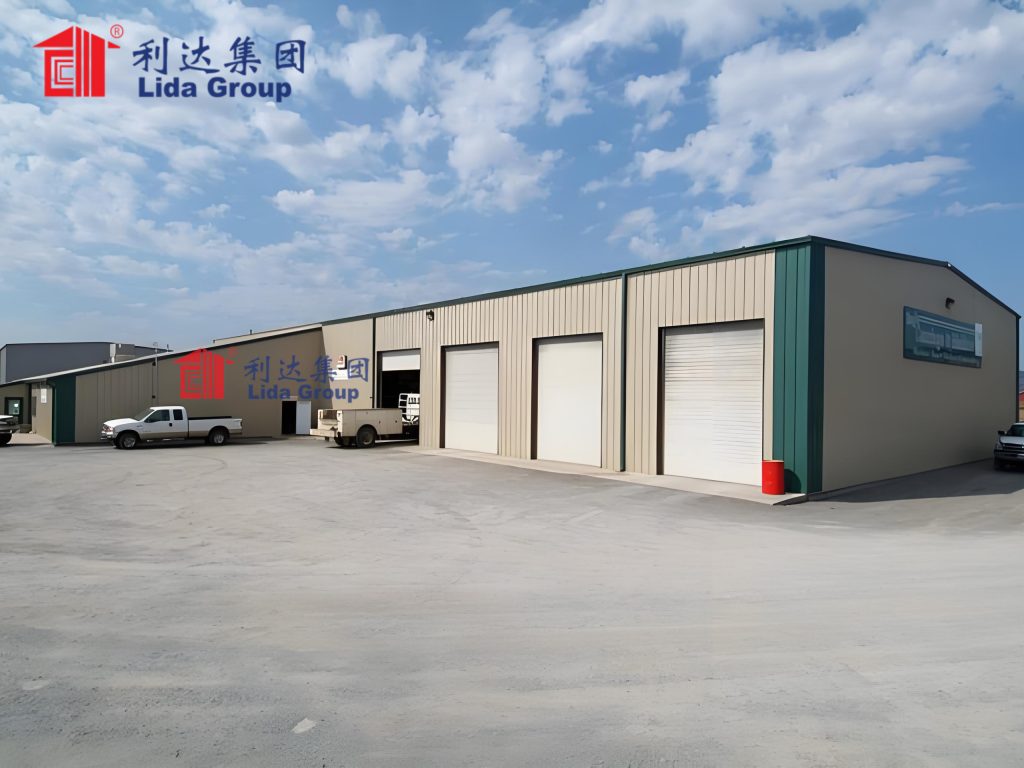
Based on the needs assessment and site analysis, Lida’s engineering team develops conceptual designs using BIM technology. Clients are invited to review 3D models and virtual walkthroughs, providing feedback to refine the design. Key design elements that can be customized include: span width (up to 60+ meters column-free); height (to accommodate multi-level mezzanines or high-racking systems); wall and roof materials (sandwich panels for insulation, single panels for cost efficiency); door configurations (rolling doors, sliding doors, or overhead crane doors); and auxiliary systems (fireproof cladding, solar panels, rainwater harvesting, or HVAC for cold storage).
Structural engineering is a critical part of this phase. Lida’s engineers use finite element analysis (FEA) to optimize the metal frame’s geometry, ensuring that it can withstand dynamic loads, seismic activity, and environmental stress while minimizing material usage. For example, a European automotive client requiring a 150,000 sq. ft. workshop with robotic assembly lines received a custom design with reinforced foundations and shock-absorbing joints to resist vibration from precision machinery.
3.3 Material Selection and Manufacturing
Material selection is tailored to the warehouse’s intended use and environmental conditions. Lida offers a range of high-quality steel materials, including hot-rolled H-beams for primary frames, cold-formed C/Z purlins for secondary systems, and galvanized or nano-ceramic coated steel for corrosion resistance. For cold storage facilities, composite wall systems with aerogel insulation achieve R-40 values within slim profiles, maintaining temperature stability of ±0.5°C. For sustainable projects, Lida prioritizes recycled steel (up to 92% content) and energy-efficient materials to reduce carbon footprints.
Once materials are selected, manufacturing begins in Lida’s controlled factory environments. Robotic welding, automated cutting, and precision coating ensure consistent quality, while strict quality control checks (including dimensional accuracy, weld strength, and coating thickness) are conducted at every stage. Custom components, such as non-standard beam lengths or specialized connections, are produced efficiently using computer-aided manufacturing (CAM) systems, eliminating the delays associated with custom fabrication.
3.4 Logistics and On-Site Assembly
Lida’s logistics team develops a tailored transportation plan to deliver components safely and on time. Components are packed in containerized kits, sorted by installation sequence to minimize on-site storage and handling. For oversized components, custom trailers and route optimization AI are used to avoid delays, while pre-certified documentation ensures smooth customs clearance. On-site, Lida’s assembly team uses laser-guided alignment tools to position columns within 2mm tolerance, and augmented reality (AR) guides to accelerate erection. Bolt-together connections eliminate the need for on-site welding, reducing labor requirements and speeding up assembly—an 80% reduction in skilled workers needed compared to traditional construction.
The speed of assembly is a key advantage of Lida’s solutions. A 50,000 sq. ft. warehouse can be completed in 12-16 weeks, compared to 12+ months for concrete structures. For example, Lida delivered a 500,000 sq. ft. logistics hub in 60% less time than conventional construction, enabling the client to expand operations and generate revenue months earlier.
3.5 Post-Construction Support and Maintenance
Lida Group’s commitment to customization extends beyond delivery. The group provides 24/7 multilingual support, on-site training for warehouse operators, and regular maintenance services to ensure the long-term performance of the metal frame warehouse. Post-construction services include structural health monitoring (using IoT sensors to detect maintenance needs with 94% accuracy), coating touch-ups, and modifications for future expansions—such as adding mezzanines or extending the warehouse footprint. This ongoing support ensures that the warehouse remains adaptable to the client’s evolving needs.
4. Industry-Specific Custom Solutions: Case Studies and Real-World Impact
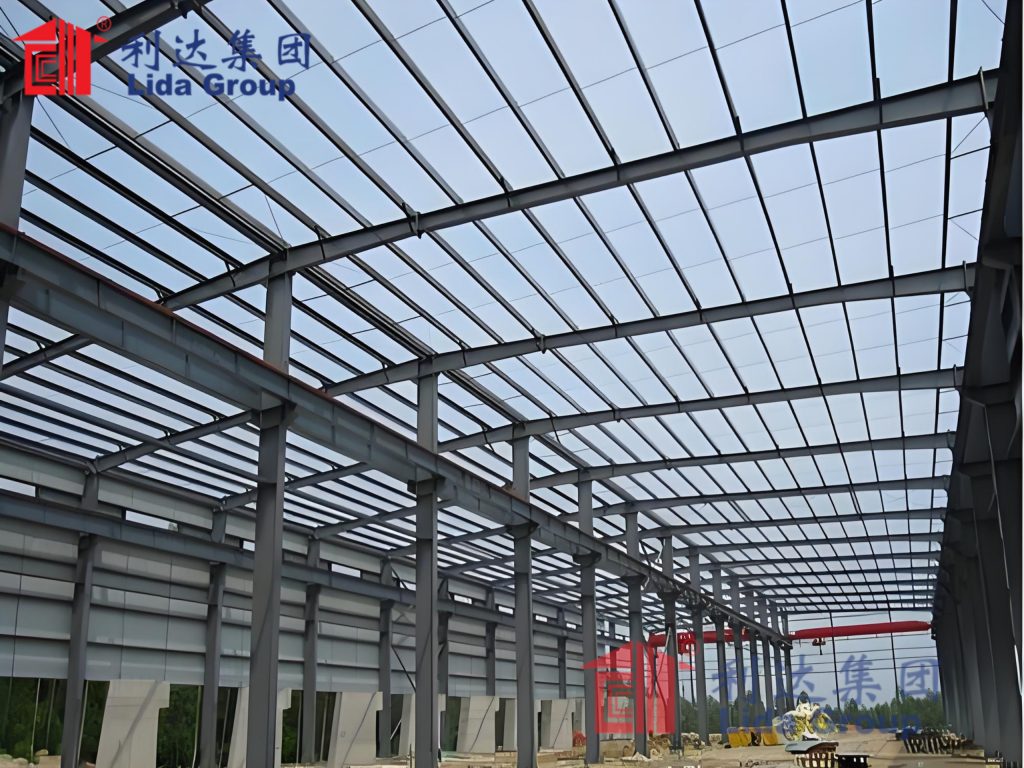
Lida Group’s custom metal frame warehouses have been deployed across a wide range of industries, each tailored to address unique sector-specific challenges. Below are three case studies that highlight the versatility and impact of Lida’s solutions.
4.1 Automotive Industry: Vibration-Resistant Workshop for EV Production
Client: A European automotive manufacturer needed a 150,000 sq. ft. workshop to support the production of a new electric vehicle (EV) model, with a strict 8-month deadline to meet market launch targets. The workshop required vibration resistance for precision robotic assembly lines, high load-bearing capacity for 20-ton cranes, and integration with automated logistics systems.
Solution: Lida Group designed a custom light steel structure with reinforced concrete foundations and shock-absorbing joints to minimize vibration transfer. The metal frame featured wide-flange columns and moment-resisting frames, ensuring structural stability while enabling column-free spans for flexible robotic placement. Prefabricated components were manufactured in China and shipped to Europe in containerized kits, with just-in-sequence delivery to align with on-site assembly. Laser-guided alignment and bolt-together connections reduced on-site work time, and BIM technology eliminated design clashes before production.
Result: The workshop was completed 2 weeks ahead of schedule, enabling the client to launch the EV model on time. The vibration-resistant design ensured precision machinery operated within tolerance, while the flexible layout allowed for future reconfiguration of assembly lines. The project achieved a 35% reduction in total cost compared to conventional construction, thanks to prefabrication and efficient logistics.
4.2 Logistics and E-Commerce: High-Density Fulfillment Center
Client: A global logistics provider needed a 500,000 sq. ft. fulfillment center to support its e-commerce expansion, with requirements for high storage density, automated AS/RS systems, and rapid construction to meet peak season demand. The site was located in a seismic zone, requiring compliance with strict earthquake resilience standards.
Solution: Lida Group developed a custom metal frame warehouse with column-free spans of 40 meters, enabling the installation of 4-tier mezzanines and high-racking systems (supporting 500 kg/m² live loads). The structure used high-strength S550MC steel, optimized via FEA to reduce material usage by 25% while maintaining seismic resilience (up to R=8). Digital twin technology simulated seismic events to test connection integrity, and CFD analysis optimized airflow for HVAC systems, reducing energy consumption by 18%. Prefabricated components were manufactured and shipped in parallel with foundation work, slashing total build time by 60%.
Result: The fulfillment center was operational in 4 months, in time for the peak season, and achieved 30% higher storage density than conventional designs. The seismic-resistant structure ensured compliance with local codes, while the energy-efficient design reduced annual operating costs by $200,000. The client reported an 18% increase in inventory turnover due to the optimized layout.
4.3 Mining Industry: Durable Warehouse in a Remote, Harsh Environment
Client: Rio Tinto, a global mining company, needed a 25,000 m² bulk storage warehouse in a remote Australian mining site, with a requirement to be operational in 11 months (half the industry standard timeline). The site faced extreme temperatures, high winds, and limited access to skilled labor.
Solution: Lida Group designed a custom heavy-light steel hybrid structure—heavy steel for primary load paths (supporting 50-ton cranes) and light steel for secondary systems (enabling rapid roof installation). The warehouse featured corrosion-resistant galvanized steel and weather-sealed sandwich panels to withstand extreme temperatures and wind speeds of up to 210 km/h. Prefabricated components were packed in flat-pack kits for easy transportation to the remote site, and assembly was simplified using AR guides, requiring only basic tools and minimal skilled labor. Just-in-sequence delivery eliminated on-site material sorting, saving 19 labor hours daily.
Result: The warehouse was completed 37 days ahead of schedule, enabling Rio Tinto to accelerate its mining operations and generate earlier revenue. The durable design withstood harsh environmental conditions, with zero maintenance issues in the first two years. The project demonstrated Lida’s ability to deliver custom solutions in remote, challenging locations, with minimal reliance on local labor.

5. Sustainability and Innovation: Shaping the Future of Metal Frame Warehouses
5.1 Sustainable Practices: Reducing Carbon Footprints
Sustainability is a core focus of Lida Group’s custom metal frame warehouse solutions, aligning with global “net-zero” goals and client demands for eco-friendly infrastructure. Steel’s inherent sustainability—92% recyclable, with recycled content reducing carbon emissions by 50%—is complemented by Lida’s innovative practices. The group’s prefabricated approach minimizes material waste (2-3% vs. 10-15% for concrete), while energy-efficient designs (such as aerogel insulation and solar-ready roofing) reduce operational energy consumption by up to 40%. Lida’s warehouses also support circular economy principles, as metal frames can be disassembled and reused or recycled at the end of their lifecycle, unlike concrete structures that are typically demolished.
Many of Lida’s projects have achieved LEED Platinum certification, thanks to recycled steel content, energy-efficient systems, and rainwater harvesting. For example, a 35,000 m² distribution center in Germany used 92% recycled steel and integrated energy recovery systems, achieving an ROI within 4.2 years through energy savings.
5.2 Emerging Technologies: Driving Innovation in Customization
Lida Group is at the forefront of adopting emerging technologies to enhance its custom metal frame warehouse solutions. 3D-printed steel joints are being tested to reduce material usage by 12-18% and enable more complex geometries, while AI-driven design optimization algorithms further refine structural efficiency. IoT sensors integrated into metal frames enable real-time structural health monitoring, predicting maintenance needs with 94% accuracy and extending the warehouse’s lifespan. The group is also exploring the integration of modular green walls and vertical gardens into custom designs, enhancing sustainability and employee well-being.
Another key innovation is the use of cold-formed steel (CFS) for light steel structures, which reduces steel tonnage by 30% and eliminates long lead times for structural steel. This has been particularly valuable during supply chain crises, enabling clients to avoid 8-month wait times for H-beams and complete projects 11 months faster than traditional methods.
6. Conclusion: Lida Group’s Custom Solutions—The Cornerstone of Modern Warehouse Infrastructure
In a rapidly evolving industrial landscape, custom metal frame warehouses have become indispensable for enterprises seeking to balance speed, flexibility, durability, and sustainability. Lida Group’s three decades of expertise in this field, combined with its commitment to precision engineering, digital innovation, and client collaboration, have established it as a global leader in custom solutions. By tailoring each warehouse to the unique operational, environmental, and regulatory needs of its clients, Lida Group delivers infrastructure that not only meets current demands but also adapts to future changes—whether through technological upgrades, expansion, or shifts in market conditions.
The case studies highlighted in this article demonstrate Lida’s ability to overcome complex challenges, from vibration resistance for automotive production to durability in remote mining sites, delivering projects on time, on budget, and to the highest quality standards. Its integrated approach—from needs assessment to post-construction support—ensures a seamless experience for clients, while its focus on sustainability and emerging technologies positions it at the forefront of the industry’s future.
As global supply chains continue to evolve and automation becomes more prevalent, the demand for custom metal frame warehouses will only grow. Lida Group, with its proven track record, technical expertise, and global reach, is well-positioned to remain a trusted partner for enterprises worldwide, helping them build the warehouses that drive operational excellence and long-term success. For businesses looking to invest in infrastructure that combines performance, flexibility, and sustainability, Lida Group’s custom metal frame warehouse solutions are the gold standard.
Related news
-
The Future of Building: Easy Install Sandwich Panel Technology
2026-01-26 17:49:54
-
Lida Group Completes Major Project Using Modern Mobile Construction Methods
2026-01-26 17:56:51
-
Scalable Prefab Apartments Meet Demand with Modern Construction
2026-01-26 17:42:36
contact us
- Tel: +86-532-88966982
- Whatsapp: +86-13793209022
- E-mail: sales@lidajituan.com
